
Low-Cost Digital Side Hustles: Practical Ways to Start in 2026
Explore low cost digital side hustles you can test in 2026. Compare freelance work, digital goods, and reselling while managing hidden platform fees and time.
October 13, 202618 min read

Data from early 2026 indicates that the average net profit margin for general online retail sits between 5% and 6%. If you've ever looked at a high-revenue month only to find your bank balance hasn't moved, you're likely experiencing the gap between gross sales and actual take-home pay. It's frustrating to manage high volumes while feeling like you're barely breaking even due to shifting platform fees and logistics surcharges. Understanding how to calculate online selling margins requires moving beyond simple subtraction to account for the volatile variables of the current marketplace.
You likely recognize that a sustainable business isn't built on revenue alone, but on the precision of your math. This guide provides a professional framework to help you master the exact formulas and hidden e-commerce variables required to determine your true profit. We'll examine the 2026 3.5% FBA fuel surcharge, the nuances of the 15.3% self-employment tax, and the reality of shipping costs that now average between $8 and $15 per order. By the end of this analysis, you'll have a repeatable strategy for pricing products and a clear path toward data-driven scaling.
In the 2026 marketplace, a business's success is measured by what stays in the bank, not what passes through it. An online selling margin is the percentage of total revenue remaining after every platform fee, payment processing charge, and logistics deduction is cleared. It's a precise calculation of efficiency that reveals the actual viability of your inventory. To understand how to calculate online selling margins, you must first differentiate between gross and net figures.
Gross margin focuses on product-level efficiency, representing the profit left after subtracting the cost of the item itself. Net margin is a broader metric that accounts for the entirety of your operating expenses, including software subscriptions, shipping supplies, and overhead. While gross margin tells you if a product is worth selling, net margin tells you if your business is actually making money. Net margin is the ultimate metric for remote business sustainability.
2026 has introduced significant margin compression for independent sellers. Factors like the 3.5% Amazon FBA fuel and logistics surcharge, alongside average shipping costs rising to between $8 and $15 per order, have narrowed the window for error. When costs rise faster than list prices, your margins shrink, making precise data more critical than ever for survival.
Many sellers fail because they treat markup and profit margin as interchangeable terms. Markup is the percentage you add to your cost to determine a list price. Margin, conversely, is the percentage of that final selling price that remains as profit. This distinction is vital for accurate pricing. If you apply a 50% markup to a product that costs $100, your price is $150. However, your margin is only 33.3%. Relying on markup alone often leads to systematic underpricing because it fails to account for the percentage-based fees charged by platforms like Etsy or eBay. A sober reality check reveals that a 50% markup rarely results in a 50% margin once 2026 marketplace fees are subtracted.
Maintaining margin integrity is what allows an individual to transition from a casual side hustle to a professional career. The 2026 e-commerce landscape has shifted away from the "growth at all costs" mentality toward a "profit-first" methodology. According to Remote Work Statistics, there's a growing trend of independent sellers prioritizing lean, high-margin operations over high-volume, low-profit models. If your margins are thin, a single shipping surcharge or a spike in return rates can turn a profitable month into a net loss. Mastering how to calculate online selling margins ensures that your business can absorb these shocks while providing the consistent income necessary for long-term remote work.
To understand how to calculate online selling margins effectively, you must look past the initial invoice from your supplier. The Cost of Goods Sold (COGS) for a 2026 e-commerce business encompasses every expense required to get a product ready for sale. This includes the "landed cost," which factors in inbound freight and any customs duties incurred during international transit. Ignoring these variables leads to an artificial inflation of your perceived profit and can result in significant tax discrepancies at year-end.
Inventory management also plays a significant role in COGS. Dead stock, which refers to items that remain unsold for extended periods, carries a high opportunity cost and incurs monthly storage fees. In 2026, these storage costs have become more aggressive as fulfillment centers optimize for high-turnover goods. If a product sits in a warehouse for six months, those cumulative storage fees must be added to that specific unit's cost, effectively eroding the margin you initially projected. Successful sellers treat storage as a variable cost that increases the longer an item remains in inventory.
Packaging is no longer a negligible expense. In 2026, rising raw material costs have increased the price of poly mailers, bubble wrap, and thermal labels. A professional seller must track these at the unit level to maintain accuracy. For example, if a bundle of 100 mailers costs $30, you must add $0.30 to the COGS of every item shipped. You should also amortize fixed storage costs by dividing your total monthly storage bill by your average unit volume. This ensures every sale contributes its fair share toward business overhead, preventing your "take-home" pay from being consumed by hidden operational expenses.
The formula for gross profit is straightforward: Selling Price minus COGS equals Gross Profit. While this provides a snapshot of product-level viability, it's only the starting line. Gross profit does not account for the marketplace referral fees or payment processing surcharges that will be analyzed in the following sections. Instead, use gross profit as a filter to determine if a category is worth the listing effort. If the gross profit is less than 35% before platform fees, the product is likely a candidate for removal from your catalog. To ensure your math remains accurate across different marketplaces, utilizing specialized selling fee calculators can help automate these complex unit-level deductions.
Gross profit is often a vanity metric that masks the true health of an e-commerce business. To master how to calculate online selling margins with precision, you must account for the "middle-man" deductions that occur between the sale and the payout. Payment processing fees are the first silent drain. In 2026, standard rates for services like Stripe (2.9% + $0.30) or PayPal Checkout (3.49% + $0.49) can be particularly damaging to small-ticket items. On a $10 sale, a $0.49 fixed fee alone consumes nearly 5% of your revenue before you address platform commissions or shipping.
Returns represent another significant margin killer. The "Return Rate Factor" is a necessary calculation that accounts for reverse logistics, which includes return shipping costs, restocking labor, and the potential for damaged, unsellable inventory. If your product category averages a 10% return rate, failing to build a 1.5% to 2% loss buffer into your pricing model will lead to a systematic erosion of your net income. This buffer acts as an internal insurance policy against the inevitable friction of online retail.
Marketplace fees are highly variable and frequently change based on product category. For instance, eBay's final value fees in 2026 typically range from 13.25% to 13.6% for most categories, while Etsy maintains a 6.5% transaction fee on top of its payment processing charges. It's critical to note that these platforms often apply their percentage cut to the total transaction amount, which includes the sales tax and shipping fees paid by the buyer. This means you are paying a commission on money that never actually enters your pocket. For the most current category-specific data, sellers should reference the Online Selling Fee Index 2026. Comparing these marketplace costs against standard profit margin formulas and benchmarks helps determine if a specific platform remains a viable channel for your inventory.
Shipping is no longer a fixed cost you can set and forget. In 2026, the average e-commerce brand pays between $8 and $15 per order for delivery, but surcharges can drive these figures much higher. Major fulfillment providers have implemented a 3.5% fuel and logistics surcharge as of April 2026, which applies directly to fulfillment fees. Peak season delivery fees and residential surcharges also fluctuate throughout the year, making "Free Shipping" an expensive proposition for the seller. To protect your margin, you must calculate a loss buffer for items lost or damaged during transit. Allocating 1% of your total revenue to a transit-loss fund ensures that shipping mishaps don't result in out-of-pocket expenses that threaten your business's sustainability.
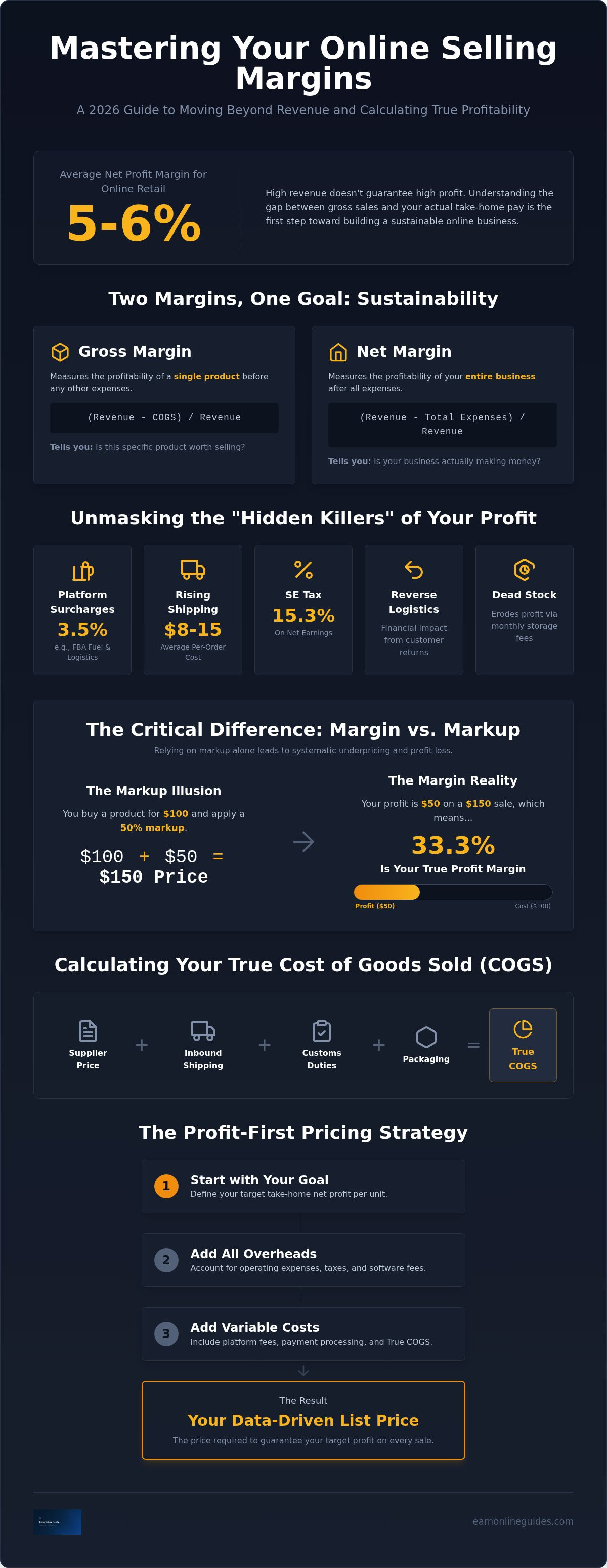
Traditional pricing strategies often fail in the 2026 e-commerce environment because they rely on a "cost-up" logic. This involves taking the product cost and adding a desired markup, a method that ignores the circular nature of platform fees. Since marketplaces like eBay and Etsy calculate their commissions based on the final transaction total, your fees actually increase as your price rises. To understand how to calculate online selling margins with professional accuracy, you must adopt a reverse margin methodology. This approach starts with your required net take-home pay and works backward to determine a market-viable list price.
This methodology also requires accounting for customer acquisition costs (CAC). In 2026, organic reach is increasingly limited, forcing many sellers to rely on internal advertising. For example, Etsy's Offsite Ads fee is mandatory at 12% for high-volume sellers, while Amazon's internal ad spend can significantly dilute your unit profit. If you don't build these marketing expenses into your initial price calculation, your "profit" will exist only on paper while your cash flow remains stagnant.
The transition to reverse pricing involves three distinct steps designed to protect your bottom line from unexpected deductions. This process ensures that every unit sold contributes a specific, pre-determined amount to your business sustainability.
Once you've calculated your MVSP, perform a competitor price audit. If your required price is significantly higher than the market average, you must either find a lower-cost supplier or pivot to a less saturated niche. You can simplify this complex math by using specialized selling fee calculators to run these reverse scenarios instantly.
Margin stability is not a "set and forget" metric. The 2026 logistics landscape is characterized by volatility, such as the 3.5% fuel and logistics surcharge that fluctuates based on carrier data. Successful sellers use dynamic pricing to adjust their list prices in real-time, ensuring that a sudden spike in shipping costs doesn't turn a profitable item into a liability. This data-driven approach prevents the "race to the bottom" often seen on major marketplaces. If the market price for an item drops below your MVSP, the correct move isn't to lower your price and lose money; it's to delist the product. Establishing a data-driven stop-loss is the only way to maintain a healthy net margin over the long term.
Scaling a remote business requires a shift from manual estimation to rigorous data integrity. While basic math formulas provide a foundation, they often fail to capture the nuances of 2026 marketplace dynamics. To truly understand how to calculate online selling margins at scale, you must implement a system of regular financial audits. These audits act as a protective filter, ensuring that your pricing remains viable even as platform policies and logistics surcharges fluctuate. Relying on outdated spreadsheets is a significant risk in an environment where a single fee update can erase a month of profit.
Generic margin calculators typically assume a linear relationship between cost and price. However, as analyzed in previous sections, e-commerce fees are often circular. Using specialized Selling Fee Calculators is superior because these tools are programmed with the specific logic of each platform. For example, an Etsy-specific tool accounts for the $0.20 listing fee and the 6.5% transaction fee, while an eBay tool factors in category-specific final value fees that include sales tax in the total calculation. This level of precision is essential for social commerce and handmade goods where margins are often tighter and more sensitive to volume changes.
Sustainability in 2026 is built on the discipline of monthly margin audits. If you don't verify your actual payouts against your projected margins every 30 days, you risk operating on outdated assumptions. These audits allow you to identify which products are suffering from margin compression and which are providing the surplus necessary for reinvestment. Maintaining healthy margins provides the capital to acquire new digital skills, which are the real engine of foundational growth in a remote career.
The most successful sellers in the current marketplace are researchers first and sellers second. They prioritize the verification of data over immediate sales volume, ensuring that every transaction contributes to long-term financial security rather than just temporary revenue. By treating your margin data as a roadmap rather than a byproduct, you transition from a reactive seller to a proactive business owner with a legitimate path to a sustainable remote career.
Mastering the math behind your business is the only way to ensure that your revenue translates into actual take-home pay. Success in the 2026 e-commerce landscape requires a shift from simple markup to a rigorous net-profit methodology. By accounting for "hidden killers" like the 3.5% logistics surcharge and the circular nature of marketplace commissions, you protect your business from the margin compression that stalls so many independent sellers. Understanding how to calculate online selling margins isn't just about subtraction; it's about building a data-driven foundation for a sustainable career.
Precision is your most effective tool for long-term growth. To simplify these complex calculations, you can protect your profit with our specialized Selling Fee Calculators. These tools are built with grounded 2026 e-commerce data and vetted by remote work experts to handle the specific fee structures of eBay, Etsy, and Mercari. Implementing these specialized audits monthly ensures your financial records remain accurate and your scaling strategy remains realistic. With the right data and a commitment to margin integrity, you can navigate the complexities of the current marketplace with confidence.
A healthy net profit margin for independent online sellers in 2026 typically ranges between 15% and 30%. While general e-commerce benchmarks often sit lower at 5% to 6%, those figures usually reflect high-volume corporations with massive overhead costs. For a sustainable remote business, you should aim for a margin that allows for reinvestment and covers the 15.3% self-employment tax. Higher margins provide a necessary safety net against unpredictable platform fee changes and rising logistics surcharges.
To calculate your margin accurately, you must treat the platform fee as a percentage of the total transaction amount rather than just the item price. If a marketplace charges a 13.5% final value fee on the total sale, that percentage applies to the shipping cost paid by the buyer as well. Subtract this total fee and your actual shipping label cost from the revenue to find your remaining profit. Using specialized calculators helps automate this specific deduction.
While traditional COGS focuses on material costs, independent sellers should track labor time as a separate operating expense to ensure business viability. If you spend three hours packing orders but don't account for that time, your net profit is artificially inflated. Assigning yourself a realistic hourly rate helps you determine if a product is truly profitable or if you are simply buying yourself a low-wage job. This data is essential for a long-term scaling strategy.
A profit margin is rarely too high from a financial health perspective, but extreme margins can signal a lack of market competitiveness or missed growth opportunities. If your margin is significantly above the 2026 industry benchmark of 30%, you might be overpricing your goods and losing volume to competitors. Alternatively, it could mean you aren't reinvesting enough into customer acquisition or digital skills. Balancing high margins with steady sales volume is the key to sustainable growth.
You should perform a comprehensive margin audit at least once per month to ensure your data integrity remains intact. Marketplace fees and shipping surcharges, such as the 3.5% FBA fuel increase, can change with little notice. Regular reviews allow you to catch these shifts before they erode your take-home pay. Consistent auditing is a core discipline for anyone learning how to calculate online selling margins to maintain a legitimate remote career.
Gross margin measures the efficiency of a specific product by subtracting the Cost of Goods Sold from the revenue. Net profit margin is a more comprehensive metric that accounts for all business expenses, including platform fees, marketing, and taxes. While gross margin shows if a product is worth stocking, net profit margin reveals the actual health of your business. Understanding this distinction is vital for determining your true take-home pay in the 2026 marketplace.
High return rates act as a direct drain on your net margin by introducing reverse logistics costs and restocking labor. In 2026, the average cost to ship an order is $8 to $15; a return doubling this expense can quickly turn a sale into a net loss. You must build a loss buffer into your pricing model based on your category's average return rate. This buffer ensures that shipping mishaps don't result in out-of-pocket expenses that threaten your sustainability.
For most independent sellers, a high-margin, low-volume model offers better long-term sustainability and lower operational risk. High-volume strategies require massive infrastructure and leave very little room for error if platform fees or shipping surcharges increase suddenly. A high-margin approach provides a protective filter for your time and capital. This allows you to focus on quality and foundational growth rather than managing the logistical complexities of thousands of low-profit transactions.

Article by
EarnOnlineGuides Editorial Team
The EarnOnlineGuides Editorial Team creates practical, research-driven educational content about making money online, remote work, freelancing, side hustles, digital skills, AI tools, online business, and self-employment. Our goal is to help readers understand their options, compare realistic opportunities, avoid misleading claims, and make better-informed decisions. We prioritize accuracy, transparency, practical guidance, and responsible reporting, and we regularly review our content to keep it useful and up to date.
The information provided in this article is for general educational and informational purposes only and should not be considered financial, investment, tax, legal, or professional advice. Earnings, income examples, costs, fees, and other figures may vary and are not guaranteed. Always conduct your own research and consult a qualified professional when appropriate.
Some articles on EarnOnlineGuides may contain affiliate links. If you click a link and make a purchase or sign up for a service, we may receive a commission at no additional cost to you. This does not influence our editorial standards or recommendations.
We strive to keep our information accurate and up to date, but products, services, fees, policies, laws, and market conditions can change. Please verify important information directly with the relevant provider before making financial or business decisions.
Educational information only. This article is not financial, tax, or legal advice. Platform fees and policies change; always confirm current rates in the marketplace's official fee documentation before making decisions.
Explore low cost digital side hustles you can test in 2026. Compare freelance work, digital goods, and reselling while managing hidden platform fees and time.

Learn how to open a freelance business bank account step by step. Explore document checklists, compare bank options, and keep business finances organized.

Learn how to write affiliate product reviews readers can trust. Discover a practical process for honest testing, balanced pros and cons, and clear disclosures.