
Low-Cost Digital Side Hustles: Practical Ways to Start in 2026
Explore low cost digital side hustles you can test in 2026. Compare freelance work, digital goods, and reselling while managing hidden platform fees and time.
October 13, 202618 min read

The median net profit margin for ecommerce businesses in 2026 sits at approximately 8 percent, a figure that highlights how easily hidden costs can erode a seller's bottom line. You likely find that your bank balance rarely reflects your total sales volume, often due to the complex layering of marketplace fees and rising shipping rates. It's frustrating to realize that a standard Etsy transaction can consume 11 percent of your sale, or that eBay's final value fees often reach 13.6 percent before you even consider packaging. Relying on a precise online seller profit calculator is the only way to move beyond guesswork and ensure your business remains sustainable.
We understand that the mathematical distinction between markup and margin is frequently a source of confusion, particularly when you are valuing older or bulk-purchased inventory. This article provides a methodical process for calculating selling prices that account for every variable and profit goal. You will learn a repeatable framework for pricing any item, giving you total clarity on your true margins. By the end of this guide, you will have the data-backed confidence needed to make informed inventory purchasing decisions and protect your long-term growth.
A selling price represents the final amount a customer pays for a product. While it appears simple on the surface, this figure must function as a comprehensive recovery mechanism for every expense incurred during the acquisition and sale process. If the price fails to cover these costs while returning a sustainable profit, the business model is inherently flawed. For many online entrepreneurs, the primary risk is a "race to the bottom," where sellers lower prices to match competitors without understanding their own financial requirements. This reactive strategy often leads to insolvency because it prioritizes volume over value.
Utilizing a dedicated online seller profit calculator provides a protective filter for your margins. It shifts the decision-making process from emotional guesswork to evidence-based analysis. Accurate pricing determines the long-term viability of your venture; it ensures that every sale contributes to foundational growth rather than merely circulating cash. Without a methodical approach, you aren't running a business; you're participating in a high-risk hobby.
Effective pricing requires balancing the "market ceiling" with your "profit floor." The market ceiling is the maximum price a consumer is willing to pay based on perceived value and available alternatives. Conversely, the profit floor is the absolute minimum you can accept to maintain operations. To find these numbers, you should prioritize historical sales data over current active listings. Active listings only show what sellers hope to receive, whereas "sold" data confirms what the market actually supports. You can use our Realistic Income Model to establish baseline expectations for your specific niche and avoid the trap of over-optimistic projections.
New sellers often struggle with invisible costs that erode net earnings. One of the most frequent errors is underestimating the impact of "free shipping" offers, which are never actually free for the merchant. You must also account for your Cost of Goods Sold (COGS), ensuring it includes inbound freight and packaging materials. Other pitfalls include:
An online seller profit calculator helps visualize these variables before you commit capital to new inventory. By identifying these costs early, you can avoid the trap of high-volume, low-profit cycles that lead to burnout. Success in 2026 requires a sober assessment of these granular details before the first listing goes live.
Cost of Goods Sold (COGS) represents the cumulative investment required to bring an item to a saleable state, encompassing both the direct purchase price and the indirect expenses associated with its acquisition and preparation. Most entry-level tools treat "item cost" as a static number from a receipt, but an accurate online seller profit calculator requires a more granular input to be effective. If you fail to account for the total capital deployed to secure an item, your net profit projections will remain consistently inflated.
Valuing inventory becomes more complex when dealing with bulk purchases or liquidation lots. In these scenarios, you shouldn't simply divide the total cost by the number of units. Instead, you must calculate the cost per saleable unit by excluding damaged or unsellable items from the denominator. This conservative approach ensures that the "good" inventory absorbs the loss of the "bad" inventory, protecting your overall business health. As you develop your export pricing strategy or local resale plan, remember that your initial valuation dictates every subsequent financial decision.
Acquisition costs extend far beyond the transaction at the register. You must factor in transportation expenses, including gas and vehicle wear, especially if you source from multiple physical locations. If you spend four hours sourcing a single high-value item, that time has a quantifiable cost that belongs in your COGS calculation. Additionally, any cleaning, repair, or refurbishment required to reach "listable" condition adds to the item's baseline value. Sellers who use specialized sourcing software should allocate a portion of those subscription "find fees" across their inventory to maintain a clear picture of their total investment.
Operational overhead consists of the recurring costs that keep your business running but aren't tied to a specific sale. High-volume sellers should calculate storage costs per unit to understand how long an item can sit before it becomes a net loss. Packaging materials, such as tape, boxes, bubble wrap, and branded inserts, often cost between $0.50 and $2.00 per shipment. By standardizing these costs into a per-item overhead buffer, you create a more resilient pricing model. Integrating these figures into an online seller profit calculator ensures that your pricing covers every operational reality. To see how these variables interact with platform-specific costs, you can explore our selling fee calculators to refine your final numbers.
Resellers often use "markup" and "margin" interchangeably, yet this linguistic error leads to significant financial miscalculations. While markup helps you decide what to add to your cost, margin tells you what you actually keep from the total sale. If you don't understand the difference, you might believe your business is performing better than it is. An online seller profit calculator helps bridge this gap by requiring precise inputs for both metrics to generate a realistic outlook.
A critical reality check for any seller is the realization that a 50 percent markup does not equal a 50 percent profit margin. If you purchase an item for $100 and sell it for $150, your markup is 50 percent. However, your profit margin is only 33.3 percent. Understanding the nuances of Margin vs. Markup is essential for setting prices that survive the complex marketplace fee structures of 2026.
Markup serves as a functional "rule of thumb" during the initial inventory valuation phase. It allows you to quickly determine if an item meets your sourcing criteria before you commit capital. The formula is straightforward: (Selling Price - Cost) / Cost. You should set target markups based on category-specific risks. For example, high-risk electronics might require a higher markup to account for potential returns compared to shelf-stable media. This metric is a useful starting point, but it shouldn't be the final word on your profitability.
Margin is the superior metric for assessing actual business health and cash flow. It represents the percentage of the selling price that remains after all costs are deducted. The formula is: (Selling Price - Cost) / Selling Price. This number is vital because all your business expenses, from taxes to shipping, are paid out of your total revenue, not your initial cost. If your margin is too thin, a single unexpected return can wipe out the profits from multiple successful sales.
In 2026, platform fees are more complex than ever. Our Online Selling Fee Index 2026 demonstrates how quickly these costs can erode a healthy-looking markup. For instance, Etsy's base transaction fee is 6.5 percent, but this can climb significantly if you're opted into Offsite Ads. Using an online seller profit calculator ensures you aren't fooled by high markups that mask thin net margins after these fees are applied. Focus on your net margin to ensure your business remains sustainable over the long term.
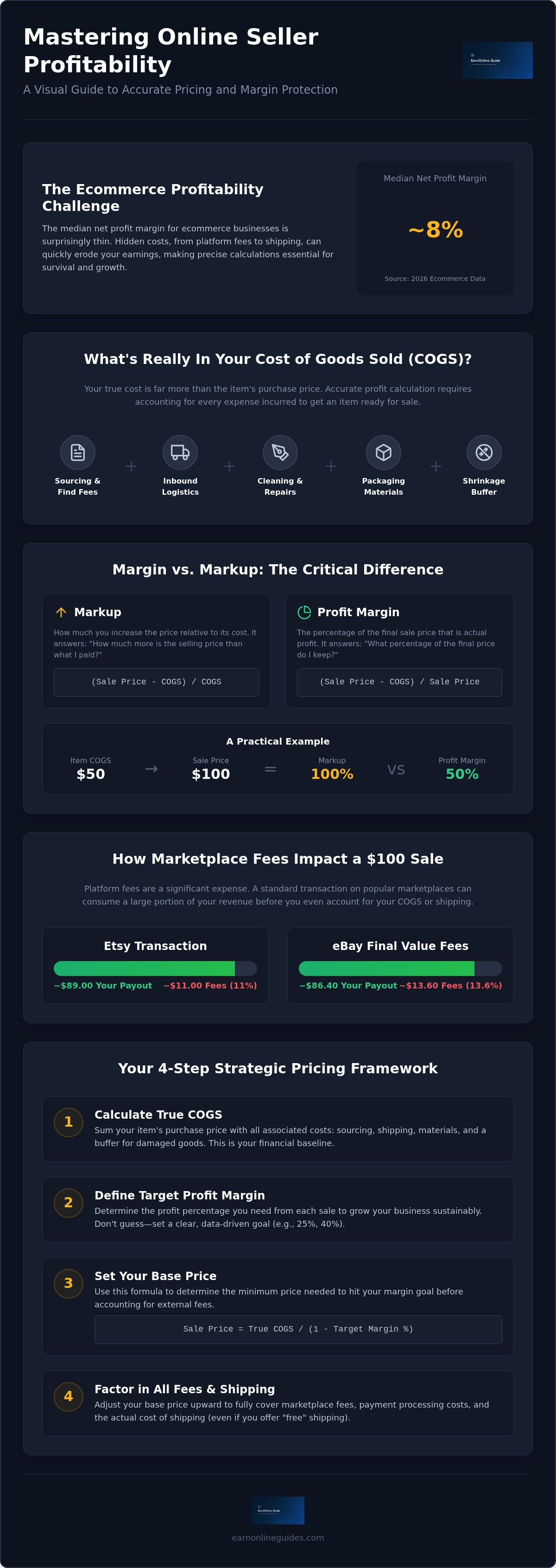
Setting a sustainable price requires moving through a sequential order of operations. A standard online seller profit calculator is most effective when it functions as the final verification step in a structured workflow. By following a methodical path, you ensure that your pricing is grounded in financial reality rather than optimistic projections.
Marketplace fees are rarely a single, flat percentage. You must distinguish between base transaction fees and conditional costs like percentage-based referral fees. In 2026, eBay sellers typically see a 13.6 percent final value fee in most categories, while Etsy maintains a 6.5 percent transaction fee. However, these figures don't include payment processing. For instance, PayPal Checkout fees for US sellers currently sit at 3.49 percent plus $0.49 per transaction. If you use "Promoted Listings" or Etsy Offsite Ads, these can consume an additional 2 to 26 percent of your gross revenue. An online seller profit calculator must incorporate these variables to prevent unexpected net losses.
Consumer behavior in 2026 continues to show a divide between value-based and premium rounding. Ending a price in .99 often triggers a "deal" response, while .00 endings are perceived as more professional or high-end. Your strategy should also reflect your inventory velocity goals. A "Quick Flip" approach might involve pricing 5 percent below the market ceiling to prioritize cash flow. If you offer "Free Shipping," your price must absorb the 2026 shipping rate hikes, such as the 6.6 percent average increase for USPS Priority Mail. Before you list your next item, use our selling fee calculators to ensure your psychological pricing doesn't accidentally erode your required profit floor.
Data generated by an online seller profit calculator serves as a critical feedback loop for your business strategy. It's a post-mortem analysis that dictates your future inventory purchases. If your results consistently show net profit margins below the 8 percent median, your sourcing criteria must become more stringent. High-volume sellers use this data to identify which categories yield the highest return on time invested, allowing them to pivot away from low-margin "busy work" that threatens long-term sustainability.
Price testing is the process of adjusting your listings based on real-time engagement data. If an item receives high traffic but fails to convert, the view-to-sale ratio indicates your price likely exceeds the current market ceiling. In 2026, consumer sensitivity to shipping costs is at an all-time high following the 7.8 percent average increase in USPS Ground Advantage rates. Small, incremental price adjustments can help you find the "sweet spot" where velocity and profitability intersect. This methodical optimization is essential if you intend to follow a realistic timeline to replace full-time income online.
Stagnant inventory represents trapped capital that could be deployed into faster-moving goods. You must perform a "breakeven point" analysis to determine the absolute lowest price you can accept without incurring a net loss. During seasonal slumps, such as the typical mid-summer slowdown, taking a lower margin to clear aging stock is often a superior strategy to holding out for a higher price. Conversely, holiday demand allows for margin expansion, but only if your online seller profit calculator has already accounted for the increased logistics and advertising costs associated with peak periods.
Automation has become a standard requirement for managing high-volume commodity items. Re-pricing software can monitor competitors and adjust your listings 24/7 to ensure you remain within the buy-box range. You can leverage the best free AI tools for beginners 2026 to conduct deep competitive analysis and identify emerging market trends before they become obvious. However, automation has limits. Unique, vintage, or rare items still require a human "gut feeling" and qualitative assessment. For these goods, use data to ground your expectations, but rely on your expertise to value the specific nuances that software might overlook.
Success in the 2026 marketplace requires a transition from speculative pricing to a data-driven methodology. You've learned that a sustainable selling price is the result of a comprehensive cost audit, not a reaction to competitor behavior. By accurately calculating your Cost of Goods Sold and maintaining a clear distinction between markup and net margin, you protect your business from the "race to the bottom" that exhausts so many independent sellers. Implementing a structured pricing workflow ensures that every item in your inventory serves your long-term profit goals rather than merely circulating cash.
Relying on a precise online seller profit calculator is the final step in verifying the viability of your inventory decisions. Our tools are vetted for 2026 platform fee changes and are currently used by thousands of independent resellers to maintain financial clarity. Ready to protect your margins? Access our suite of Selling Fee Calculators to apply this methodical approach to your own inventory. With the right data and a disciplined strategy, you can build a resilient online business that thrives in any market environment.
The list price is the initial advertised amount you set for an item, while the selling price is the final amount a customer pays after discounts or negotiations. In a competitive 2026 marketplace, these figures often differ. Your financial planning should always rely on the expected selling price rather than the list price. This ensures your net profit calculations remain grounded in realized revenue rather than optimistic marketing goals.
To calculate a 20 percent profit margin, you must divide your total costs by 0.8 rather than simply adding 20 percent to your cost. For example, if your total expenses are $80, a 20 percent margin requires a $100 selling price. Using an online seller profit calculator helps automate this math, ensuring you don't confuse margin with markup. This distinction is vital for maintaining the cash flow necessary for long-term business sustainability.
You should include a standardized labor rate for sourcing, cleaning, and listing time to understand your true return on investment. While many resellers treat their time as free, this obscures the actual efficiency of your business model. If an item takes three hours to prepare but only returns a $10 profit, your hourly rate is unsustainable. Accounting for labor allows you to compare reselling against other remote work opportunities or digital skill learning paths.
If the current market ceiling is lower than your required profit floor, you should generally avoid purchasing that inventory. For existing stock, you must decide between holding for a market recovery or selling at a breakeven point to recoup capital. Recouping your initial investment allows you to pivot into higher-margin categories. Consistently encountering this scenario indicates a need to refine your sourcing criteria or find lower-cost acquisition channels.
You should review your pricing at least once per quarter or whenever major logistics providers announce rate increases. In 2026, shipping costs and marketplace fee structures change frequently, which can quickly turn a profitable item into a net loss. Regular audits of your active inventory help you stay aligned with the current market ceiling. Dynamic pricing is especially critical for commodity items where competition is high and margins are naturally thinner.
The choice between high markup and high volume depends on your storage capacity and available labor hours. High-volume models require significant automation and efficient shipping systems to remain profitable at thin margins. High-markup models often involve unique or vintage items that require more expertise but less physical processing. Most sustainable businesses find a balance, using high-volume goods for consistent cash flow and high-markup items for foundational growth while maintaining a sober outlook on returns.
Platform fees directly reduce your gross revenue, meaning your selling price must be high enough to absorb these costs while still meeting your profit goal. For example, eBay's 13.6 percent final value fee and Etsy's 6.5 percent transaction fee are applied to the total amount the buyer pays, including shipping. An online seller profit calculator accounts for these deductions automatically. Failing to factor in these percentages leads to phantom profits that disappear once the marketplace takes its cut.
You can use a selling price calculator for digital products, although the cost structure differs from physical inventory. While you don't have traditional shipping or storage costs, you must account for hosting fees, software subscriptions, and advertising spend. Digital goods often allow for much higher margins, but the market ceiling is frequently dictated by intense competition. Accurate pricing ensures your digital offerings cover these operational overheads while rewarding the time spent on product development and creation.

Article by
EarnOnlineGuides Editorial Team
The EarnOnlineGuides Editorial Team creates practical, research-driven educational content about making money online, remote work, freelancing, side hustles, digital skills, AI tools, online business, and self-employment. Our goal is to help readers understand their options, compare realistic opportunities, avoid misleading claims, and make better-informed decisions. We prioritize accuracy, transparency, practical guidance, and responsible reporting, and we regularly review our content to keep it useful and up to date.
The information provided in this article is for general educational and informational purposes only and should not be considered financial, investment, tax, legal, or professional advice. Earnings, income examples, costs, fees, and other figures may vary and are not guaranteed. Always conduct your own research and consult a qualified professional when appropriate.
Some articles on EarnOnlineGuides may contain affiliate links. If you click a link and make a purchase or sign up for a service, we may receive a commission at no additional cost to you. This does not influence our editorial standards or recommendations.
We strive to keep our information accurate and up to date, but products, services, fees, policies, laws, and market conditions can change. Please verify important information directly with the relevant provider before making financial or business decisions.
Educational information only. This article is not financial, tax, or legal advice. Platform fees and policies change; always confirm current rates in the marketplace's official fee documentation before making decisions.
Explore low cost digital side hustles you can test in 2026. Compare freelance work, digital goods, and reselling while managing hidden platform fees and time.

Learn how to open a freelance business bank account step by step. Explore document checklists, compare bank options, and keep business finances organized.

Learn how to write affiliate product reviews readers can trust. Discover a practical process for honest testing, balanced pros and cons, and clear disclosures.