
Low-Cost Digital Side Hustles: Practical Ways to Start in 2026
Explore low cost digital side hustles you can test in 2026. Compare freelance work, digital goods, and reselling while managing hidden platform fees and time.
October 13, 202618 min read

Earning an identical gross income as a freelancer compared to your previous salary is effectively a thirty to forty percent pay cut. While the freedom of contracting is appealing, many digital professionals fail to account for the total cost of replacing a standard benefits package. If you transition without a precise financial framework, you risk professional burnout by working more hours for less net profit. Using a dedicated 1099 vs w2 calculator is the only way to move beyond guesswork and identify the specific rate required to maintain your current lifestyle.
It's natural to feel uncertain when you're trying to value intangible perks like 401k matches or group health insurance premiums. You aren't just looking for a higher hourly rate; you're seeking a sustainable business model that covers your overhead and tax obligations. This article provides a clear methodology for calculating the income gap between employment and independent contracting. We'll examine the 2026 self-employment tax rates, quantify the "benefit replacement cost," and establish a data-backed breakeven number that gives you the confidence to sign your next contract or leave your traditional job with security.
The transition from a W-2 employee to a 1099 contractor represents more than a change in tax forms. It is a fundamental shift from being a protected worker to becoming a business entity. While an employee operates within a pre-built infrastructure, a contractor is the infrastructure. This means you are responsible for your own hardware, software, office space, and insurance. The most common mistake career changers make is performing a direct gross salary comparison. If you earn $90,000 as an employee, accepting a contract for $90,000 results in a significant drop in actual purchasing power. This discrepancy is known as the "Tax and Benefit Gap." In most cases, a contractor must earn 25% to 40% more than their previous salary just to maintain the same net lifestyle. Integrating a 1099 vs w2 calculator into your planning process allows you to visualize these trade-offs before you commit to a new contract.
Employers pay substantial costs that never appear on a standard paystub. These include the employer portion of Social Security and Medicare, unemployment insurance, and workers' compensation. When you use a 1099 vs w2 calculator, you can account for these hidden figures. A high hourly rate often acts as a psychological trap, leading you to ignore the overhead required to generate that income. To find your true baseline, locate your "Total Compensation" statement in your current employer's HR portal. This document reveals the full dollar value of your benefits package, providing a realistic target for your freelance transition.
By 2026, the professional market has adapted to a "Hybrid Contractor" model where individuals manage multiple specialized income streams. Current Remote Work Statistics indicate that while flexibility is a primary driver for this shift, salary expectations have become more volatile. Companies often pay a premium for specialized digital skills but offer zero long-term security. This landscape requires a methodical approach to financial planning. If you understand the underlying data of your specific niche, you can set rates that account for both market demand and your personal breakeven requirements.
The most immediate financial shock for new contractors is the realization that they are now both the employer and the employee. In a traditional W-2 role, your tax obligations are partially obscured. You see a deduction for Social Security and Medicare on your paystub, but you never see the matching amount your employer pays on your behalf. This "employer half" is a significant part of your total compensation that vanishes the moment you switch to a 1099 arrangement. Failing to account for this 7.65% hidden cost is why many freelancers feel they are earning less despite a higher hourly rate.
The self-employment tax rate is currently 15.3% of your net earnings. This figure covers the 12.4% for Social Security and the 2.9% for Medicare. Using a 1099 vs w2 calculator is essential for understanding how these percentages impact your take-home pay. For 2026, the Social Security portion only applies to earnings up to a specific annual threshold. Once your income exceeds this cap, you only pay the 2.9% Medicare portion on the remaining balance. This cap is adjusted annually for inflation, so high-earners should monitor official IRS announcements to refine their projections.
In a standard employment setting, FICA taxes are split equally. You pay 7.65%, and the company pays 7.65%. As a business owner, you assume the full 15.3% responsibility. It's a heavy lift for cash flow, but there is a small reprieve in the tax code. You can deduct the employer-equivalent portion of your self-employment tax when calculating your adjusted gross income. This doesn't change the amount you pay into the Social Security system, but it does reduce the amount of income subject to federal income tax.
Transitioning to 1099 work means you no longer have a payroll department to manage your withholdings. You must take an active role in tax compliance by making manual quarterly payments to the IRS. To avoid expensive underpayment penalties, you should follow the "Safe Harbor" guidelines. These rules generally require you to pay either 90% of your current year's estimated tax or 100% of the tax shown on your prior year's return. If your income fluctuates, using a 1099 Tax Calculator helps you set aside the correct amount each month so you aren't blindsided by a large bill in April.
Beyond the immediate tax implications, the largest financial discrepancy in the 1099 vs. W-2 debate is the "Benefit Replacement Cost." Traditional employers leverage group buying power to provide insurance, retirement perks, and legal protections at a fraction of the price an individual pays on the open market. When you transition to contracting, you lose this economy of scale. You aren't just replacing your salary; you are replacing a suite of risk-mitigation tools that have been managed for you. A comprehensive 1099 vs w2 calculator must account for these invisible line items to provide an accurate reflection of your purchasing power.
Federal and state protections also carry a tangible dollar value. W-2 employees are covered by unemployment insurance and workers' compensation, which are funded by employer premiums. As a 1099 worker, you have no such safety net. If a client terminates your contract or you suffer a work-related injury, you are financially responsible for the gap. This necessitates building a larger cash reserve than a standard employee might require, effectively "self-insuring" against the lack of institutional support.
To value your current health plan, examine the total annual premium paid by your employer, not just your personal contribution. Replacing a high-quality corporate PPO on the individual market often costs 20% to 50% more due to the lack of group negotiation power. Additionally, consider the 401(k) match. If an employer matches 4% of your $100,000 salary, that is $4,000 in immediate, tax-advantaged capital you lose as a contractor. You should also factor in Health Savings Account (HSA) contributions, which many employers use as a hidden incentive to lower their overall insurance overhead.
A W-2 salary is typically based on a 2,080-hour work year, which includes paid holidays, sick leave, and vacation time. In contrast, a 1099 contractor only earns income when they are billable. If you take three weeks of vacation and ten federal holidays, your billable year shrinks to approximately 1,880 hours. You can use this simple formula to find your baseline:
The reduction to 1,800 hours accounts for "unpaid" administrative time. Freelancers spend significant hours on invoicing, lead generation, and professional development. If you don't bake these non-billable hours into your rate, you will find yourself working more than 40 hours a week just to match your old salary. Using a 1099 vs w2 calculator to model these different hour scenarios is the most effective way to ensure your freelance rate remains sustainable over the long term.
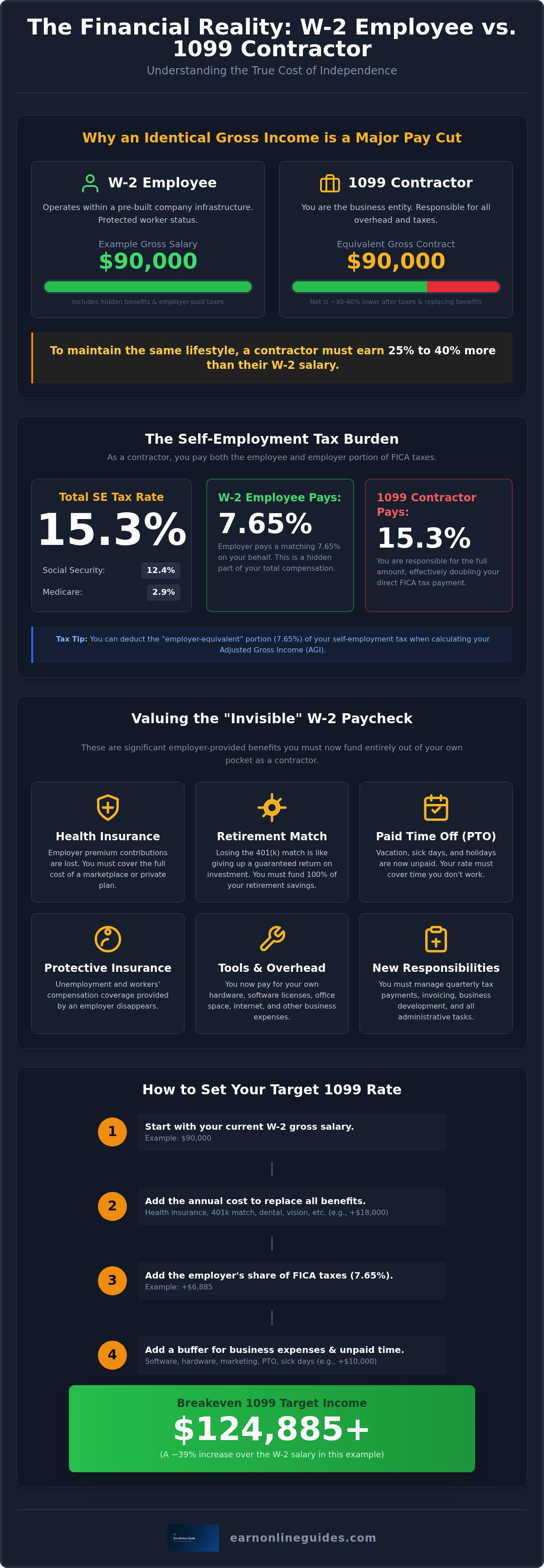
Establishing a sustainable freelance rate requires a methodical workflow. It's a calculation that moves from your baseline financial needs toward a gross revenue target that accounts for the inherent risks of self-employment. Using a 1099 vs w2 calculator allows you to perform this "reverse math" with precision. The process begins with your desired W-2 equivalent take-home pay. From there, you must layer on the costs your employer previously absorbed. This includes the 15.3% self-employment tax and local tax estimates, followed by the "Benefit Replacement Cost" detailed in previous sections. Finally, you add your business overhead and divide the total by your realistic billable hours to find your minimum hourly rate.
In 2026, remote work overhead has evolved beyond a simple laptop and desk. You must account for recurring costs such as professional-grade AI tool subscriptions, high-speed fiber internet, and specialized software licenses. These are no longer optional extras; they're the tools required to maintain competitiveness in the digital market. You should also factor in a hardware replacement fund, as you're now responsible for your own technical support and upgrades. It's vital to distinguish between "working hours" and "billable hours." If you spend ten hours a week on administrative tasks, those hours must be subsidized by your billable rate. You can refine these specific overhead numbers using the Freelance Rate Calculator to ensure your margins remain protected.
A true breakeven rate should include a "Risk Premium." This is a buffer, typically 10% to 20%, that accounts for the lack of job security and potential gaps between contracts. Unlike a W-2 role, your income stops the moment a project ends. If you don't build this premium into your rate, a single month of "bench time" can erase your entire year's profit. You can benchmark your proposed rate against the latest Remote Work Statistics to see how your skills align with current market trends. Undercharging during your first year is a common path to burnout. It forces you to work excessive hours just to meet basic obligations, leaving no room for business growth or personal recovery. Before you finalize your next contract, use our 1099 vs w2 calculator to verify that your rate covers both your lifestyle and your business risks.
The transition from a traditional employment structure to independent contracting is a strategic maneuver rather than a leap of faith. Once you have used the 1099 vs w2 calculator to establish your financial floor, you can use the resulting data as a comprehensive roadmap for your career pivot. This transition requires a methodical approach that prioritizes long-term sustainability over an immediate, uncalculated exit. If you understand your precise breakeven number, you can evaluate legitimate remote jobs with a level of objectivity that prevents you from accepting low-margin contracts. The data provides a protective filter, ensuring you only pursue roles that actually improve your net financial position.
Transitioning directly from a stable W-2 role into full-time 1099 work carries significant risk if your cash flow isn't yet proven. Many successful professionals utilize what we call a "Side Hustle Bridge" to validate their market value while maintaining their primary income. Exploring vetted online side hustles allows you to test your pricing assumptions and build a small client base in a low-risk environment. During this validation phase, your primary objective should be the accumulation of a three to six-month "Tax and Emergency Buffer." This cash reserve isn't just for personal emergencies; it serves as the working capital necessary to handle the irregular payment cycles and project gaps that are standard in the contracting world. Without this buffer, you may find yourself forced to accept unfavorable contract terms just to cover immediate overhead.
The mathematical foundation provided by a 1099 vs w2 calculator represents the floor of your business, not the ceiling. To move beyond a simple replacement of your old salary, you must transition from a generalist service provider to a high-value consultant. This shift is driven entirely by the depth of your specialized knowledge. Following structured Digital Skill Learning Paths enables you to increase your market rate by solving more complex, high-impact problems for your clients. In the 2026 economy, your ability to leverage emerging technical methodologies directly correlates with your profit margins. While the math ensures your safety, your commitment to upskilling creates the leverage required for true financial independence. The goal of this process is to move past the "breakeven" point and into a phase of foundational growth where your income is no longer limited by a corporate salary cap.
Transitioning to independent contracting is a significant professional milestone, but its success depends on your ability to manage the underlying financial data. You've learned that matching your W-2 salary isn't enough. You must account for the 15.3% self-employment tax and the substantial cost of replacing employer-paid benefits. By quantifying these invisible perks and factoring in business overhead, you create a sustainable floor for your freelance business. This methodical approach ensures you don't fall into the trap of accepting a gross rate that actually lowers your net purchasing power.
Using a 1099 vs w2 calculator provides the evidence-based clarity needed to negotiate with confidence and avoid the burnout associated with underpricing. If you have the right data, you can transition safely without compromising your financial stability. Relying on verified numbers allows you to focus on growth rather than survival.
Ready to see your real numbers? Use the 1099 vs W-2 Breakeven Tool.
Our platform provides data-driven guidance that's updated for 2026 tax thresholds and vetted by financial experts. Taking control of your income model is the first step toward a career that offers both flexibility and long-term security.
The answer depends entirely on your business expenses and income level. A W-2 status is generally more tax-efficient for lower earners because the employer pays half of the FICA taxes. However, high-earning 1099 contractors can often lower their taxable income significantly through business deductions that aren't available to employees. You should evaluate your specific situation using a 1099 vs w2 calculator to see how your net take-home pay changes after accounting for the self-employment tax burden.
You should aim for a gross rate that is at least 30% to 40% higher than your equivalent W-2 salary. This premium covers the 15.3% self-employment tax, the cost of private health insurance, and the lack of paid time off. If you don't build this buffer into your contract, you'll effectively take a pay cut. Specialized digital skills may command an even higher premium to account for the increased risk of short-term contract work.
A comprehensive 1099 vs w2 calculator allows you to input custom benefit values, including health insurance premiums and deductible differences. Since individual plans are often more expensive than group employer plans, it's vital to use the "replacement cost" rather than the "employer cost" in your math. Accurate calculators should also factor in the loss of employer-sponsored Health Savings Account (HSA) contributions and dental or vision coverage to provide a true financial comparison.
Yes, you can deduct a portion of your home expenses if you use a specific area of your residence exclusively for business. This deduction can include a percentage of your rent or mortgage interest, utilities, and internet costs. While these write-offs help reduce your taxable income, they rarely bridge the entire 15.3% self-employment tax gap. You must still set a higher gross rate to account for the lack of employer-paid social security and medicare contributions.
The 1099 breakeven multiplier is a rule of thumb used to estimate a contractor's required rate. A common multiplier is 1.3x to 1.5x your W-2 hourly rate. For example, if you earn $50 per hour as an employee, you would need to charge $65 to $75 per hour as a contractor to maintain the same net lifestyle. This multiplier accounts for the "Benefit Replacement Cost" and the administrative time spent on non-billable tasks like invoicing and lead generation.
Standard 1099 contractors are generally not eligible for state unemployment benefits because they don't pay into the unemployment insurance system. Employers pay these premiums for W-2 workers, which provides a safety net if a role is eliminated. As a contractor, you must "self-insure" by maintaining a larger emergency fund. This lack of a safety net is a primary reason why your 1099 rate must include a risk premium to cover potential gaps between projects.
Start by dividing your annual W-2 salary by 2,080 hours to find your base hourly rate. Next, add the annual value of your current benefits, such as 401(k) matches and insurance premiums, and increase that total by 15.3% for taxes. Finally, divide this new total by a realistic number of billable hours, typically 1,800 per year. This adjustment accounts for unpaid holidays and administrative time, ensuring your 1099 offer provides the same financial security as your salary.

Article by
EarnOnlineGuides Editorial Team
The EarnOnlineGuides Editorial Team creates practical, research-driven educational content about making money online, remote work, freelancing, side hustles, digital skills, AI tools, online business, and self-employment. Our goal is to help readers understand their options, compare realistic opportunities, avoid misleading claims, and make better-informed decisions. We prioritize accuracy, transparency, practical guidance, and responsible reporting, and we regularly review our content to keep it useful and up to date.
The information provided in this article is for general educational and informational purposes only and should not be considered financial, investment, tax, legal, or professional advice. Earnings, income examples, costs, fees, and other figures may vary and are not guaranteed. Always conduct your own research and consult a qualified professional when appropriate.
Some articles on EarnOnlineGuides may contain affiliate links. If you click a link and make a purchase or sign up for a service, we may receive a commission at no additional cost to you. This does not influence our editorial standards or recommendations.
We strive to keep our information accurate and up to date, but products, services, fees, policies, laws, and market conditions can change. Please verify important information directly with the relevant provider before making financial or business decisions.
Educational information only. This article is not financial, tax, or legal advice. Platform fees and policies change; always confirm current rates in the marketplace's official fee documentation before making decisions.
Explore low cost digital side hustles you can test in 2026. Compare freelance work, digital goods, and reselling while managing hidden platform fees and time.

Learn how to open a freelance business bank account step by step. Explore document checklists, compare bank options, and keep business finances organized.

Learn how to write affiliate product reviews readers can trust. Discover a practical process for honest testing, balanced pros and cons, and clear disclosures.