A low-cost digital side hustle can still demand substantial time, practice, and persistence. The appeal of low cost digital side hustles is understandable when paid tools, inventory, or a slow start feel like risks you can’t afford. But a small cash outlay doesn’t automatically make an idea easy or a good fit.
The practical question isn’t just what you can start cheaply. It’s what you can deliver with the skills, time, and resources you already have, and what you may need to spend as you test the idea. This guide compares freelance services, digital products, affiliate content, and online reselling without promising a particular income.
You’ll also learn to account for less obvious costs, including platform fees, learning time, and the work involved in finding customers. Use those factors to narrow your options, then choose one small, testable first step before committing more money or time.
Key Takeaways
Compare service work, digital products, affiliate content, and online reselling by the skills and work patterns each requires.
Use your available time, existing abilities, and comfort with uncertainty to narrow down low cost digital side hustles that may suit you.
Separate setup expenses from recurring subscriptions, transaction fees, and optional upgrades before choosing a model.
Test customer interest with a simple offer before committing to inventory, paid tools, or advertising.
Track time, expenses, inquiries, and completed work to decide whether your plan remains practical.
What Makes a Digital Side Hustle Low-Cost, and What Still Takes Investment?
A low-cost digital side hustle limits the cash you need to begin; it doesn’t remove the work, learning, or uncertainty involved. You may be able to start with a device and internet connection you already have, but building a portfolio, finding customers, or learning a new skill still takes resources. The digital economy provides the broader setting for these activities, but an online business still needs a useful offer and a way to reach people who may want it.
Low-cost means limited upfront cash investment, not low total effort. That distinction matters when you compare low cost digital side hustles. An idea that avoids inventory may still require substantial practice or outreach. A model with low initial spending can also carry risk: you might invest time or money without confirming that customers are interested.
Which costs matter before choosing an online side hustle?
Separate expenses by timing and necessity. A device or reliable internet connection may already be part of your household budget, while specific software or a seller-platform fee may be a new expense. List what you need to start, what you’ll pay as you operate, and what can wait. This makes it easier to judge whether an idea is affordable for you, rather than simply advertised as free to start.
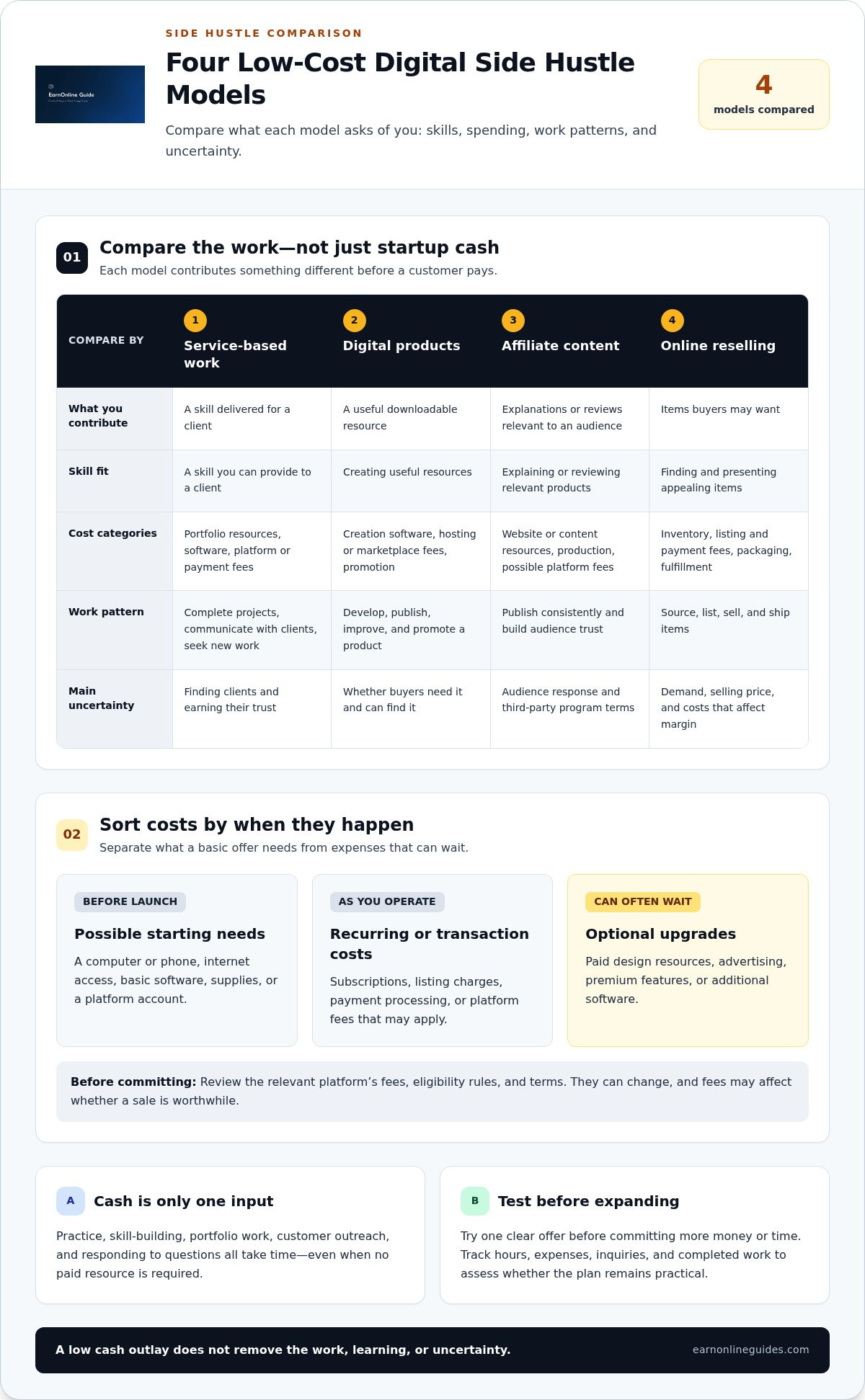
Possible launch needs: a computer or phone, internet access, basic software, supplies, or a platform account.
Recurring or transaction costs: subscriptions, listing charges, payment processing, or platform fees that may apply as you operate or make sales.
Optional upgrades: paid design tools, advertising, premium features, or additional software that can often wait until you have evidence of demand.
Separate what you need to deliver a basic version of your offer from what would only make it more polished or convenient. A freelance service, for example, might be testable with existing equipment and a simple portfolio. A digital product may require time to create and a platform to distribute it. Before committing, review the relevant platform’s fees, eligibility rules, and terms. These can change, and a fee that seems small may affect whether a sale is worthwhile.
Compare the options in this online side-hustle guide while noting which costs apply to your specific idea. Treat any estimates as assumptions to review, not promises about what you’ll spend or earn.
Why low startup cost does not mean easy or fast income
Cash is only one input. You may need to develop a skill, practice until your work meets a customer’s needs, and build a portfolio or other proof of reliability. You’ll also need to explain your offer, reach potential buyers, respond to questions, and improve based on feedback. These activities take time even when no paid tool is required.
There’s also an opportunity cost: hours spent practicing, creating samples, or doing outreach could have gone to other work or responsibilities. Revenue may be delayed or uncertain while you test whether the offer connects with an audience. Results depend on the offer, its execution, the audience, and market demand. Low startup spending alone can’t predict them.
Be cautious of claims that promise guaranteed income, effortless results, or risk-free returns. A more grounded approach is to set a spending limit, test one clear offer, and track both cash expenses and hours worked. That gives you better evidence for deciding whether to continue, adjust, or stop before making a larger commitment.
How Low-Cost Digital Side Hustles Work: Four Models to Compare
Digital side hustles differ in what you contribute before a customer pays: a service, a product, useful content, or items for resale. Don’t compare them on startup cash alone. Consider the skills each model uses, the work involved in finding buyers, and what needs to go right for the idea to become viable. The at-home side hustle ideas overview offers additional examples to help you identify a model that matches your interests.
Model
Skill fit
Typical cost categories
Work pattern
Main uncertainty
Service-based work
A skill you can deliver for a client
Portfolio tools, software, platform or payment fees
Complete projects, communicate with clients, seek new work
Finding clients and earning their trust
Digital products
Creating useful downloadable resources
Creation software, hosting or marketplace fees, promotion
Develop, publish, improve, and promote a product
Whether buyers need it and can find it
Affiliate content
Explaining or reviewing relevant products for an audience
Website or content tools, production, possible platform fees
Publish consistently and build audience trust
Audience response and third-party program terms
Online reselling
Identifying and presenting items buyers want
Inventory, listing and payment fees, packaging, fulfillment
Source, list, sell, and ship items
Demand, selling price, and costs that affect margin
In short, services trade skills for client work, digital products trade problem-solving for buyer demand, affiliate content trades trusted attention for referrals, and reselling trades sourcing and inventory for sales potential. None guarantees a particular result. Demand and individual outcomes vary.
Service-based work: sell a skill before building an audience
Writing, design, editing, or administrative support can be offered directly to clients, so you don’t necessarily need a large audience first. You do need examples that show what you can deliver and time to contact prospective clients. If you’re considering this route, beginner freelancing guidance can help you understand the basic steps.
Products, affiliate content, and reselling: compare dependencies
A digital product needs to solve a specific problem, and you still have to reach likely buyers. Affiliate content depends on audience trust and the terms of third-party programs, which can change. Reselling adds operational work: sourcing items, planning fulfillment, and accounting for fees and other expenses to see whether a sale leaves a workable margin. For related business models like network marketing, modern tools can also play a role in scaling outreach; resources such as aipowerednetworkmarketing.com explore how artificial intelligence strategies can be integrated into direct marketing and prospect communication.
Use the comparison to identify which dependency you can manage best: delivering a defined service, reaching buyers for a product, earning an audience’s trust, or sourcing items carefully. The online side-hustle guide can help you explore specific directions within those models before choosing one to investigate further.
Which Low-Cost Digital Side Hustle Fits Your Skills, Time, and Risk Tolerance?
The best fit depends on your starting point, not on a universal ranking. Compare each option against four constraints: what you can already do, how much time you can set aside consistently, how much cash you’re prepared to risk, and how comfortable you are with delayed or uncertain feedback. These factors can help you distinguish an idea you can test now from one that needs more preparation.
Existing skills: Can you already deliver a service or create a useful resource, or would you need to learn first?
Available time: Can you make room for scheduled client work, or do shorter, flexible work sessions fit better?
Startup cash: Can you begin with what you own, or does the idea depend on inventory, paid software, or other spending?
Risk tolerance: Would uncertain audience growth feel manageable, or would you prefer to test an offer through direct conversations with potential clients?
Service work and audience-based models have different timelines and feedback loops. A service provider can present a focused offer to prospective clients and learn from their responses, though client acquisition still takes effort. Affiliate content and digital products usually depend on attracting an audience or reaching buyers over time. Reselling adds inventory and fulfillment decisions, so it may involve more cash exposure than a service you can demonstrate with samples.
If you already have a marketable skill
Start with a narrow service you can demonstrate, such as editing a short document or designing a simple graphic. Prepare relevant sample work, a clear description of what the client receives, and a straightforward process for completing the task. These details give prospective clients something concrete to assess. Begin with tools you already know, and add advanced software only when a real workflow requirement justifies it.
If client work seems like a practical way to apply an existing skill, this guide to beginner freelancing outlines how to approach the first steps. Make the offer specific enough that you can explain who it helps and what problem it addresses. A broad claim such as “I can help with anything” gives a potential client little basis for deciding whether you’re a fit.
If you need to build skills or an audience first
Skill-building can delay outreach, but it may help you produce work you can stand behind. Choose one skill and one use case, then practice on a small sample related to that task. For example, if you want to offer basic email editing, practice improving a sample message for clarity rather than studying a wide range of unrelated writing topics. Beginner digital skills guidance can help you identify a focused learning direction. Similarly, for those exploring financial ventures such as digital asset trading, educational communities like Moonstream Finance provide structured guidance on learning cryptocurrency markets before putting capital at risk.
Audience-based work may suit you if you’re willing to publish consistently without immediate confirmation that people will buy. If you need quicker feedback on whether a specific service is useful, direct conversations may be more informative. Use online side-hustle ideas to compare possible directions, then filter them through your skills, schedule, cash limit, and comfort with uncertainty.
How to Test a Low-Cost Digital Side Hustle Before Spending More
A small test can help you find out whether a real customer problem exists before you commit more money. For low cost digital side hustles, the goal isn’t to prove future income. It’s to gather enough relevant evidence to decide whether to refine the offer, keep testing, or stop.
Set a personal spending limit before you begin. Decide in advance how much you’re willing to put toward subscriptions, inventory, or advertising. Don’t treat that limit as an amount you need to spend. A useful test can often start with tools you already have and direct conversations with potential customers. A guide to validating an online business idea can help you structure the process.
Define a specific customer problem. Identify one type of person and one task or frustration they want to address. “Small business owners need help” is too broad to test. “Independent consultants need a clearer way to organize client onboarding” points toward a more specific question: Do those consultants recognize the problem, and are they looking for a solution?
Shape a narrow offer. Describe one deliverable, product, or outcome in plain language. Use skills and accessible tools you already have where practical. Before you build more, identify the assumption that would most change your decision. That might be whether the intended audience has the problem, whether it will pay for a solution, or whether you can deliver the work within the time available.
Test interest with a relevant audience. Put the offer in front of people who plausibly fit the audience. Explain what it includes and invite a clear response, such as a conversation, request for details, or purchase. Avoid spending on ads or elaborate branding before you know what you’re testing. Record who responds and what they ask, rather than treating general encouragement as proof of demand.
Review the evidence before expanding. Track inquiries, completed sales, repeat interest, delivery time, and expenses. Expressions of interest can show that a problem resonates, but payment is stronger evidence that someone will act on the offer. Repeat demand may offer another useful signal, though a small test still can’t predict future results.
Define a narrow offer and the person it serves
A focused offer makes feedback easier to interpret. If you change the audience, problem, and deliverable at once, you won’t know which part influenced the response. Keep the first version simple enough to deliver, then ask focused questions about what the person needs, what feels unclear, and what would prevent them from proceeding. Avoid building features around guesses.
Review evidence and choose a measured next step
If people understand the offer but don’t act, clarify the value or test a different audience before raising your spending limit. If requests are specific but delivery takes too long, refine the workflow. If responses remain weak after a fair test, pause spending and reconsider the problem or idea. Treat findings as directional evidence, not a forecast or income guarantee.
For planning beyond the test, use the realistic income model to organize assumptions and assess whether the idea remains workable under different scenarios.
Build a Sustainable Low-Cost Digital Side Hustle With a Simple Plan
A side hustle needs a workable place in your week, not just a promising idea. Choose work blocks that fit around your existing responsibilities and give each one a clear purpose, such as learning a tool, preparing a sample, or handling a client task. Leave room for interruptions. If the plan only works during an unusually quiet week, it may be difficult to maintain.
Review your routine regularly. Ask whether the work is manageable alongside your other commitments, whether tasks routinely take longer than expected, and whether you still have time for rest and essential responsibilities. If the schedule feels strained, reduce the scope or frequency before adding new commitments. A sustainable pace is one you can repeat without relying on constant extra hours.
Set a realistic first milestone without assuming earnings
Choose a milestone you control, such as publishing a sample, completing a learning project, or setting up a simple process for handling client requests. These goals help you establish a routine without making progress depend on customer decisions or market conditions. For planning that separates assumptions from outcomes, use the realistic income planning model.
Use learning resources to choose what to improve next
Once the routine is in place, focus your learning on the step that currently slows you down. If preparing a sample takes too long, practice the relevant skill. If explaining your offer feels difficult, work on making its scope clearer. Beginner digital skills guidance can help you select a focused learning direction. If your activity becomes self-employment, tax responsibilities may apply depending on your circumstances. Consult current IRS guidance for information relevant to your situation. This article isn’t individualized tax advice.
You don’t have to decide whether a side hustle will become a long-term business before you begin. Treat the first stage as a way to learn what kind of work you enjoy, what responsibilities it brings, and whether it fits alongside the rest of your life. That information can be valuable even if it leads you to adjust your direction.
Change course based on what you discover. A side project should serve your priorities, not become an obligation simply because you’ve already invested effort in it. If the work feels worthwhile and manageable, continue deliberately. If not, use what you learned to make a better-informed choice about what comes next.
Choose one manageable action you can take this week, and give yourself room to learn from it. To compare ideas and explore practical next steps, start with EarnOnlineGuides' side-hustle guide. If you’re considering reselling, use EarnOnlineGuides' online selling fee calculators to factor selling costs into your evaluation.
Frequently Asked Questions
What are the best low-cost digital side hustles for beginners?
The best fit depends on what you can already do and how you prefer to find customers. If you can demonstrate a useful skill, a narrowly scoped service may be easier to explain than a broad business idea. If you enjoy creating resources, consider a simple digital product tied to a specific need. Compare options by how you can demonstrate value, not by claims that one model is universally easiest.
Can I start a digital side hustle with no money?
Sometimes you can test an idea without spending new money, especially if you already have a suitable device, internet access, and free tools. “No money” doesn’t mean no trade-offs: you may invest unpaid time in practice, creating samples, or reaching potential customers. Before choosing a model, identify anything you must buy to deliver it, and don’t assume that a free trial or free account will stay free.
How much can you realistically earn from a digital side hustle?
There’s no reliable amount that applies to everyone. Results depend on factors such as the offer, customer demand, time available, and expenses. To assess your progress, record payments received and subtract relevant platform fees and business costs. Then compare what remains with the hours you spent. Treat early results as information about your specific offer, not as a forecast of future earnings.
Are low-cost online side hustles legitimate?
Some are legitimate ways to sell services, products, content, or goods online, but the label “side hustle” doesn’t verify a particular opportunity. Be cautious if someone requires payment to unlock promised work, pressures you to act immediately, or guarantees returns. Before sharing sensitive information or paying a platform, review its official terms and confirm what the fee covers. A real business still carries uncertainty.
Which digital side hustle can I start with no experience?
Choose a small task you can learn and demonstrate, rather than claiming broad expertise. For example, you might practice formatting a document or organizing information, then create a sample that shows your process. Check whether the task requires specialized knowledge before offering it to a customer. If you’re not ready to deliver reliably, build the relevant skill first and use practice work to assess your progress.
Do I need to report side-hustle income on your taxes?
U.S. tax reporting depends on your circumstances, and not receiving a tax form doesn’t necessarily mean income is exempt from reporting. Keep records of payments and related expenses, and consult the IRS’s Gig Economy Tax Center for guidance on online and gig work. Tax rules can change, so use current IRS information or consult a qualified tax professional about your situation.
Article by
EarnOnlineGuides Editorial Team
The EarnOnlineGuides Editorial Team creates practical, research-driven educational content about making money online, remote work, freelancing, side hustles, digital skills, AI tools, online business, and self-employment. Our goal is to help readers understand their options, compare realistic opportunities, avoid misleading claims, and make better-informed decisions. We prioritize accuracy, transparency, practical guidance, and responsible reporting, and we regularly review our content to keep it useful and up to date.
Disclaimer
The information provided in this article is for general educational and informational purposes only and should not be considered financial, investment, tax, legal, or professional advice. Earnings, income examples, costs, fees, and other figures may vary and are not guaranteed. Always conduct your own research and consult a qualified professional when appropriate.
Some articles on EarnOnlineGuides may contain affiliate links. If you click a link and make a purchase or sign up for a service, we may receive a commission at no additional cost to you. This does not influence our editorial standards or recommendations.
We strive to keep our information accurate and up to date, but products, services, fees, policies, laws, and market conditions can change. Please verify important information directly with the relevant provider before making financial or business decisions.
Frequently Asked Questions
Separate expenses by timing and necessity. A device or reliable internet connection may already be part of your household budget, while specific software or a seller-platform fee may be a new expense. List what you need to start, what you’ll pay as you operate, and what can wait. This makes it easier to judge whether an idea is affordable for you, rather than simply advertised as free to start. Separate what you need to deliver a basic version of your offer from what would only make it more polished or convenient. A freelance service, for example, might be testable with existing equipment and a simple portfolio. A digital product may require time to create and a platform to distribute it. Before committing, review the relevant platform’s fees, eligibility rules, and terms. These can change, and a fee that seems small may affect whether a sale is worthwhile. Compare the options in this online side-hustle guide while noting which costs apply to your specific idea. Treat any estimates as assumptions to review, not promises about what you’ll spend or earn.
Educational information only. This article is not financial, tax, or legal advice. Platform fees and policies change; always confirm current rates in the marketplace's official fee documentation before making decisions.