
Low-Cost Digital Side Hustles: Practical Ways to Start in 2026
Explore low cost digital side hustles you can test in 2026. Compare freelance work, digital goods, and reselling while managing hidden platform fees and time.
October 13, 202618 min read

A review that hides its drawbacks is advertising, not useful guidance. If you’re learning how to write affiliate product reviews, the challenge isn’t making a product sound appealing. It’s showing readers what supports your judgment, what you couldn’t verify, and when another option may be a better fit.
Affiliate links can make that responsibility feel more complicated. Readers deserve to know when a recommendation may earn you a commission, and a clear disclosure doesn’t have to interrupt a useful review. Make your evidence and commercial relationship visible, and don’t present opinion as firsthand testing or overlook meaningful trade-offs.
This guide lays out a repeatable process for researching a product, evaluating its strengths and limitations, and comparing it with alternatives. You’ll learn how to distinguish firsthand experience from other sources, explain what you couldn’t test, and write a balanced recommendation that helps readers decide whether the product suits their needs.
An affiliate product review evaluates a product for a particular audience and may earn the publisher a commission when readers buy through tracked links. That commercial relationship doesn’t automatically make the assessment unreliable. What matters is whether the review gives readers relevant, clearly framed information to judge the product for themselves.
A useful review supports a decision, rather than simply making a sale. It explains who the product may suit, where it has limitations, and what evidence supports each conclusion. A high ranking, enthusiastic praise, or a page crowded with links can’t substitute for that analysis. If a product fits one use case but not another, state the difference plainly.
Disclose affiliate links in language readers can understand, and distinguish observed facts from personal judgment. A feature listed by the manufacturer, for example, is different from your assessment of how useful that feature may be. Keeping those categories separate helps readers understand what the recommendation rests on.
A product description presents features, often in the seller’s language. A review interprets those features in context. Instead of repeating that a device includes a certain function, explain what it could help the intended reader do, what conditions may affect its usefulness, and what trade-off to consider. Repeating manufacturer claims without analysis adds little independent value and can make promotional language sound like a verified assessment.
You can use a seller’s specifications as evidence, but identify their source and don’t present them as your own test results. That distinction helps readers see where documented product information ends and your analysis begins.
Start by naming the intended audience, use case, and decision. A review for someone choosing a tool for occasional personal projects may need different criteria from one for a business comparing options for a team. If you’re still learning the basics of the model, this affiliate marketing guide for beginners can provide useful context.
Then make the basis of the review clear. State whether you used the product, examined official documentation, compared published specifications, or relied on another type of research. If you haven’t tried it, don’t imply hands-on experience with phrases such as “after using it” or “in my testing.” Qualify your conclusions to match the evidence available.
Before recommending a product, ask whether a reader can tell:
That standard is the foundation of how to write affiliate product reviews: make your reasoning visible, then let readers assess whether the product fits their needs.
A reliable review starts with research, not a draft. Define the reader’s use case, gather evidence, evaluate how well the product fits, and then write. This sequence helps keep persuasive claims from getting ahead of what you can verify. It also reveals gaps. If an important question remains unanswered, qualify your conclusion or leave that claim out.
Start with one clear reader question, such as whether a particular type of software suits a solo business with a specific workflow. Gather information against that need rather than collecting every available detail. For background on the affiliate model behind tracked links, EarnOnlineGuides’s affiliate marketing guide for beginners provides broader context.
Keep a simple record for each claim: the statement you may make, its source, the date you checked it, and its evidence type, such as firsthand observation, official documentation, or independent reporting. Collect relevant specifications, support terms, pricing details, and eligibility conditions from official sources. Mark changeable details for a final check before publication. Don’t rely on an old note for information that may have changed.
For example, if a plan’s official page lists a feature, record the page and the date you checked it instead of paraphrasing another review. If several independent articles repeat a claim but none points to primary evidence, mark it unverified rather than treating repetition as proof.
If you test a product, document the setup, criteria, timeframe, and limits of your assessment. A result from one workflow may not apply to other users or conditions. If you haven’t tested it, describe the article as a research-based assessment and identify the documentation or other evidence you reviewed. Never imply access, use, or test results you don’t have.
This evidence-first workflow is central to writing affiliate product reviews responsibly. Before publication, revisit your evidence file and recheck details that can change, including program rules. If your sources don’t support a useful, appropriately qualified assessment, gather more evidence or narrow the review’s scope.
A fair comparison begins with the reader’s decision, not the commission attached to each link. Choose criteria that help someone determine which option fits their task, constraints, and preferences. If a product earns a higher commission but falls short of a reader’s essential needs, that shouldn’t change your assessment.
Keep the comparison focused. Include alternatives only when they serve a distinct use case, such as a simpler option for occasional tasks or a more flexible one for users with different requirements. Decide what evidence supports each comparison before drafting. If you have firsthand evidence for one product but only documentation for another, make that difference clear rather than implying the same depth of evaluation.
Use the same criteria for each option wherever possible. For a hypothetical comparison of email tools, a useful framework might include the reader’s required workflow, eligibility or plan limits, data export options, and relevant support terms. Verify specifics against official documentation. If a criterion doesn’t affect the reader’s decision, leave it out.
A compact comparison can show each criterion, the verified difference, and the type of reader it may matter to. For example: “Option A may suit readers who prioritize a particular documented capability; Option B may be a better fit when that capability isn’t needed.” Avoid declaring a universal winner when the right choice depends on the use case.
A feature matters in context. Explain what it changes for the reader’s task, whether it is essential or optional, and what limitation comes with it. If a feature is available only under certain eligibility conditions, state those conditions and verify them with the official provider before publication. A benefit without its relevant constraint can leave readers with an incomplete picture.
Separate requirements from preferences. A requirement can rule an option out; a preference may simply make another choice more convenient. State drawbacks plainly, especially those that could affect likely buyers. Don’t hide a meaningful limitation beneath a long list of minor advantages.
Use this simple comparison framework to keep the review specific and balanced:
Search visibility may help the right readers discover a review, but it shouldn’t dictate the verdict or criteria. If you’re building that discovery foundation, this guide to learning SEO from scratch covers broader fundamentals.
This is a practical part of how to write affiliate product reviews: show how the evidence connects to readers’ needs, then let the comparison explain the trade-offs without pushing everyone toward the same choice.
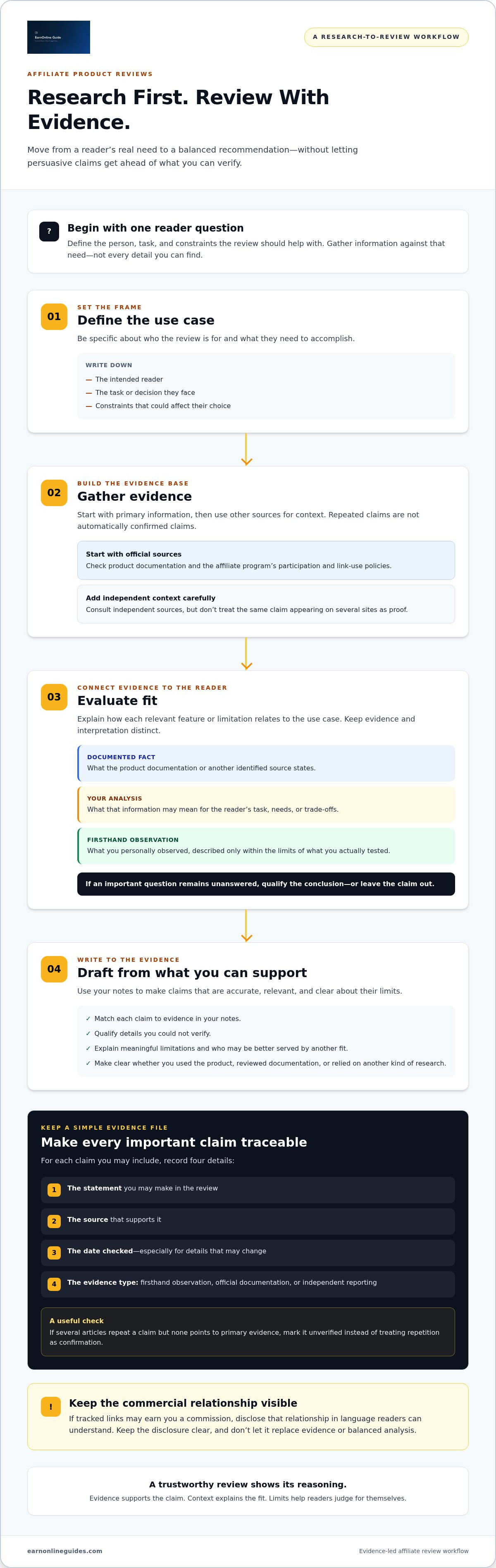
A clear structure helps readers find what they need without mistaking a recommendation for a sales pitch. Begin with the product category, intended reader, and basis for your evaluation. Then address fit, supporting evidence, relevant alternatives, drawbacks, and a practical next step. This order makes your reasoning easier to follow and keeps the conclusion connected to the evidence.
Keep important claims close to their support. If you say a product includes a particular capability, point readers to the relevant product documentation or explain how you verified it. Replace broad claims such as “the best choice for everyone” with qualified language: “may suit readers who need this documented feature, but may not fit those with a different requirement.” Specific wording tells readers what your recommendation does and doesn’t establish.
Use section headings that reflect real reader questions, such as “Who is this for?”, “What evidence supports the assessment?”, and “What are the limitations?” Explain whether the review is based on firsthand testing or research, and distinguish source-backed facts from your interpretation. A concise conclusion should say which needs the product may meet, which it may not, and what readers should consider before choosing.
Audience definition matters before drafting. If you’re assessing whether a product serves a particular group, clarify the problem and demand you’re evaluating. The same audience-first reasoning can help you validate an online business idea.
Place a plain-language affiliate disclosure near the beginning, before readers rely on linked recommendations. For example: “I may earn a commission if you buy through links in this review.” The FTC explains endorsement disclosure principles in its endorsement guidance. Review that official guidance and the specific affiliate program’s policies when preparing or updating content, since requirements may depend on the circumstances and program.
A disclosure clarifies the relationship; it doesn’t substantiate a product claim or excuse an unsupported recommendation. Keep those responsibilities separate. Recheck relevant details before publication, then revisit the page when product documentation or program policies change. Test affiliate links and confirm that the conclusion still reflects the evidence, rather than leaving outdated claims in place.
For a practical editing pass, check that the review answers these questions:
These checks help make affiliate product reviews useful for informed decisions. The aim isn’t to make every review longer; it’s to make the reasoning, relationship, and limitations clear enough for readers to assess the recommendation.
A review is ready to publish when its evidence supports a useful conclusion, not simply when the draft is complete. Use a repeatable workflow to move from the reader’s question to a final accuracy check. If a critical claim remains uncertain, narrow the review or explain the gap instead of presenting a stronger verdict than the evidence allows.
Build the outline around reader decisions rather than a seller’s marketing sequence. Headings such as “Who may benefit?”, “What should readers compare?” and “What are the limitations?” give the draft a practical structure. Add source notes for factual claims, especially details that can change, so you can verify them before publishing.
Pause before publication if a central point depends on an unsupported claim, an unclear eligibility condition, or testing you didn’t perform. A narrower review can still help readers if it clearly states what it covers and where its evidence stops.
Publishing isn’t the last accuracy check. Reader questions can reveal where an explanation leaves an important choice unclear. Update the relevant section when new information changes the assessment, and recheck linked product details and affiliate program policies against their official sources when they change.
Keep a brief revision note with the date and what changed. This makes it easier to distinguish a substantive update from a wording edit and gives you a record of why the review’s conclusion may have shifted. If the evidence no longer supports the assessment, revise the conclusion rather than preserving an outdated recommendation.
Traffic and commission data can help identify how readers find and interact with a review, but they don’t prove that it answered the right question or helped someone choose well. Treat those measures as performance signals, then consider reader feedback and content accuracy alongside them. The standard remains whether the review supports an informed decision.
For a broader foundation in the business model behind product reviews, explore affiliate marketing learning resources. A careful publishing process won’t guarantee clicks or commissions, but it gives each review a sounder basis: a clear purpose, supportable claims, and an appropriately qualified conclusion.
Your next review doesn’t need to cover every product or answer every possible question. Choose one audience need you can investigate responsibly, then decide whether the evidence is strong enough to help readers make a choice. That focused approach gives you room to improve your research and judgment with each piece you publish.
Learning how to write affiliate product reviews is part of a broader practice of creating useful, transparent affiliate content. EarnOnlineGuide publishes practical guides on affiliate marketing and other ways to build online income, with an emphasis on clear information and realistic expectations.
Explore EarnOnlineGuide for practical affiliate marketing resources and take a measured next step toward creating reviews readers can assess for themselves. Each careful review is an opportunity to build trust through clear reasoning and useful information.
Write a research-based assessment, not a firsthand verdict. Use it to answer questions that available materials can support, such as whether a product’s published requirements align with a stated use case. Avoid judging reliability, ease of use, or real-world performance without direct evidence. If a reader’s decision depends on those qualities, identify them as unresolved rather than filling the gap with inference.
Disclose an affiliate relationship so readers can account for it when weighing your recommendation. Also consider whether you received other value, such as a free product or a special benefit connected to the brand. The disclosure should describe the actual relationship, not just use an ambiguous label. Check official FTC guidance and the relevant program’s policies for details that apply to your publishing format.
Identify the exact product or version being discussed so readers don’t confuse it with a different model or plan. Explain compatibility or prerequisites that could rule someone out, and note any relevant purchasing or return conditions you’ve verified. A helpful review can also say who should skip the product. These details can prevent a mismatch even when the product’s general features appear suitable.
There’s no required count. Set the scope based on the decision: a review focused on one product can be useful without a comparison, while a shortlist article needs enough options to represent the meaningful choices available to its audience. Don’t imply that a small selection covers an entire category. State the scope clearly so readers understand what the comparison does and doesn’t represent.
You can write a limited overview of what a seller’s description says, but that alone doesn’t establish the product’s quality or suitability. Label the piece accordingly and attribute specifications to the seller. For example, you may report a listed compatibility requirement, but shouldn’t conclude that the product works well with a particular setup unless you have evidence beyond the description.
Use a change-based approach rather than treating a calendar interval as proof that a review is accurate. Keep an internal note of which claims are most likely to affect a purchase, then prioritize those when checking the page. Stable background information may need less attention than product versions or terms that can change. Make visible update notes only when an edit meaningfully changes the reader’s assessment.

Article by
EarnOnlineGuides Editorial Team
The EarnOnlineGuides Editorial Team creates practical, research-driven educational content about making money online, remote work, freelancing, side hustles, digital skills, AI tools, online business, and self-employment. Our goal is to help readers understand their options, compare realistic opportunities, avoid misleading claims, and make better-informed decisions. We prioritize accuracy, transparency, practical guidance, and responsible reporting, and we regularly review our content to keep it useful and up to date.
The information provided in this article is for general educational and informational purposes only and should not be considered financial, investment, tax, legal, or professional advice. Earnings, income examples, costs, fees, and other figures may vary and are not guaranteed. Always conduct your own research and consult a qualified professional when appropriate.
Some articles on EarnOnlineGuides may contain affiliate links. If you click a link and make a purchase or sign up for a service, we may receive a commission at no additional cost to you. This does not influence our editorial standards or recommendations.
We strive to keep our information accurate and up to date, but products, services, fees, policies, laws, and market conditions can change. Please verify important information directly with the relevant provider before making financial or business decisions.
Educational information only. This article is not financial, tax, or legal advice. Platform fees and policies change; always confirm current rates in the marketplace's official fee documentation before making decisions.
Explore low cost digital side hustles you can test in 2026. Compare freelance work, digital goods, and reselling while managing hidden platform fees and time.

Learn how to open a freelance business bank account step by step. Explore document checklists, compare bank options, and keep business finances organized.

Use this free freelance proposal template for beginners to outline project scope, pricing, and timelines. Win clients and set clear terms with confidence.