
Low-Cost Digital Side Hustles: Practical Ways to Start in 2026
Explore low cost digital side hustles you can test in 2026. Compare freelance work, digital goods, and reselling while managing hidden platform fees and time.
October 13, 202618 min read

Opening a freelance business bank account gives client income and work expenses a separate place to land, making transactions easier to review. If you’re wondering how to open a freelance business bank account, start with a few practical questions: Do you need an LLC or an EIN? Which documents will the bank request? How will you keep client payments separate from personal spending?
The right setup depends on your business structure, the bank’s requirements, and how you handle payments. This guide explains what to prepare, how to compare account terms and services, and what to expect during the application process. It also covers ways to keep clearer financial records without treating general information as personalized legal or tax advice.
A freelance business bank account is an account you use for business income and expenses. Instead of routing client payments through the account you use for groceries, rent, and personal bills, you give freelance transactions a separate place to land. That separation makes it easier to see what came in, what went out, and which transactions need documentation.
The benefit is clearer records, not an automatic tax break or legal protection. A separate account doesn’t by itself change how your income is taxed, establish a particular tax treatment, or protect personal assets. It can make transactions easier to categorize and reconcile. The right setup depends on your business structure, the bank’s rules, and how you receive and spend money.
If you’re still building your freelance or online-work plan, this step-by-step guide to starting to make money online covers broader early decisions. Setting up a place for business income is one practical detail to consider as you begin earning.
Not necessarily. A sole proprietor may be able to apply using their existing business setup, but eligibility and required information vary by bank. An LLC is a legal business entity; opening a bank account is a separate action and does not form an LLC. If you’re weighing entity options or have questions about state-specific requirements, consult official state resources or a qualified legal or tax professional.
Separation can make bookkeeping more manageable because business deposits and purchases are easier to identify in one transaction history. For example, if a client payment and a software subscription both run through the dedicated account, you can review them without sorting through personal purchases. Consistent use matters: routing business transactions through a personal account as well can make reconciliation harder.
Record what each transaction relates to and keep the supporting invoice or receipt. A bank statement shows money moving, but it may not explain the business purpose. Descriptions and saved documentation add context when you review records later.
These habits can support cleaner records, but an account alone doesn’t determine whether an expense is deductible or how income is treated. Those questions depend on your circumstances and applicable rules. The goal is a consistent recordkeeping workflow, not a substitute for professional guidance. That distinction is a useful starting point when deciding how to open a freelance business bank account.
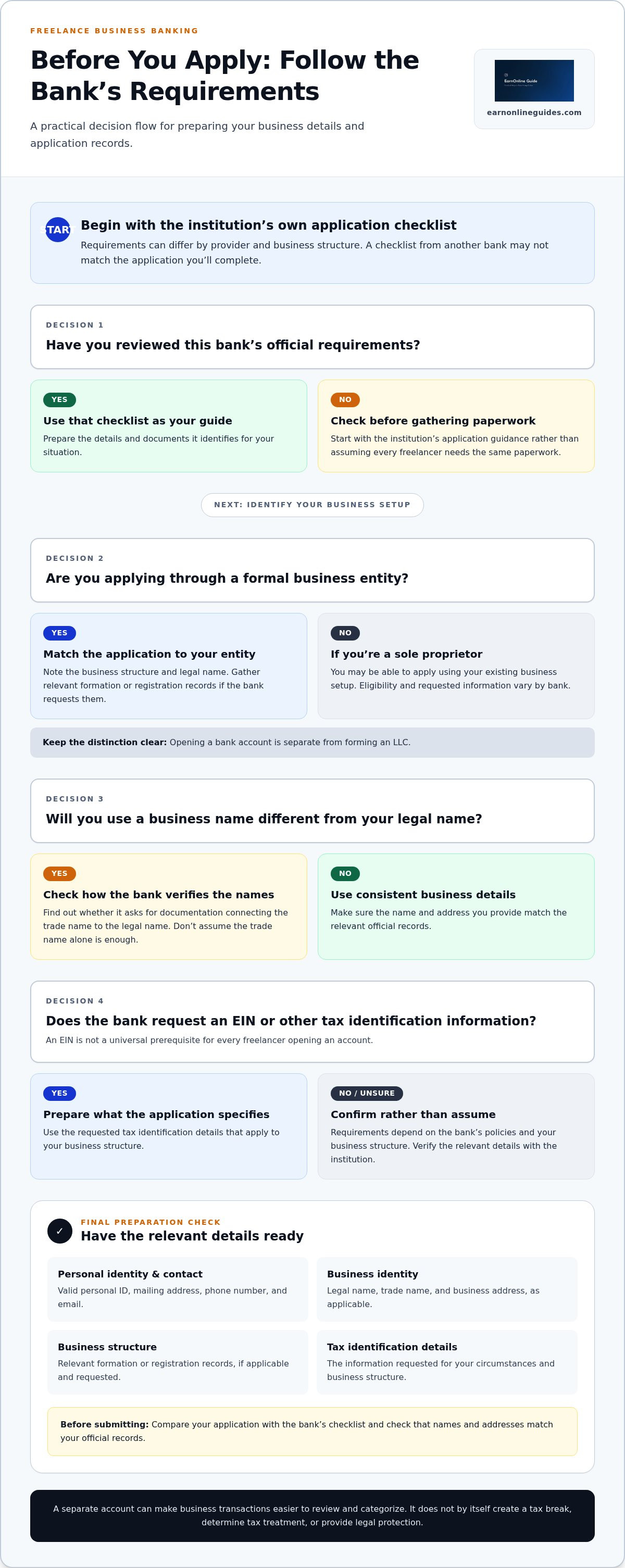
Start with the application checklist published by the bank or financial institution you’re considering. Requirements can differ by provider and business structure, so a checklist from another bank may not match the application you’ll complete. Reviewing the institution’s instructions first helps you gather relevant information without assuming every freelancer needs the same paperwork.
Separate information you can prepare in advance from documents you need to verify. Personal identification and basic contact details are useful to have ready. Formation documents, trade-name registration, and a specific tax identification number may depend on your business and the institution’s rules. Use the institution’s official application guidance to identify what applies.
Write down how your business is organized before applying. A sole proprietor and a freelancer operating through a formal entity may be asked for different details. Be prepared to provide the legal name associated with the business and, if you use one, its trade name. The bank may also request formation records for an entity. Make sure the application information matches your official records.
An Employer Identification Number (EIN) is a federal tax identification number, but it isn’t a universal prerequisite for every freelancer opening an account. The IRS explains who needs an EIN and how to apply in its guidance on Employer ID Numbers (EINs). A bank may ask for an EIN or other tax identification information based on its policies and your business structure. Confirm the relevant requirements with the IRS and your chosen institution.
Before starting, gather a valid personal identification document and the business contact details you plan to use, such as a mailing address, phone number, and email. If your business uses a name that differs from your legal name, find out whether the institution asks for documentation connecting the two. Don’t assume a trade name alone satisfies the bank’s requirements.
Depending on the application, the institution may ask for additional supporting records or details about your business. Use this working list to prepare, then compare it with the bank’s own checklist:
These are preparation categories, not a universal document list. If your records use different names or addresses, note the discrepancy and identify which official document reflects the correct information before applying. Consistent details make it easier to complete the application accurately.
Approval criteria, application methods, and review steps vary by institution. Submitting an application doesn’t guarantee acceptance, and a general checklist can’t establish your eligibility. For how to open a freelance business bank account, first verify the selected institution’s requirements, then prepare information that matches your business structure and records.
A long feature list doesn’t tell you whether an account fits your work. Begin with your actual money flow: how clients pay you, how often you make purchases or transfers, whether you handle cash, and how you prefer to get support. Then compare account terms and access alongside features. The aim is to choose an account that supports your routine, not simply one with the most tools.
Review each provider’s published disclosures and account agreement. Look for maintenance charges, balance conditions, transaction limitations, and rules for deposits, withdrawals, and transfers. A feature such as invoicing or budgeting tools is useful only if it fits the way you bill clients and manage expenses.
Use a comparison table to keep the decision grounded in your needs:
| Comparison area | What to check | Workflow question |
|---|---|---|
| Account purpose | Business checking, savings, or another deposit account | Will this account handle routine payments, hold reserves, or both? |
| Transactions | Deposit, withdrawal, transfer, and cash-handling options | Can it accommodate how clients pay and how you pay expenses? |
| Access | Online and mobile access, branches, and cash services | Do you need in-person service or can you manage digitally? |
| Support | Available support channels and published support terms | How will you get assistance if a payment or account issue comes up? |
| Published terms | Fees, minimums, transfer limits, eligibility, and rate conditions | Do the terms work for your expected account use? |
Before applying, verify fees, minimum balance requirements, transfer limits, and eligibility in each provider’s disclosures. Rates and account terms can change, so use the provider’s own materials rather than relying on an older comparison or promotional summary.
Compare how each provider delivers account services, not just the label. A bank or credit union may offer branch access, while a financial technology provider may deliver services through an app or website and work with a separate insured bank. Account structure, support, and eligibility vary. Read the account agreement and disclosures to identify which institution holds deposits and what protections apply.
For accounts at an FDIC-insured bank, the FDIC’s standard deposit insurance limit is $250,000 per depositor, per insured bank, for each ownership category, subject to its rules. A financial technology company is not itself necessarily an FDIC-insured bank, even if it describes deposits as eligible for coverage through partner banks. Review the provider’s disclosures and the FDIC’s deposit insurance guidance to understand how coverage applies to the specific account. Don’t assume that an advertised feature or coverage claim tells the whole story.
The process is easier to manage as a sequence rather than a single application. The application channel and review steps depend on the institution, so use its official instructions as your reference. If you’re still shaping your services and client workflow, this beginner guide to starting freelancing online can help you think through the business setup alongside your banking choices.
A provider may request clarification or additional supporting materials during its review. Respond through the official channel and make sure any added information is consistent with what you submitted. Once the account is available, verify that you can access it and locate the disclosures and support instructions. If a term is unclear, consult the provider’s account materials before relying on an assumption.
Decide how to route client payments to the account when appropriate, and update payment instructions through the relevant client or platform process. You don’t need to adopt a particular banking feature or payment method just because it’s available. Choose controls that fit your workflow, and keep transaction descriptions and supporting records clear enough to review later.
For example, a note identifying a payment as a project deposit can make its purpose easier to recognize during reconciliation. Keep invoices, receipts, and other records in your bookkeeping system rather than relying on the bank description alone. This gives each transaction context without assuming that opening the account determines how it should be categorized.
An account supports recordkeeping only when you review and categorize its activity consistently. Choose a schedule that fits your workload, such as a weekly check-in or a review after each billing cycle. The goal is to recognize transactions while they’re still familiar instead of reconstructing their purpose much later.
During each review, match deposits to invoices or payment records, identify business expenses, and flag transactions that need follow-up. Save account statements and supporting documents in an organized place. Use a consistent naming system so you can find records by date, client, or expense type. Retain records according to applicable guidance for your circumstances.
A bank account provides a transaction history, but it doesn’t replace bookkeeping. A statement may show that a payment was made without explaining what it was for or how it should be categorized. Record business transactions consistently in your bookkeeping system, and don’t treat personal purchases as business expenses. If a personal transaction appears in the account, label it accurately and keep an explanation with your records.
Keep the routine proportionate to your business. A freelancer with a small number of monthly transactions may need a simpler review process than someone managing frequent client payments and purchases. What matters is that the process is repeatable and gives each transaction enough context for later review.
Banking records can inform tax preparation, but account separation doesn’t determine tax treatment. Whether you work as an employee or an independent contractor also affects the broader context of your records; this guide to 1099 and W-2 work differences explains that distinction. For an educational estimate related to self-employment taxes, you can use the self-employment tax calculator. It isn’t personalized tax advice. Discuss tax questions specific to you with a qualified tax professional.
Review your account details if your business structure, name, address, or payment workflow changes. Notify the institution when its account rules require an update, and check whether the change affects account records or access. Keep copies of relevant updates with your business documents. If you’re unsure how a change affects entity, tax, or reporting decisions, seek advice from a qualified professional familiar with your circumstances.
A regular review process helps make your freelance business bank account part of a working financial system. Use the account to support accurate records, then maintain those records with clear categories, saved documentation, and periodic checks.
Opening an account is one part of building a freelance operation you can manage. As your work develops, revisit whether your financial routines still match how you find clients, deliver projects, and receive payment. Keep banking decisions separate from questions that call for legal or tax guidance, and seek qualified professional advice when your circumstances require it.
If you’re still shaping your freelance path, beginner-friendly freelancing guidance can help with early business decisions. For work-status context, explore the 1099 vs. W-2 resource, or use the self-employment tax calculator as an educational estimate, not personalized tax advice.
Knowing how to open a freelance business bank account gives you a practical starting point, not a fixed formula. Choose the next step that fits your situation, verify important details, and build your system at a sustainable pace. Explore EarnOnlineGuides' practical freelancing and online-work resources to keep moving forward.
Often, yes. A bank may let a sole proprietor apply, subject to its eligibility rules. Use the structure you actually operate under rather than selecting an LLC option for convenience. If a client contract, state filing, or another business concern is prompting you to consider an LLC, base that decision on the relevant requirements and professional guidance, not on account access alone.
Not every freelancer has the same identification requirements. If you already have an EIN, make sure the business name and number you provide match your records. If you’re unsure whether to apply for one, review the IRS’s EIN guidance and compare it with the selected bank’s instructions. The application checklist explains what that institution requires.
That depends on the account agreement. Check whether its terms permit business transactions before sending client payments there. If the bank limits the account to personal use, routing invoice payments through it could conflict with those terms. Also consider whether your payment processor or client requires account details that match the payee information on your invoices.
There’s no universal checklist. Follow the chosen bank’s application instructions, since requirements may depend on the account and your business setup. If an application requests a document that doesn’t fit your situation, don’t substitute an unrelated record or guess what the bank means. Use the institution’s official application support channel to clarify the requirement before submitting.
Possibly, depending on the institution’s eligibility criteria. Be ready to describe the freelance services you plan to provide and how you expect to use the account. Keep those details factual: don’t report prospective clients as existing customers or estimate future payments as received income. If the application asks for information you can’t yet provide, follow the provider’s instructions rather than inventing an answer.
No general statement covers every account arrangement. Check the account’s legal documents to identify the insured bank and whose name or names hold the deposit. If you keep deposits in multiple accounts at the same bank, ownership details can affect how coverage is assessed. Use the FDIC’s official resources to evaluate the particular arrangement rather than relying only on an account’s marketing language.

Article by
EarnOnlineGuides Editorial Team
The EarnOnlineGuides Editorial Team creates practical, research-driven educational content about making money online, remote work, freelancing, side hustles, digital skills, AI tools, online business, and self-employment. Our goal is to help readers understand their options, compare realistic opportunities, avoid misleading claims, and make better-informed decisions. We prioritize accuracy, transparency, practical guidance, and responsible reporting, and we regularly review our content to keep it useful and up to date.
The information provided in this article is for general educational and informational purposes only and should not be considered financial, investment, tax, legal, or professional advice. Earnings, income examples, costs, fees, and other figures may vary and are not guaranteed. Always conduct your own research and consult a qualified professional when appropriate.
Some articles on EarnOnlineGuides may contain affiliate links. If you click a link and make a purchase or sign up for a service, we may receive a commission at no additional cost to you. This does not influence our editorial standards or recommendations.
We strive to keep our information accurate and up to date, but products, services, fees, policies, laws, and market conditions can change. Please verify important information directly with the relevant provider before making financial or business decisions.
Educational information only. This article is not financial, tax, or legal advice. Platform fees and policies change; always confirm current rates in the marketplace's official fee documentation before making decisions.
Explore low cost digital side hustles you can test in 2026. Compare freelance work, digital goods, and reselling while managing hidden platform fees and time.

Learn how to write affiliate product reviews readers can trust. Discover a practical process for honest testing, balanced pros and cons, and clear disclosures.

Use this free freelance proposal template for beginners to outline project scope, pricing, and timelines. Win clients and set clear terms with confidence.