
Low-Cost Digital Side Hustles: Practical Ways to Start in 2026
Explore low cost digital side hustles you can test in 2026. Compare freelance work, digital goods, and reselling while managing hidden platform fees and time.
October 13, 202618 min read

A freelance proposal template for beginners gives you a clear way to explain how you’ll address a client’s needs, even if your portfolio is still small. You don’t need to pretend you have years of experience. Focus on the work you can do, the deliverables the client will receive, and the expectations you need to agree on.
If you’re unsure which sections belong in a proposal or how to describe deliverables, timing, and payment, start with a structure you can customize. A vague proposal can leave both sides with different expectations. This guide provides a practical template with prompts for defining the client’s problem, scope, schedule, price, and next steps.
You can build credibility by showing relevant examples and explaining a realistic work process. Use the template as a starting point, tailor it to the project, and give the client a clear way to respond. A proposal is an educational aid, not legal advice or a substitute for a suitable written agreement.
A freelance proposal outlines a project, its scope, and the working expectations for both sides. It gives the client a project-specific offer to assess: what you understand they need, what you plan to do, and what the work involves. For beginners, the goal isn’t to make a document look elaborate. It’s to make the offer clear enough for the client to decide whether your approach fits.
A proposal is most useful when a client needs a tailored plan rather than a standard service description or a general expression of interest. For example, a client requesting a content audit and a prioritized list of improvements needs more than a price. Your response can specify what you’ll review, what you’ll deliver, and which assumptions the plan depends on. Project-specific clarity is part of professional freelancing, where work and payment arrangements can vary by engagement.
Keep a proposal distinct from related documents. A brief describes the client’s needs and goals. An estimate focuses on anticipated cost and can be included in a proposal without explaining the full approach. An invoice requests payment for work or a payment milestone; it isn’t a project plan. A signed agreement can document agreed terms and responsibilities. A proposal can support the client’s decision, but it isn’t automatically a substitute for a suitable written agreement.
A proposal is an offer to complete defined work under stated assumptions. The client uses it to assess fit, scope, and approach, not to treat projected outcomes as certain. For instance, you can describe an audit and its deliverables, but shouldn’t promise that it will produce a particular business result. If the client accepts, document the agreed scope, payment, responsibilities, and other project terms appropriately before work begins.
Send a proposal when a client asks for a project plan, a tailored response, or details beyond a standard service description. A simple inquiry about an established service may need only a concise reply with relevant details. A job application is different: it responds to an employment opportunity, while a freelance proposal presents a defined project offer. For straightforward work, the proposal can be brief.
Ask whether the client needs to evaluate choices before deciding. If scope, deliverables, timing, or price depend on the project, a proposal can put those variables in one place. If the request is already clear and limited, a short written outline may be enough. Either way, don’t add sections just to make the document seem more substantial.
A freelance pricing guide can help you consider how project scope connects to price. A clear proposal makes the offer easier to assess, but it can’t guarantee the client will accept. Its purpose is to show what’s included and what would require a separate discussion.
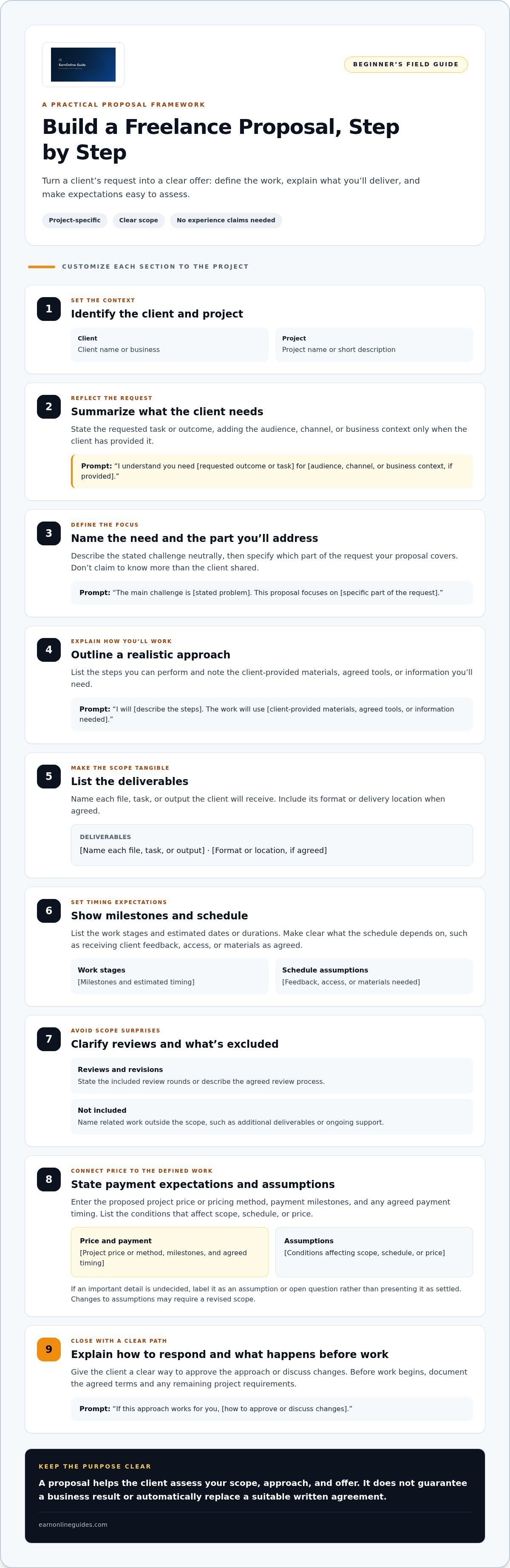
Use this freelance proposal template for beginners as a working draft, not a form to send unchanged. Replace each bracketed prompt with information from the client’s request, and remove sections that don’t apply. Describe work you can deliver, with boundaries clear enough that neither side has to guess what the price or schedule covers.
Copy the fields below into a document, then tailor the summary and approach to the project. If a detail is undecided, label it as an assumption or open question instead of presenting it as settled.
Describe the client’s need neutrally, without claiming to know more than they shared. For example, write “You’re looking for a review of the landing page’s structure and copy,” not “Your current page is losing customers.” Describe your process in terms of actions you can complete, such as reviewing supplied materials, drafting, and incorporating agreed feedback. Don’t invent credentials, results, or client quotes to strengthen your offer.
Make deliverables observable: name what the client receives, not just the activity you’ll perform. Separate included work from exclusions so requests for extra pages or another review round can be discussed rather than silently added. Keep schedule estimates conditional when they depend on client feedback or access. Choose a pricing structure that fits the defined scope. A guide to pricing freelance work can help you think through that decision without treating any rate as universal.
End with a direct, low-pressure question, such as: “Would you like to proceed with this scope, or discuss an adjustment before approval?” This invites questions while making the next step clear. Keep the proposal easy to scan, but include the details that affect expectations.
A short client history doesn’t require inflated credentials. Build trust with evidence relevant to the requested work, a clear explanation of your process, and realistic boundaries. A freelance proposal template for beginners gives you space to connect that evidence to the project without presenting practice work as paid client work.
Different kinds of proof show different things, so label each one accurately:
Choose proof that answers the client’s likely question: “Can this person handle the work I’m asking for?” One closely related sample with a concise explanation can be more useful than a collection of unrelated examples.
Use a sample, practice project, or prior experience, and label it plainly. Explain the problem you set out to address, the decisions you made, and what the sample demonstrates. For example, describe how you organized information for readability, not how the work increased sales unless you have reliable evidence for that result. State your experience level directly, then connect your skills to the project requirements.
Propose work that matches your demonstrated skills and available capacity. Before committing, separate the client’s stated requirements from assumptions that need discussion. If the project depends on materials, access, or timely feedback, identify those dependencies. Avoid promising results that rely on client decisions, audience behavior, or factors outside your control.
A bounded sample can help when a client needs to see your approach before considering a larger project. Define the sample’s purpose, deliverable, and limits in advance. It might demonstrate one part of a workflow rather than include a complete project at no charge or imply that a small sample proves every capability. If the sample uses client materials, keep its use within what the client has agreed to.
Make the connection explicit in your proposal: “My sample shows [specific skill relevant to the request]. For this project, I would apply that approach by [proposed step].” This gives the client something concrete to evaluate instead of relying on a broad claim of expertise. For more foundation on setting up freelance work, the guide to starting freelancing online can help you identify skills and services to present accurately.
A template saves time only when the offer fits the client’s actual request. Before sending your proposal, trace each section back to the client’s brief or conversation. If a detail is your assumption, not something the client specified, label it clearly or resolve it before presenting the plan as final.
Keep the useful structure, but replace generic language with the client’s stated goal and relevant project context. If the client wants a website review, name the pages or materials they mentioned instead of opening with a broad claim about improving online performance. Remove sections that don’t apply. Each promised deliverable should match work you can provide and the scope you’re prepared to take on.
Before sending, read the proposal from the client’s perspective. Can they tell what they’ll receive, what they need to provide, and what happens next? If the client gave you a decision timeline, follow up in line with it. If they didn’t, a courteous note after a reasonable interval can ask whether they have questions. Avoid repeated messages, artificial deadlines, or wording that pressures the client to decide.
Use the final review to make the proposal specific without overbuilding it. Customize the relevant details, remove anything that doesn’t apply, and send the finished document with a calm invitation to discuss or approve the scope.
A client’s acceptance is a useful signal, but it doesn’t mean every detail is settled. Before work begins, confirm the working plan in writing. The proposal may not address every agreement or administrative requirement, so use acceptance as the point to clarify what both sides have agreed to and what still needs to be documented.
Send a concise confirmation that restates the approved deliverables, schedule, review process, payment expectations, and materials the client will provide. Identify who will give feedback and where project communication and approvals will happen. If anything has changed since you sent your proposal, record the change and its effect on scope or timing before treating it as included work.
A practical kickoff confirmation might cover:
If the client adds a deliverable or requests a different process, pause to discuss the change. Confirm whether it affects the schedule, price, or other terms, and document the revised plan before proceeding. A shared written record helps prevent an informal request from becoming an unclear commitment.
After the project terms are clear, keep a record of the agreed scope and the time or effort the work requires. That information can inform future pricing decisions, but one project shouldn’t automatically become a universal rate. Consider the work involved, your capacity, and the costs your freelance business needs to account for. The freelance rate calculator can help you examine rate assumptions as part of your planning.
Use the freelance proposal template for beginners as a structure, not a script. Each client request may call for different deliverables, assumptions, or payment milestones. Update the relevant fields and remove anything that doesn’t fit. A proposal is most useful when it reflects the actual project rather than a promise copied from an earlier engagement.
Before sending your next proposal, review the scope, schedule, and pricing as one connected plan. If they align with what the client requested and what you can deliver, send it with a clear invitation to discuss questions or approve the proposed next step.
Your first proposal doesn’t need to establish a perfect system for every future project. Treat it as a starting point. Notice which questions clients ask, where you need clearer boundaries, and which parts of your process you want to refine. These observations can help you make future offers more realistic and easier to evaluate.
As you build experience, revisit how you estimate the work and set your rates. EarnOnlineGuides offers practical freelance pricing and rate-calculation resources, along with beginner-focused guidance for developing your freelance skills. Use them to inform your decisions, then apply your judgment to the scope and conditions of each project.
Keep the freelance proposal template for beginners as a flexible working document. Adjust it as your services and experience develop, while staying accurate about what you can deliver. To support your next steps, explore EarnOnlineGuides’s freelance skill-building guides and tools.
Include the client’s need, your proposed approach, specific deliverables, schedule, review process, exclusions, pricing and payment expectations, assumptions, and next steps. Use clear labels instead of unexplained industry terms, and put the most project-specific information near the top. Before sending, check that the client can distinguish the proposed work from optional or future work.
There’s no universal page count. Let the project’s complexity determine the length, and keep each section if it helps the client evaluate the offer or understand a condition that could affect the work. Combine paragraphs that make the same point. For a longer proposal, use clear headings and keep dense technical notes separate from the main decision-making information.
Yes. If you don’t have a portfolio, don’t attach unrelated work just to make the proposal look fuller. Help the client judge fit by responding directly to their requirements and explaining your approach. If you lack a capability the project requires, be candid about that gap rather than implying experience you haven’t gained.
Not necessarily. The proposal and any separate agreement should work together without conflicting or unclear terms. Before accepting work, pay attention to subjects the proposal may not address, such as how the client may use the final work or how sensitive project information will be handled. If those issues matter to the engagement, resolve them in writing and seek qualified legal advice when needed.
If the client’s needs or project timing change while they’re considering your offer, ask whether they’re still evaluating the same scope before treating the original proposal as applicable. A short message can check without pressure: “Has the project scope or timing changed since I sent the proposal?” If the client confirms a change, revise the offer rather than relying on outdated details.
First decide whether the work is defined well enough for a fixed project price or whether an hourly structure better reflects uncertainty in the task. Then check that your estimate accounts for the work involved, not only the time spent producing the final item. The freelance rate calculator and freelance pricing guide can help you examine those planning assumptions.

Article by
EarnOnlineGuides Editorial Team
The EarnOnlineGuides Editorial Team creates practical, research-driven educational content about making money online, remote work, freelancing, side hustles, digital skills, AI tools, online business, and self-employment. Our goal is to help readers understand their options, compare realistic opportunities, avoid misleading claims, and make better-informed decisions. We prioritize accuracy, transparency, practical guidance, and responsible reporting, and we regularly review our content to keep it useful and up to date.
The information provided in this article is for general educational and informational purposes only and should not be considered financial, investment, tax, legal, or professional advice. Earnings, income examples, costs, fees, and other figures may vary and are not guaranteed. Always conduct your own research and consult a qualified professional when appropriate.
Some articles on EarnOnlineGuides may contain affiliate links. If you click a link and make a purchase or sign up for a service, we may receive a commission at no additional cost to you. This does not influence our editorial standards or recommendations.
We strive to keep our information accurate and up to date, but products, services, fees, policies, laws, and market conditions can change. Please verify important information directly with the relevant provider before making financial or business decisions.
Educational information only. This article is not financial, tax, or legal advice. Platform fees and policies change; always confirm current rates in the marketplace's official fee documentation before making decisions.
Explore low cost digital side hustles you can test in 2026. Compare freelance work, digital goods, and reselling while managing hidden platform fees and time.

Learn how to open a freelance business bank account step by step. Explore document checklists, compare bank options, and keep business finances organized.

Learn how to write affiliate product reviews readers can trust. Discover a practical process for honest testing, balanced pros and cons, and clear disclosures.