
Low-Cost Digital Side Hustles: Practical Ways to Start in 2026
Explore low cost digital side hustles you can test in 2026. Compare freelance work, digital goods, and reselling while managing hidden platform fees and time.
October 13, 202618 min read

If you're selling a $10 item via PayPal Checkout in 2026, the effective fee rate can climb as high as 8.4 percent. While many business owners view transaction costs as a minor overhead, the reality of a $0.49 fixed fee combined with varying percentage surcharges often leads to significant margin erosion. It's frustrating to see your hard-earned revenue vanish into a complex web of domestic and international processing costs without a clear explanation of where the money went. You shouldn't have to guess what your take-home pay will be after every sale.
This guide provides the analytical clarity you need to move from estimation to precision by utilizing a reliable paypal fee calculator framework. By understanding the data-driven methodology behind these deductions, you can make informed decisions about your pricing structures and service tiers. We believe that profitability is the result of careful planning and evidence-based adjustments rather than luck or high sales volume alone.
We'll provide a comprehensive breakdown of the current percentage plus fixed fee model, including the 1.50 percent surcharge for international sales and the higher costs associated with digital wallets. You will also learn actionable strategies to minimize fee impact and implement accurate pricing for your 2026 sales. This methodical approach ensures that your business remains profitable and resilient against shifting platform policies.
PayPal functions as a comprehensive merchant service provider rather than a simple digital wallet. This PayPal overview highlights its role as a global payment processor that facilitates secure digital transactions for a fee. Unlike a standard bank transfer that moves funds via the Automated Clearing House (ACH) network, PayPal offers immediate settlement and a robust dispute resolution framework. These additional layers of infrastructure are why sellers incur costs that exceed the nominal fees of traditional banking. The platform essentially charges for the convenience of instant access to funds and the security of a vetted payment ecosystem.
The core of this pricing is the percentage plus fixed fee model. The percentage portion scales with your sales volume, while the fixed fee remains constant. Understanding this math is essential when using a paypal fee calculator to project your net income accurately. If your business model relies on high transaction volume, these small deductions compound quickly, making manual estimation a risk to your long-term sustainability.
If you're selling a product or service, you're required by the terms of service to use Commercial payments, often labeled as "Goods and Services." This classification provides both Buyer and Seller Protection, which acts as a financial buffer against fraudulent claims or unauthorized transactions. While "Friends and Family" payments avoid these fees, they offer zero protection. Using personal payment categories for business purposes is a violation of platform rules. If a seller is caught misclassifying transactions to avoid fees, they face a high risk of account suspension or a permanent ban, which can freeze access to existing funds for 180 days or longer.
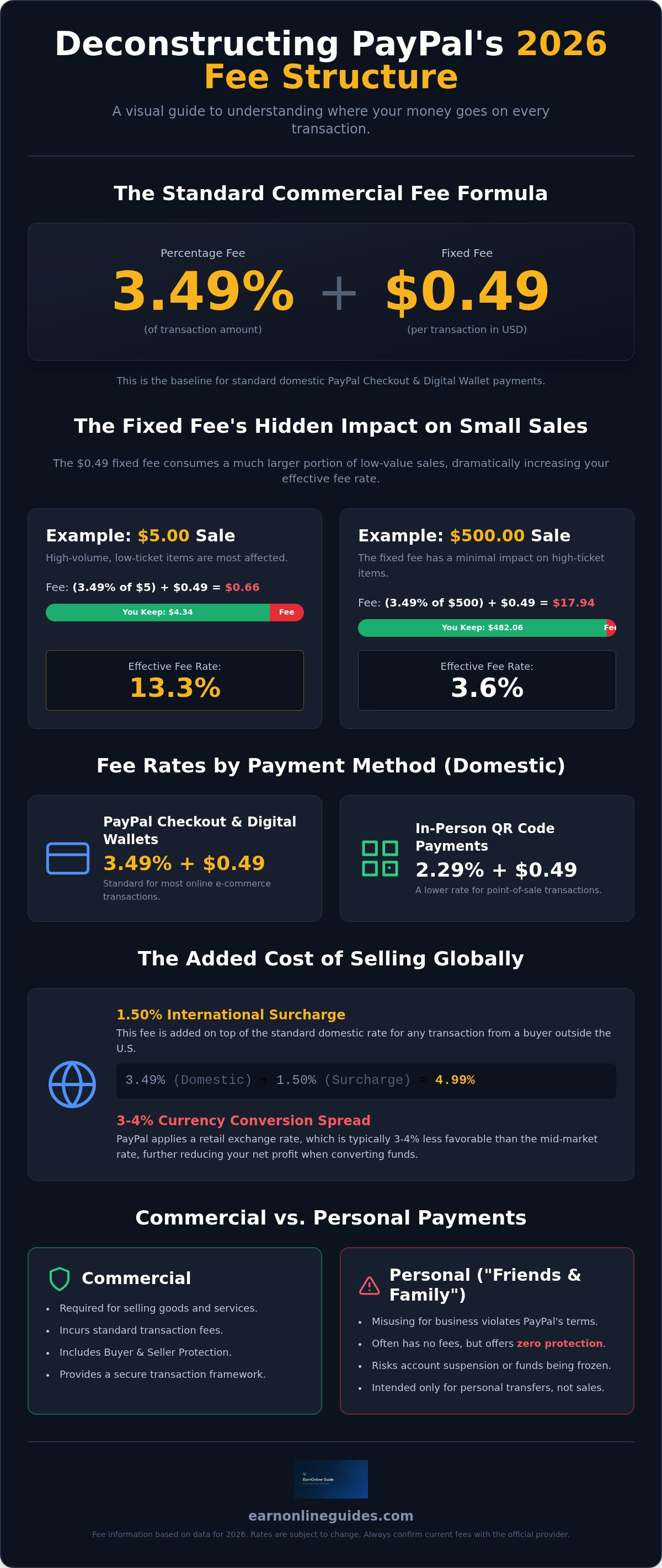
The fixed fee represents the non-negotiable baseline cost of every transaction regardless of the total sale amount. In the United States, this is typically $0.49 for standard commercial transactions. While this amount seems small, its impact is inversely proportional to your sale price. For a high-ticket item of $500, the $0.49 fee is less than 0.1 percent of the total. However, for a $5 digital download, that same fee consumes nearly 10 percent of your revenue before the percentage cut is even applied. This disparity is why high-volume, low-ticket sellers must be especially diligent when using selling fee calculators to audit their margins. Fees also vary by currency; transactions in Euros or British Pounds will have different fixed baselines that reflect local market conditions and processing overhead in those regions.
Domestic transaction rates in the United States for 2026 are relatively straightforward. Standard PayPal Checkout transactions incur a 3.49 percent fee plus a fixed $0.49. However, selling globally introduces a secondary layer of costs that many sellers overlook. These international surcharges are designed to cover the risk and complexity of moving money across borders. If you don't account for these variables, your projected net profit will be inaccurate.
When a buyer outside the United States completes a purchase, PayPal applies an additional 1.50 percent fee on top of the standard domestic rate. This means a transaction that would normally cost 3.49 percent effectively becomes 4.99 percent. You can track these regional variations and platform updates using the Online Selling Fee Index 2026. The location of the buyer's account is the determining factor here, not the buyer's physical location at the time of purchase. Understanding fees for different payment types is critical because these international surcharges apply to almost all commercial methods, including digital wallets and standard card payments.
Currency conversion is often the most significant hidden expense for global sellers. PayPal does not use the mid-market exchange rate found on financial news sites. Instead, they apply a retail conversion rate that includes a spread of 3 percent to 4 percent over the mid-market rate. If you receive British Pounds and convert them to US Dollars, you lose value twice: once to the transaction fee and once to the exchange rate spread. To mitigate these losses, freelancers can hold multiple currencies in their PayPal wallet. This allows you to wait for a more favorable exchange rate or spend the foreign currency directly on business expenses.
Consider the following breakdown of a $100 sale from a UK buyer to a US seller to see how these fees compound:
In this scenario, your total processing cost is approximately $8.98 to $9.98. This leaves you with a net amount of roughly $90.00 to $91.00 before you even consider shipping or inventory costs. If you're looking to optimize your pricing for international markets, using a dedicated paypal fee calculator helps you account for these cross-border variables before you send an invoice or set your list price.
A common error among online sellers is the assumption that a single transaction rate applies to all payments. In reality, the specific method a customer uses to pay significantly dictates the final deduction. For instance, payments made through the PayPal digital wallet or Venmo currently incur a 3.49 percent fee plus a $0.49 fixed fee. In contrast, standard credit and debit card payments are processed at 2.99 percent plus the same fixed fee. By inputting these specific variables into a paypal fee calculator, you can observe how a shift in customer preference directly impacts your bottom line.
Choosing between a basic integration and an advanced API-driven checkout is a decision that balances technical effort against long-term savings. Standard Checkout is the most accessible option, but it carries the higher 3.49 percent digital wallet rate. If your business processes a high volume of credit card payments, switching to Advanced Credit and Debit Card Payments reduces your rate to 2.89 percent plus $0.49. Understanding PayPal's merchant fees across these tiers is essential for high-volume sellers who want to reclaim a portion of their margins. If your monthly revenue exceeds $5,000, the technical requirement of an advanced integration often pays for itself through these reduced processing costs.
Sellers who specialize in low-ticket digital goods, such as stock photos or short instructional guides, face a unique challenge with the standard $0.49 fixed fee. If you sell an item for $5, the fixed fee alone consumes nearly 10 percent of the sale. To address this, PayPal offers a Micropayments rate of 4.99 percent plus a significantly lower fixed fee, typically $0.05. This model is mathematically superior for any transaction where the total is less than approximately $29, though it is most commonly leveraged for sales under $10. You must submit a specific application to your business account to enable this rate. If your average order value sits comfortably below the $10 threshold, this transition is one of the most effective ways to protect your take-home pay.
In-person transactions offer another avenue for cost reduction. Using QR codes for physical sales results in a 2.29 percent fee plus a fixed fee, which is the lowest standard rate available for most small businesses. This rate makes PayPal a viable competitor for physical pop-up shops and local markets, provided you use the official app to generate the payment code. This methodical approach to choosing your payment methods ensures that you aren't leaving money on the table due to avoidable processing overhead.
Understanding the numbers provided by a paypal fee calculator is only the first step toward safeguarding your revenue. The second step is a proactive pricing strategy that shifts these costs from a surprise deduction to a planned overhead. Many successful sellers use a reverse calculator approach; they determine their required net profit first and then adjust their list price to absorb the platform fees. This method ensures your business remains sustainable regardless of transaction volume.
One of the most effective ways to protect your margin is to use a gross-up formula to set your list price. If you need to receive exactly $100 after a standard 3.49 percent fee plus a $0.49 fixed fee, you don't simply add 3.49 percent to the total. Instead, you divide your desired net plus the fixed fee by the remaining percentage. In this case, ($100 + $0.49) divided by 0.9651 equals a list price of $104.12. Integrating this logic into your Realistic Income Model allows you to maintain consistent take-home pay.
Communicating this to customers requires a professional approach. In the United States, adding a surcharge at checkout is subject to varied state-level regulations and often creates friction with buyers. It's generally more effective to present fee-inclusive pricing as your standard rate or bundle it into a "standard processing" fee. This also simplifies your bookkeeping. You'll report the gross income to the IRS and then deduct the PayPal fees as a legitimate business expense, which is often cleaner than managing fee-exclusive invoices.
As your business scales, you should periodically audit your account settings to ensure you aren't overpaying. Merchants with consistent high monthly volume, typically over $3,000, may qualify for lower percentage rates through PayPal's merchant discount programs. These aren't always applied automatically, so you must monitor your volume and request a review when you hit new thresholds. You can learn more about strategic pricing in our guide on how to price freelance work to ensure your base rates are high enough to absorb these costs.
Reducing dispute and chargeback risks is another critical pathway for fee management. PayPal charges a non-refundable $20 fee for every chargeback and a $15 fee for standard disputes. Even if you win the case, the platform does not return the original transaction fee. High-volume dispute merchants may even see their dispute fees double to $30. Providing clear product descriptions, tracking numbers, and responsive customer service acts as a protective filter for your profit. For high-ticket sales exceeding $2,000, it's often more pragmatic to encourage clients to use ACH or bank transfers to avoid the percentage-based deduction entirely. To ensure your business is optimized for 2026, you should regularly audit your current margins using our suite of specialized tools.
Static fee tables provide a baseline, but they often fail to capture the nuanced reality of modern e-commerce. If you're managing international orders with currency conversions and tiered payment methods, a simple list of percentages won't suffice. Using a dynamic paypal fee calculator is the only way to account for the cumulative impact of these variables in real time. This technical approach moves your business away from guesswork and toward a verified financial model that supports long-term growth.
Our Selling Fee Calculators suite is designed to act as a protective filter for your margins. These tools allow you to input specific transaction data to see your exact take-home pay. For those transitioning from traditional employment, this data integrates directly with our 1099 vs W-2 analysis. It helps you understand if your freelance rates are truly covering your overhead, self-employment taxes, and processing costs. If you don't know your net numbers, you aren't running a business; you're managing a hobby.
A successful selling strategy requires monthly cash flow forecasting based on granular data. By running every new product price through the calculator before launch, you can identify which sales channels provide the best return. We recommend auditing your last 30 days of transactions for fee leakage by following these steps:
This methodical review ensures that your net margins remain healthy across all platforms. You might find that while a specific marketplace has higher traffic, your net margins are significantly better on a direct-to-consumer platform due to lower combined fees and fewer third-party surcharges.
Managing processing costs is just one component of a broader Online Side Hustles strategy. The most resilient sellers prioritize net income over gross revenue. It's easy to be misled by high sales volume if you don't account for the 3 percent to 4 percent erosion caused by payment processing. If your gross revenue is growing but your bank balance is stagnant, fee management is likely the missing link in your operations.
Fees shouldn't be viewed as a barrier but as a tool for access to a global marketplace. However, without active management, these tools can become a primary source of profit loss. Success in the 2026 digital economy belongs to the seller who treats their paypal fee calculator as a mandatory part of their daily workflow. By grounding your ambitions in practical constraints and verified data, you ensure that your business remains a sustainable and predictable source of income.
Maintaining profitability in 2026 requires moving beyond estimation and toward analytical precision. We've established that the difference between a 2.29 percent QR code rate and a 4.99 percent international transaction can determine whether a product line is a sustainable asset or a financial liability. By implementing a "gross-up" pricing model and auditing your transaction history for fee leakage, you transform processing costs from a hidden drain into a predictable overhead that you can account for in every sale.
Relying on a precise paypal fee calculator is the most effective way to ensure your list prices accurately reflect current platform rates. Our suite of tools is updated for 2026 platform rates and grounded in realistic income modeling to act as a protective filter for your take-home pay. These resources are vetted by online selling experts to provide the clarity you need for foundational growth. You don't have to guess what your net income will be when the data is available.
Access the Full Suite of Selling Fee Calculators to audit your current margins and secure your net profit. With the right data and a methodical approach, you can build a resilient business that thrives on informed decision-making. Your success is the result of careful planning and we're here to help you navigate the path forward.
PayPal does not charge a fee for domestic personal transfers if you fund the payment entirely with your PayPal balance or a linked bank account. If you choose to use a credit or debit card to send money to friends or family, a percentage-based fee plus a fixed fee applies. International personal transfers are never free; they always incur a cross-border surcharge and a currency conversion spread regardless of your funding source.
An international transaction using PayPal Checkout costs $5.48 plus any applicable currency conversion spreads. This total is calculated by taking the domestic 3.49 percent rate, adding the 1.50 percent international surcharge to reach 4.99 percent, and then adding the $0.49 fixed fee. If you use a paypal fee calculator, you will see that conversion spreads of 3 to 4 percent can further reduce your actual net payout from global customers.
The standard fixed fee for US dollar commercial transactions is $0.49 as of September 2026. This fee is a non-negotiable baseline that the platform applies to nearly every payment type, including standard checkout and digital wallet transfers. While this amount remains constant regardless of the total sale price, it represents a much higher percentage of overhead for low-ticket items compared to high-ticket sales where the impact is negligible.
You cannot legitimately use the Friends and Family option for business transactions because it violates the platform terms of service. This category is strictly for personal transfers and does not provide any Buyer or Seller Protection. If the platform identifies business activity on a personal account, it can lead to account suspension or the permanent freezing of your funds. It is safer and more professional to build the commercial fee into your pricing strategy.
There is no difference in the core transaction fee percentage or fixed fee between the mobile app and the desktop website. Both platforms use the same merchant fee schedule based on the payment method used by the customer. However, the app provides unique access to QR code payment generation, which carries a lower 2.29 percent rate plus a fixed fee for in-person sales. This is often cheaper than standard online checkout fees.
The Micropayments rate is a specialized fee tier designed for transactions under $10, typically charging 4.99 percent plus a $0.05 fixed fee. This model is highly effective for digital goods because the lower fixed fee prevents the standard $0.49 charge from consuming too much of your margin. Sellers must apply for this status; once it is enabled, it replaces the standard commercial rate for all incoming payments on that specific business account.
PayPal transaction fees are considered a necessary cost of doing business and are generally tax-deductible for US-based freelancers and small business owners. When you file your taxes, you should report your gross income before any fees were deducted. You then list the total amount of processing fees as a business expense on Schedule C. This approach ensures you only pay income tax on your actual net earnings after all processing costs.

Article by
EarnOnlineGuides Editorial Team
The EarnOnlineGuides Editorial Team creates practical, research-driven educational content about making money online, remote work, freelancing, side hustles, digital skills, AI tools, online business, and self-employment. Our goal is to help readers understand their options, compare realistic opportunities, avoid misleading claims, and make better-informed decisions. We prioritize accuracy, transparency, practical guidance, and responsible reporting, and we regularly review our content to keep it useful and up to date.
The information provided in this article is for general educational and informational purposes only and should not be considered financial, investment, tax, legal, or professional advice. Earnings, income examples, costs, fees, and other figures may vary and are not guaranteed. Always conduct your own research and consult a qualified professional when appropriate.
Some articles on EarnOnlineGuides may contain affiliate links. If you click a link and make a purchase or sign up for a service, we may receive a commission at no additional cost to you. This does not influence our editorial standards or recommendations.
We strive to keep our information accurate and up to date, but products, services, fees, policies, laws, and market conditions can change. Please verify important information directly with the relevant provider before making financial or business decisions.
Educational information only. This article is not financial, tax, or legal advice. Platform fees and policies change; always confirm current rates in the marketplace's official fee documentation before making decisions.
Explore low cost digital side hustles you can test in 2026. Compare freelance work, digital goods, and reselling while managing hidden platform fees and time.

Learn how to open a freelance business bank account step by step. Explore document checklists, compare bank options, and keep business finances organized.

Learn how to write affiliate product reviews readers can trust. Discover a practical process for honest testing, balanced pros and cons, and clear disclosures.