
Low-Cost Digital Side Hustles: Practical Ways to Start in 2026
Explore low cost digital side hustles you can test in 2026. Compare freelance work, digital goods, and reselling while managing hidden platform fees and time.
October 13, 202618 min read
For a seller moving 10,000 units a month, the January 2026 fee increase adds $800 to your monthly overhead before you even account for the 3.5% fuel and logistics surcharge introduced in April. It's common to feel that your margins are under constant siege by unpredictable spikes and complex storage tiers. You likely started selling to build a sustainable business, but the reality of fee stacking can make it feel like you're working for the platform rather than yourself.
This guide will help you regain control by showing you how to use a sophisticated amazon fba fee calculator strategy to protect your profitability. You'll learn to navigate the 2026 fee structure, including the $2.40 per cubic foot peak storage rates and the low-inventory-level fees that often remain hidden until they hit your statement. We'll provide a methodical breakdown of the current referral and fulfillment landscape, followed by a data-driven framework to model your true net margins with professional precision. By treating these costs as manageable variables rather than surprises, you can secure the long-term health of your online business.
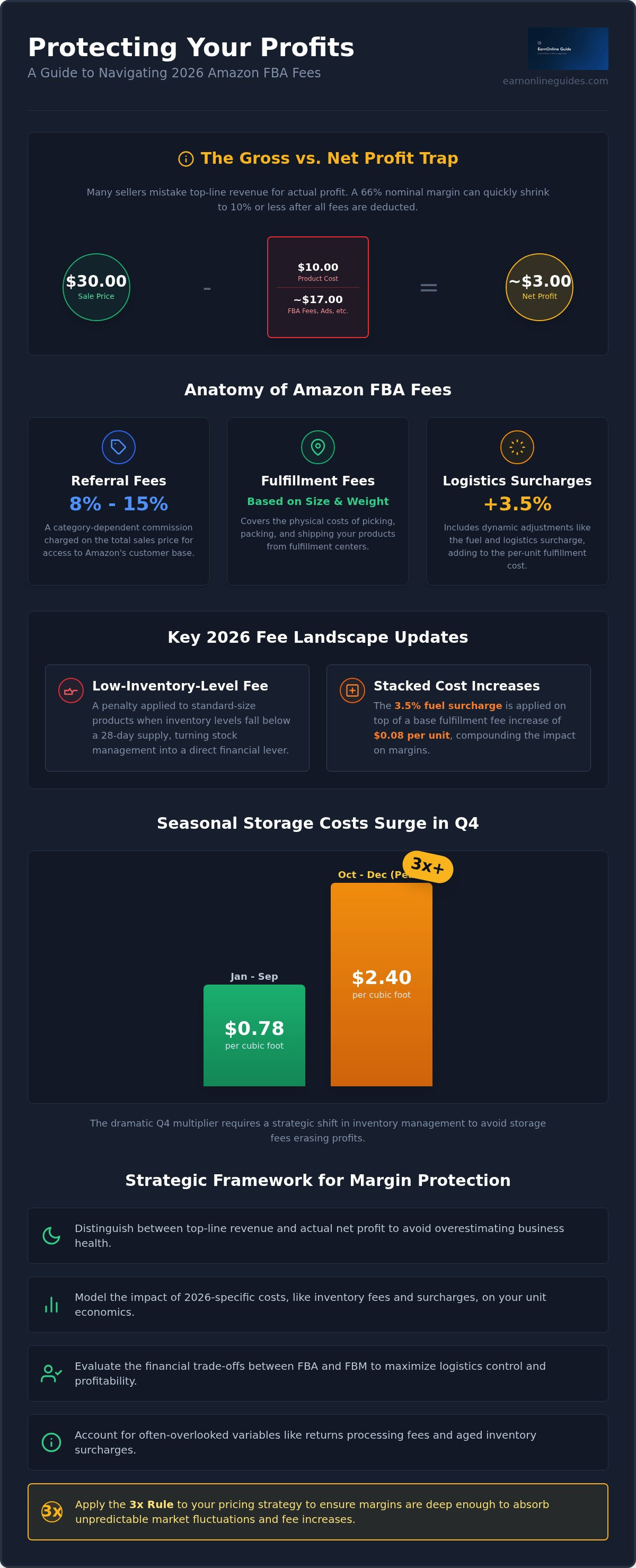
Profitability on the platform is rarely determined by how much you sell, but by how much you keep after the ecosystem takes its share. Many new sellers fall into the "Gross vs. Net" trap, where they mistake top-line revenue for disposable income. If you source a product for $10 and sell it for $30, a superficial glance suggests a nominal 66% margin. However, once you account for inbound shipping, advertising, and the multi-layered fee structure of Fulfillment by Amazon (FBA), that 30% margin often shrinks to a lean 10% or less. This is why a professional amazon fba fee calculator should be viewed as a predictive tool for margin protection rather than a simple accounting utility. It's best used as part of a broader suite of selling fee calculators that analyze the financial viability of your inventory. Before you commit capital to a new SKU, you should validate an online business idea using data-driven modeling to ensure the unit economics are sustainable.
The expense structure of the platform is divided into several primary categories that dictate your final payout. Understanding these is the first step in building a resilient financial model.
Dimensional weight is a pricing method that calculates the volume of a package to determine its shipping tier, which means light but bulky items can be significantly more expensive to ship than small, heavy ones.
Amazon functions as a distribution network, not a long-term warehousing solution. They charge monthly storage fees based on the daily average volume your inventory occupies in their fulfillment centers. For January through September 2026, standard-size products incur a fee of $0.78 per cubic foot, while oversize items are charged $0.56 per cubic foot. These costs represent a ticking clock for your product's profitability. If your inventory turnover rate is slow, the cumulative storage fees will eventually exceed the potential profit from the sale. A precise amazon fba fee calculator strategy allows you to project exactly when a product turns from an asset into a financial liability based on these storage tiers.
The 2026 Amazon fee structure is defined by a shift toward behavior-based penalties and dynamic surcharges. Effective April 17, 2026, a 3.5% fuel and logistics surcharge applies to all U.S. FBA fulfillment fees, adding roughly $0.17 to the cost of an average unit. This surcharge is independent of the base fulfillment fee increase of $0.08 that took effect in January. If you're using an amazon fba fee calculator to project your yearly earnings, you must account for these stacked costs. Reviewing the Online Selling Fee Index 2026 provides a clear view of how these adjustments vary by category. One of the most impactful changes is the low-inventory-level fee, which penalizes sellers who fail to maintain at least 28 days of supply for standard-sized products. This fee turns stock management into a direct financial lever.
To protect your business from these rising costs, follow this fee-proofing checklist:
Storage fees undergo a dramatic transformation during the fourth quarter. From January through September, standard-size storage costs $0.78 per cubic foot; however, this jumps to $2.40 per cubic foot from October through December. This 3x multiplier requires a shift in strategy. You should model Q4 earnings months in advance to ensure that holiday sales velocity justifies the increased holding costs. The Inventory Performance Index (IPI) score determines your storage volume limits, which directly impacts your ability to scale during peak demand periods.
The 2026 Low-Price FBA rate applies to products priced under $10, offering an effective discount of $0.86 per unit compared to standard fulfillment. While this helps preserve margins on low-cost goods, media items still carry unique flat-fee variable closing burdens that can erode profitability. Integrating a Small Business Administration e-commerce strategy can help you balance these platform costs by diversifying your fulfillment approach. Be aware that opting for lower-fee tiers often involves a trade-off with shipping speeds, which may influence your conversion rates on the storefront.
Fulfillment by Merchant (FBM) serves as the necessary control for your profit experiment. It represents the baseline cost of fulfilling an order using your own infrastructure or a third-party logistics provider. While Amazon’s marketing often positions FBA as the default choice for growth, a sober analysis reveals that self-fulfillment can be more sustainable for specific product profiles. To determine which path is viable, you must compare your internal costs for storage, packing materials, and labor against the 2026 FBA rate card. An amazon fba fee calculator is most effective when it's used to contrast these two models side-by-side rather than viewing FBA costs in a vacuum.
Storage costs in Amazon's network are designed for high-velocity turnover, not long-term warehousing. With peak season storage reaching $2.40 per cubic foot in 2026, bulky items can quickly become liabilities. If you have access to personal warehouse space or a 3PL with flat monthly rates, FBM often provides better margin protection for oversized goods. Fragile items also carry a unique risk in the high-speed FBA environment; higher damage rates during automated sorting can lead to increased returns. In 2026, the returns processing fee starts at $1.78 for the smallest items and increases with size. By handling fulfillment personally, you can often reduce these return rates and avoid the per-unit penalty for exceeding return-rate thresholds.
The primary benefit of FBA is the total offloading of customer service and return logistics. This allows you to scale your unit volume without a linear increase in administrative headcount. In the 2026 competitive landscape, the Prime Badge remains a primary driver for Buy Box win rates. You must evaluate whether the projected 20% to 30% sales lift associated with Prime visibility justifies the fulfillment fees and the 3.5% logistics surcharge. If your product is small, light, and has a high sales velocity, FBA’s efficiency is difficult to replicate through FBM. To see how these variables interact across different platforms, you should consult a wider range of selling fee calculators.
A pragmatic choice framework for 2026 follows a simple logic path. If your product is standard-sized, priced under $100, and has a high turnover rate, FBA is likely your most profitable route. If your product is heavy, fragile, or carries a high retail price that can absorb individual shipping costs, FBM provides the control needed to protect your net margins. Using an amazon fba fee calculator to model these "what-if" scenarios ensures your fulfillment strategy is based on data rather than convenience.
Most digital tools provide a static view of the "perfect sale," assuming every unit shipped results in a completed transaction without friction. However, real-world profitability is often eroded by variables that a standard amazon fba fee calculator might omit. To protect your capital, you must account for the "Hidden Three": return processing fees, aged inventory surcharges, and the costs associated with stock removal. These are not edge cases; they are core operational expenses that determine whether a high-revenue SKU is actually generating a net profit. If your modeling doesn't include these friction points, you aren't calculating profit; you're calculating a best-case scenario.
In the 2026 market, return processing fees have become a primary profit-killer. These fees apply to all categories for sellers who exceed their specific category’s return-rate threshold. For apparel and shoes, the fee applies to every single returned unit. As of 2026, these charges start at $1.78 for the smallest items and increase significantly with size and weight. Beyond the direct fee, you must consider the lost original fulfillment cost and the potential for Customer Return Dissatisfaction metrics to degrade your account health. A pragmatic approach involves factoring a 5% to 10% return buffer into your initial margin inputs to simulate a more realistic outcome. This buffer acts as a financial shock absorber for the inevitable percentage of stock that cannot be resold as new.
The Aged Inventory Surcharge, which many veteran sellers still refer to as long-term storage fees, penalizes stock that remains in a fulfillment center for extended periods. This makes your exit strategy just as important as your sourcing strategy. When a product fails to sell at your target margin, you face a choice between paying for removal, disposal, or liquidation. Each of these paths carries a per-unit cost that can quickly turn a break-even product into a net loss. You should model a "break-even liquidation" price before you buy stock, determining the exact point where it's cheaper to sell at a loss than to continue paying storage surcharges. Determining an exit strategy using comparative fee modeling is a requirement for long-term sustainability.
While not technically a platform fee, advertising spend (ACOS) behaves like a variable cost of goods sold and should be treated as a fee-adjacent expense. In a crowded marketplace, the cost to acquire a customer can often exceed the referral fee itself. If your advertising costs aren't integrated into your margin modeling, you risk scaling a business that loses money with every sale. To model these complex trade-offs with professional accuracy, you can utilize our comprehensive selling fee calculators to ensure no variable is left unexamined.
The 3x Rule is a foundational heuristic for anyone using an amazon fba fee calculator to assess a new product. It dictates that your target retail price should be at least three times your landed cost to provide a sufficient buffer for fees, advertising, and operational overhead. If a product’s unit economics don't support this ratio, the margin is likely too thin to survive the fee stacking and surcharges explored in previous sections. Building a "Skeptic’s Budget" for 2026 launches means you don't just calculate for the best-case scenario. You should intentionally model for higher advertising spend and slower inventory turnover. By integrating these reality checks into your amazon fba fee calculator workflow, you move from mere estimation to professional risk management. This process requires verified manufacturer data rather than rough guesses, as even a half-inch discrepancy in packaging can shift a product into a more expensive shipping tier.
Moving from calculation to execution requires a commitment to data integrity. You shouldn't rely on the "estimated" weights provided in a catalog. Instead, use our broader suite of selling fee calculators to model how small changes in sourcing or logistics impact your long-term sustainability. This methodical approach allows you to filter out high-risk products before you commit capital to a production run.
A resilient strategy requires a stress test of your financial assumptions. You should calculate the impact on your net margin if inbound shipping costs were to rise by 20% suddenly. Relying on a single winning SKU is a high-risk 2026 strategy because category-specific fee changes or a sudden drop in Buy Box percentage can destabilize your entire income stream. Instead, use comparative structures to evaluate different product niches, looking for categories with stable referral fees and lower return rates to balance your portfolio. This diversification acts as a protective filter against platform-wide volatility.
Before you finalize your order, you must verify every data point against the current reality of the logistics network. Manufacturer estimates for box dimensions are often inaccurate; always request a sample to measure the exact dimensional weight yourself. This prevents you from being surprised by a higher fulfillment tier once your stock arrives at the warehouse.
Success in 2026 is the result of careful planning and informed decision-making rather than speed or luck. By treating your fee calculations as a live, evolving model rather than a one-time task, you create a grounded path toward a sustainable online business.
Mastering the Amazon ecosystem requires moving past the mindset that top-line revenue equals business health. Net profitability is a result of managing stacked variables, from the 3.5% logistics surcharge to the $2.40 peak storage rates. Success depends on your ability to treat these costs as manageable data points rather than unavoidable surprises. By applying the 3x rule and maintaining a Skeptic’s Budget for new launches, you create a protective buffer for your capital.
A reliable amazon fba fee calculator is your primary tool for this verification process. It allows you to stress-test your margins against volatility before you commit to a production run. While current market conditions are demanding, they reward sellers who prioritize data integrity and long-term sustainability over immediate gratification. This grounded approach turns platform fees from a source of fear into a predictable operational expense.
We invite you to Model your real profit with our Selling Fee Calculators. Our resources provide an independent, data-driven analysis structured for the 2026 market, intentionally free from get-rich-quick hype. With the right modeling in place, you can navigate these complexities with professional clarity and build a resilient online business.
Amazon typically updates its base fulfillment rates annually, often announcing changes in the fourth quarter for the following year. However, surcharges like the 3.5% fuel and logistics fee introduced in April 2026 or seasonal peak storage adjustments can occur throughout the year. Sellers should monitor their Seller Central notifications monthly to account for these dynamic shifts in their margin models and ensure their pricing remains sustainable.
Most versions of the amazon fba fee calculator are marketplace-specific and designed for the national US market. If you are selling in the UK, Germany, or Japan, you must use the calculator dedicated to that specific region because referral percentages and fulfillment tiers vary significantly by country. Using US-based data for international logistics will result in inaccurate margin projections and potential financial losses for your business.
A referral fee is a commission paid to Amazon for every item sold, typically ranging from 8% to 15% depending on the product category. In contrast, a fulfillment fee covers the physical costs of picking, packing, and shipping the item to the customer. While the referral fee is a percentage of the sales price, the fulfillment fee is determined strictly by the unit's physical weight and dimensions.
You can mitigate high Amazon storage costs by utilizing a third-party logistics (3PL) provider to hold the bulk of your inventory. This allows you to drip-feed stock into Amazon's fulfillment centers, maintaining the Prime badge while avoiding the $2.40 per cubic foot peak storage rates. However, you must calculate the additional shipping costs from the 3PL to Amazon to ensure the total logistics strategy remains net-profitable.
Standard versions of the amazon fba fee calculator typically don't include variable costs like Sponsored Products or Sponsored Brands advertising. Since advertising spend (ACOS) acts as a fee-adjacent expense that directly impacts your net margin, you must manually subtract these costs from your final profit estimate. Professional sellers often use a 10% to 15% buffer for customer acquisition when modeling the viability of new product launches.
If Amazon misclassifies your product’s dimensions, you'll be overcharged for every unit sold until the error is corrected. You should audit your Fee Preview report monthly and request a re-measurement if you notice discrepancies between your manufacturer specs and Amazon's data. Amazon typically allows up to two re-measurement requests per SKU per year to ensure that fulfillment fees align accurately with the actual package size.
Profitability for low-margin items in 2026 requires high sales velocity and strict adherence to the Low-Price FBA program. For products priced under $10, Amazon offers an effective discount of $0.86 per unit compared to standard fulfillment rates. However, if your returns exceed category thresholds or if you incur low-inventory-level fees, these small margins can vanish entirely. Success in this tier depends on precise unit economic modeling.
Landed cost is calculated by summing the total manufacturing price, international freight, customs duties, and third-party inspection fees. You then divide this total by the number of sellable units in your shipment. This figure serves as the foundation for your profit calculations; without an accurate landed cost, any output from a fee calculator will be fundamentally flawed and could lead to poor inventory investment decisions.

Article by
EarnOnlineGuides Editorial Team
The EarnOnlineGuides Editorial Team creates practical, research-driven educational content about making money online, remote work, freelancing, side hustles, digital skills, AI tools, online business, and self-employment. Our goal is to help readers understand their options, compare realistic opportunities, avoid misleading claims, and make better-informed decisions. We prioritize accuracy, transparency, practical guidance, and responsible reporting, and we regularly review our content to keep it useful and up to date.
The information provided in this article is for general educational and informational purposes only and should not be considered financial, investment, tax, legal, or professional advice. Earnings, income examples, costs, fees, and other figures may vary and are not guaranteed. Always conduct your own research and consult a qualified professional when appropriate.
Some articles on EarnOnlineGuides may contain affiliate links. If you click a link and make a purchase or sign up for a service, we may receive a commission at no additional cost to you. This does not influence our editorial standards or recommendations.
We strive to keep our information accurate and up to date, but products, services, fees, policies, laws, and market conditions can change. Please verify important information directly with the relevant provider before making financial or business decisions.
Educational information only. This article is not financial, tax, or legal advice. Platform fees and policies change; always confirm current rates in the marketplace's official fee documentation before making decisions.
Explore low cost digital side hustles you can test in 2026. Compare freelance work, digital goods, and reselling while managing hidden platform fees and time.

Learn how to open a freelance business bank account step by step. Explore document checklists, compare bank options, and keep business finances organized.

Learn how to write affiliate product reviews readers can trust. Discover a practical process for honest testing, balanced pros and cons, and clear disclosures.