
Low-Cost Digital Side Hustles: Practical Ways to Start in 2026
Explore low cost digital side hustles you can test in 2026. Compare freelance work, digital goods, and reselling while managing hidden platform fees and time.
October 13, 202618 min read

A sustainable freelance rate is a mathematical requirement, not a market negotiation. Many independent professionals treat their pricing as a flexible response to client budgets, but this approach often leads to a breakeven point that fails to account for the reality of self-employment. Without a structured freelance rate calculator approach, it's easy to fall into a cycle of undercharging that leads directly to burnout.
You've likely felt the anxiety of working full-time hours only to realize that your net take-home pay is lower than a comparable salary. This is often a reality check for those who overlook the 2026 self-employment tax rate of 15.3 percent or the Social Security wage base rising to $184,500. Guessing at your numbers is no longer a viable strategy when your margin for error is compressed by rising overhead and non-billable obligations.
This guide provides the exact framework needed to set rates that cover your obligations while funding your desired lifestyle. We'll examine the specific components of tax allocations, the cost of benefits, and the essential profit margins required for long-term sustainability. By the end, you'll have a clear path to defending your rates with evidence-based confidence.
A freelance rate is the gross income per billable hour required to sustain both a business and a personal life. It's a foundational concept for understanding what a freelancer is in a modern economic sense. Many professionals fall into the 'Market Rate Trap' by setting prices based solely on what their peers charge. This often leads to financial insolvency because peer averages don't account for your specific overhead, local tax rates, or retirement goals. If your business model is built on someone else's cost of living, you're likely ignoring the gaps in your own budget.
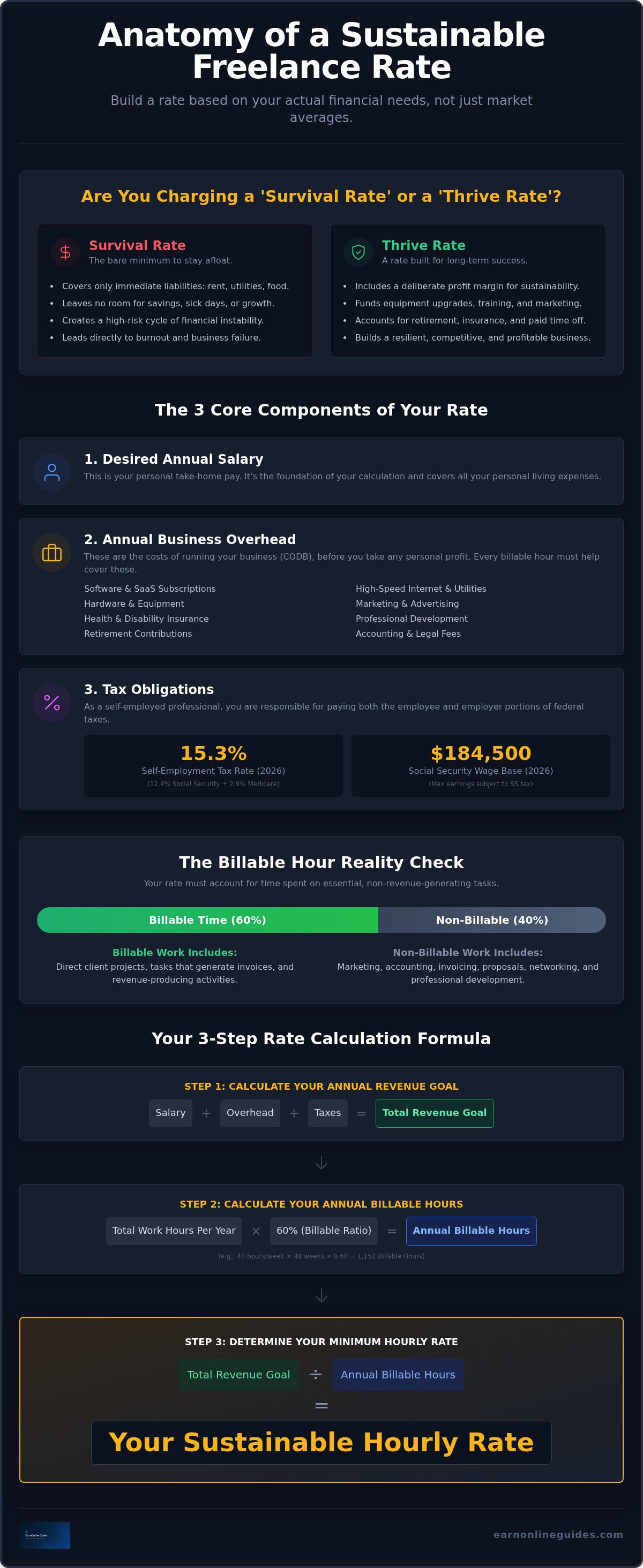
In the 2026 economy, the distinction between a 'Survival Rate' and a 'Thrive Rate' is critical. A Survival Rate covers only your immediate liabilities, such as rent, basic utilities, and food. A Thrive Rate includes a deliberate profit margin for equipment upgrades, periods of illness, and long-term savings. With 72.9 million workers now in the U.S. freelance pool, the market is increasingly crowded. Precision in your freelance rate calculator methodology is the only way to remain competitive without sacrificing your personal solvency.
Your hourly rate is not your take-home pay. It's a gross revenue figure from which multiple 'hidden' costs are deducted. These include software subscriptions, hardware depreciation, and health insurance premiums. You should view your freelance operation as a corporate entity. This means separating your personal salary from the business's gross revenue. If you don't account for the 15.3 percent self-employment tax and non-billable administrative time, your actual profit margin may be dangerously thin. A successful freelancer understands that every billable hour must also fund the hours spent on accounting, marketing, and professional development.
Crowdsourced data from major platforms provides a baseline, but it's often a race to the bottom. These tools show what clients are willing to pay, not what you need to earn. For specialized niche roles, marketplace averages are frequently inaccurate. You can reference Remote Work Statistics to see how 2026 salary expectations have shifted across various sectors. While these benchmarks are useful for context, they cannot replace a personalized freelance rate calculator. Your specific financial requirements must dictate your final number. Relying on an average from a designer in a different tax bracket or cost-of-living area is a recipe for a cash flow crisis.
A sustainable freelance rate is built on three pillars: personal cost of living, business overhead, and tax liabilities. If you neglect any of these factors, your business is essentially subsidizing your clients' projects. Professionals often find AIGA's guide to calculating your freelance rate helpful for establishing a baseline for these mathematical inputs. In 2026, the self-employment tax rate is 15.3 percent, which consists of 12.4 percent for Social Security and 2.9 percent for Medicare. You must also account for the Social Security wage base, which applies to the first $184,500 of net earnings this year. Failing to reserve these funds monthly creates a significant financial liability that can compromise your long-term stability.
Your overhead includes every expense required to maintain operations. In 2026, the cost of Software-as-a-Service (SaaS) and AI tool integration has increased due to inflationary pressures on digital infrastructure. Beyond subscriptions, you must calculate the cost of health and disability insurance, alongside retirement contributions to a SEP IRA or Solo 401k. While the home office deduction is a useful tax strategy, it often fails to cover the actual rise in utility and high-speed internet costs. Aggregating these figures reveals your true Cost of Doing Business (CODB), which must be cleared before you earn a single dollar of personal profit.
There is a significant difference between work hours and billable hours. Non-billable time includes marketing, invoicing, and continuous learning. A reliable 60/40 rule of thumb suggests that only 60 percent of your time will generate direct revenue. To adjust for this, you need to determine your 'Efficiency Factor' by dividing your total financial need by your actual billable capacity. This ensures your active projects fund the administrative labor required to keep your business running. For a more granular breakdown of these pricing strategies, you can explore our detailed methodology on how to price freelance work.
If you're struggling to visualize how these pillars interact, using a freelance rate calculator can help you determine the exact breakeven point for your specific situation.
Establishing a gross hourly requirement is only the first stage of financial planning. How you apply that number to your billing structure determines your actual profit and long-term sustainability. Hourly billing remains the standard for tasks with unpredictable timelines, such as consulting or technical debugging. It provides a safety net for beginners who are still gauging their production speed. For experienced professionals, however, hourly rates can become a penalty for efficiency. If you work twice as fast as your peers, an hourly model effectively cuts your pay in half.
Project-based fees reward your speed and specialized knowledge. To make this model sustainable, you must include a 'Risk Premium'. This is an additional buffer, often between 15 and 25 percent, that accounts for potential scope creep or unforeseen technical hurdles. You should use a freelance rate calculator to normalize these fees before signing a contract. By dividing the total project price by your estimated hours, you can verify if the flat fee meets the "Thrive Rate" established earlier in this guide. This conversion is essential for maintaining a consistent margin across different clients.
The integration of generative tools has fundamentally decoupled labor time from final output. Research indicates a 109 percent increase in demand for AI-related skills in 2026, which gives freelancers significant pricing leverage. If an AI-augmented workflow allows you to complete a deliverable in three hours that previously required twelve, an hourly model is no longer logical. You are selling a business outcome, not a block of your schedule. Selling time in an automated economy is a path to diminishing returns.
Mastering the best AI skills to learn 2026 allows you to move toward value-based billing. Consider a scenario where a client receives a high-impact campaign. A $2,000 flat fee for five hours of work yields an effective hourly rate of $400. This is far more profitable than a $75 hourly contract for the same deliverable. Using a freelance rate calculator to audit these outcomes helps you identify which projects are truly profitable. This model protects your margins and ensures that your investment in new technology results in higher earnings rather than just shorter workdays.
Performing a rigorous audit of your financial requirements is the only way to move from guesswork to a data-backed number. This process requires a shift in perspective; you're no longer just an individual worker, but a business owner managing a revenue target. To find your required hourly rate, follow these five steps in sequence.
This calculation provides your minimum viable hourly rate. If your current rates fall below this number, your business is technically operating at a loss, even if your bank balance appears positive in the short term.
Your personal breakeven point is the absolute minimum you need to cover non-negotiable living expenses. For remote workers in 2026, this must account for rising costs in major remote work hubs where energy and housing prices have fluctuated. You can use our 1099 vs W2 tool to find your parity salary. This comparison ensures that your freelance income actually matches the purchasing power of a corporate salary after accounting for employer-paid benefits and payroll tax contributions.
A common mistake is failing to price in the hidden cost of paid time off (PTO) and sick days. As a freelancer, you don't have a safety net provided by an HR department. Every day you don't work is a day without revenue. Additionally, you must fund your own healthcare and retirement. We recommend adding a 10 to 15 percent 'Profit Buffer' to your final calculation. This buffer isn't for personal spending; it's for business reinvestment, hardware upgrades, and professional development.
If you're ready to establish a sustainable pricing structure, use our freelance rate calculator to generate an accurate number based on your specific 2026 data.
Communicating a rate increase to existing clients requires a sober, evidence-based approach. Instead of focusing on personal needs, frame the adjustment around the increased value of your services and the rising costs of the technical infrastructure required to deliver them. Providing a 30 to 60-day notice period demonstrates professional courtesy and allows clients to adjust their budgets accordingly. Most clients value reliability over the lowest possible price, and a transparent explanation of your sustainability model often builds further trust.
For new business, use a tiered pricing strategy. This involves anchoring your highest rate for new inquiries while gradually moving existing clients toward that benchmark. This approach protects your cash flow during the transition. In 2026, the market favors the 'Specialized Generalist'. These are professionals who possess deep expertise in a niche but can also manage the broader AI-augmented workflow. This versatility increases your pricing power because you reduce the client's need for multiple specialized contractors. You aren't just selling a skill; you're selling the efficiency of a streamlined process.
Financial planning isn't a one-time event. You should audit your rates every six months to account for shifts in inflation and tool costs. Using the EarnOnlineGuides Freelance Rate Calculator for recurring audits ensures your numbers remain grounded in current data. Use the self employment tax calculator for quarterly planning to avoid surprises during tax season. It's also vital to track your 'Realized Hourly Rate' versus your 'Quoted Hourly Rate'. If a project quoted at a specific hourly rate takes longer than expected, your realized rate drops. Regular audits help you identify which types of work are eroding your margins and which are most profitable.
Building a consistent pipeline is the best way to support higher rates. You can explore the Remote Job Directory 2026 to find opportunities that value high-level expertise. If your current market doesn't support your calculated needs, you may need to develop new digital skills for beginners to move up the value chain. Here is a final reality check: if your math indicates a $100 hourly requirement but your market only pays $40, the solution isn't to lower your needs. It's a signal to pivot your skills or target a different client demographic. Use the freelance rate calculator as a compass to guide these strategic pivots toward long-term profitability.
A sustainable freelance career is built on the reality of your numbers rather than the optimism of your estimates. Protecting your margins requires a disciplined approach to managing the liabilities and overhead identified throughout this guide. By shifting from market-driven pricing to a personal mathematical formula, you ensure that every billable hour contributes to a viable business model instead of just covering immediate expenses. This transition is essential for maintaining professional autonomy in an increasingly automated economy.
Success depends on your ability to audit your income needs regularly and adjust your strategy as your skills evolve. We provide the resources to make this transition manageable and data-driven. Use the EarnOnlineGuides Freelance Rate Calculator to find your target 2026 income. Our platform features a vetted 1099 vs W-2 Breakeven Tool and a methodology tailored for the current remote work landscape. You can also utilize our Remote Job Directory to find opportunities that align with your updated pricing structure. Taking control of your financial data is the first step toward a more resilient and predictable professional future. You have the framework; now it's time to apply it.
You should audit your rates every six months to remain resilient against inflationary pressures. In 2026, the cost of digital infrastructure and specialized software fluctuates more frequently than in previous years. If you acquire high-demand skills, such as AI integration or advanced data analysis, an immediate rate adjustment is justified. Regular reviews ensure your gross income continues to support your desired net income after all operational costs are subtracted.
A comprehensive freelance rate calculator must prioritize the 15.3 percent self-employment tax. This rate covers your Social Security and Medicare obligations, which are typically split between employer and employee in a W-2 role. For 2026, you must also consider the Social Security wage base of $184,500. If your earnings exceed this threshold, the Social Security portion of the tax no longer applies, which significantly alters your net margin calculations.
A sustainable profit margin for most solo professionals ranges between 10 and 20 percent above your personal salary and business overhead. This buffer isn't for discretionary spending; it serves as a capital reserve for hardware cycles, periods of illness, and professional development. Maintaining this margin ensures your business can survive a temporary loss of clients or an unexpected increase in the cost of doing business without compromising your personal financial stability.
You should quote your rates in U.S. Dollars whenever possible to maintain the integrity of your calculated margins. If a client requires billing in their local currency, you must factor in a 1 to 3 percent buffer to account for exchange rate volatility and platform conversion fees. This protective margin ensures that the final amount deposited into your account doesn't fall below the breakeven point established by your freelance rate calculator.
You can use a calculator to normalize project-based fees by converting them into an effective hourly rate. Divide the total project price by your estimated hours to see if it clears your "Thrive Rate" threshold. If a flat fee results in an hourly return that is lower than your requirement, you must either increase the price or reduce the scope. This methodology prevents you from accepting high-effort projects that offer low financial returns.
The most common errors include ignoring non-billable administrative time and failing to account for the 15.3 percent self-employment tax. Many freelancers also fall into the trap of charging "market rates" without auditing their own specific cost of living. If you don't factor in the 40 percent of your time spent on marketing and invoicing, your actual take-home pay will be significantly lower than your quoted hourly rate suggests.
Lowering your rate to secure initial reviews is a high-risk strategy that often attracts low-quality clients. Instead of competing on price, focus on demonstrating specialized expertise in a niche sector. Businesses on platforms like Upwork are increasingly looking for specialized talent rather than general labor. Setting a sustainable rate from the start establishes professional authority and ensures you aren't trapped in a cycle of low-paying contracts that lead to burnout.
You should aggregate your total annual software and AI subscription costs as part of your business overhead. Divide this total figure by your annual billable hours to determine how much each hour of work must contribute to these expenses. In 2026, as AI tools become central to the freelance workflow, these costs should be viewed as essential infrastructure rather than optional extras. This ensures your technology investment doesn't erode your personal profit.

Article by
EarnOnlineGuides Editorial Team
The EarnOnlineGuides Editorial Team creates practical, research-driven educational content about making money online, remote work, freelancing, side hustles, digital skills, AI tools, online business, and self-employment. Our goal is to help readers understand their options, compare realistic opportunities, avoid misleading claims, and make better-informed decisions. We prioritize accuracy, transparency, practical guidance, and responsible reporting, and we regularly review our content to keep it useful and up to date.
The information provided in this article is for general educational and informational purposes only and should not be considered financial, investment, tax, legal, or professional advice. Earnings, income examples, costs, fees, and other figures may vary and are not guaranteed. Always conduct your own research and consult a qualified professional when appropriate.
Some articles on EarnOnlineGuides may contain affiliate links. If you click a link and make a purchase or sign up for a service, we may receive a commission at no additional cost to you. This does not influence our editorial standards or recommendations.
We strive to keep our information accurate and up to date, but products, services, fees, policies, laws, and market conditions can change. Please verify important information directly with the relevant provider before making financial or business decisions.
Educational information only. This article is not financial, tax, or legal advice. Platform fees and policies change; always confirm current rates in the marketplace's official fee documentation before making decisions.
Explore low cost digital side hustles you can test in 2026. Compare freelance work, digital goods, and reselling while managing hidden platform fees and time.

Learn how to open a freelance business bank account step by step. Explore document checklists, compare bank options, and keep business finances organized.

Learn how to write affiliate product reviews readers can trust. Discover a practical process for honest testing, balanced pros and cons, and clear disclosures.