
Low-Cost Digital Side Hustles: Practical Ways to Start in 2026
Explore low cost digital side hustles you can test in 2026. Compare freelance work, digital goods, and reselling while managing hidden platform fees and time.
October 13, 202618 min read

Most beginners believe that joining the largest marketplace is the fastest route to a paycheck, but the data suggests that high-volume platforms often function as low-pay traps for those without an established reputation. Identifying the best freelance websites for beginners in 2026 requires looking past marketing hype and analyzing actual barrier-to-entry and fee structures. It's exhausting to spend hours crafting proposals only to be undercut by automated bidding bots or buried under thousands of competing applications. You're likely concerned that hidden service fees and high competition will eat your margins before you've even earned a profit.
This guide provides a pragmatic, evidence-based evaluation of current platforms to help you secure your first legitimate contract without falling for common scams. We focus on long-term sustainability rather than immediate, low-value wins. If you choose a platform based on your specific skill set rather than general popularity, your chances of landing a contract increase significantly. You'll learn how to match your skills to the right ecosystem, understand the true cost of platform commissions, and follow a clear pathway to move from a new profile to your first paid gig. This research-driven approach identifies which marketplaces offer the highest probability of success for those starting with a limited portfolio.
The freelance market in 2026 is fundamentally different from the landscape of even a few years ago. AI-augmented workflows have automated many routine tasks, which has simultaneously lowered the barrier to entry for some while increasing competition for others. For those researching the best freelance websites for beginners, the primary challenge is no longer just finding a platform. It's identifying an environment where volume doesn't mask low-quality opportunities. Understanding the definition of freelance work is essential because it frames your activity as a business rather than a hobby. This guide provides a pragmatic evaluation of current platforms based on verified data and realistic outcomes.
The "Beginner Trap" is a common phenomenon where new entrants flock to the largest marketplaces, assuming high traffic equals high opportunity. However, these platforms are often saturated with bidding bots and established accounts that are difficult to outrank. To achieve stability, you must embrace platform diversification. Relying on a single source of leads is a high-risk strategy that leaves you vulnerable to algorithmic shifts. Successful beginners in 2026 use a combination of general and niche sites to build their initial reputation while protecting their income from single-platform dependency.
Upwork, Fiverr, and Freelancer.com have largely transitioned into pay-to-play ecosystems. On Upwork, the rising cost of "Connects" creates a tangible financial hurdle for those who haven't yet earned their first dollar. Fiverr has adjusted its ranking systems to prioritize sellers who have already achieved high-tier status, which can leave new profiles in a visibility vacuum. These platforms are still functional, but they require a calculated approach to bidding and profile optimization. Using specialized fee calculators can act as a necessary pre-flight check to determine if a platform's commission structure is actually sustainable for your business model. If your bidding budget isn't managed properly, the expense of finding work can quickly erode your actual profits.
Curated marketplaces are becoming the preferred starting point for specialists. Unlike open marketplaces that allow anyone to join, vetted platforms require an initial screening process. This barrier actually works in your favor by reducing the sheer number of competitors you face for every job post. Specialized sites for writers, designers, or developers often command higher margins because the clients on these platforms are looking for specific expertise rather than the lowest price. You can use digital skills learning paths to determine which specialized marketplace aligns with your current technical proficiency. Choosing a curated environment allows you to bypass the "race to the bottom" pricing often found on generalist sites.
Evaluating the best freelance websites for beginners requires a focus on four specific pillars. First, fee transparency is critical. You need to know how much of your gross earnings actually reach your bank account. Many platforms use a sliding scale, charging 20% on the first $500 earned with a client before dropping to 10% or 5%. This Bureau of Labor Statistics analysis of gig work highlights how platform structures can impact long-term earnings. Second, consider the barrier to entry. Some sites allow an immediate start with just an email, while others require a rigorous portfolio review. Third, payment protection via escrow or milestones is a non-negotiable safety feature. Finally, assess the quality of leads. High-intent clients value quality over cost, whereas price-shoppers will always choose the lowest bidder regardless of skill.
Platform commissions are only the first layer of your expenses. If you earn $100 and the site takes $20, you aren't actually keeping $80. As an independent contractor, you're responsible for both the employer and employee portions of Social Security and Medicare. This often comes as a surprise for those transitioning from traditional employment. You should use a self-employment tax calculator to see your true net income. Understanding these numbers early prevents financial burnout and helps you set realistic income targets.
Legitimate platforms enforce strict communication rules for a reason. A major red flag in 2026 is a client asking to move to an encrypted messaging app before a contract has officially started. This usually precedes a request for "security deposits" or off-platform payments that offer no protection. You should also be wary of "test" work that isn't paid; professional clients expect to pay for a freelancer's time. For a deeper look at these risks, read our guide on how to spot fake remote job listings. Staying within the platform's ecosystem ensures you have a paper trail for dispute resolution. If you aren't sure how to price your services to cover these risks, check out our freelance rate calculator to set a sustainable floor for your bids.
Selecting the best freelance websites for beginners in 2026 requires a shift from browsing massive, unvetted lists to targeting specific entry points that match your current skill level. While many sources suggest joining dozens of sites simultaneously, a focused approach on a few high-probability platforms typically yields better results. As you begin earning, it's vital to follow the IRS Gig Economy Tax Center guidelines to manage your new federal obligations, estimated payments, and recordkeeping requirements correctly from day one.
Upwork remains the industry heavyweight, but success now depends on a strategic "niche-down" approach rather than being a generalist. The platform's bid-based model means you must be selective about the projects you pursue. Before you start spending money on Connects, use a freelance rate calculator to determine if a project's pay realistically covers your operational costs and bidding expenses. If the numbers don't work, the project isn't worth the bid.
Fiverr operates on a search-based model where clients find your "productized" services. It's often the better choice for beginners who have a clearly defined deliverable, such as a specific type of logo or a 500-word blog post. The strategy here is to offer a low-friction entry point to build your rating, then use tiered packages to upsell clients to higher-value work. PeoplePerHour provides a balanced alternative to these two, offering a smaller ecosystem with lower competition in specific regions, particularly for administrative and technical support roles.
FlexJobs is a unique option because it requires a subscription fee. This might seem counterintuitive for a beginner, but the site's manual vetting process eliminates the scams and low-pay traps found on open boards. It's a pragmatic investment for those who want to skip the "race to the bottom" pricing. Contra is an emerging favorite due to its commission-free model for freelancers. While they don't take a cut of your earnings, they often monetize through premium profile features, so you should still monitor your total business expenses.
For specialized paths, ProBlogger remains the gold standard for writers, while SolidGigs acts as a lead-generation service that delivers vetted jobs directly to your inbox. This "lead-gen" approach is ideal if you prefer to spend your time working rather than browsing job boards for hours. Finally, EarnOnlineGuides serves as an essential resource in this landscape. While not a marketplace, it provides the "pre-flight" vetting tools and income calculators necessary to navigate these platforms safely. Using these data-backed tools ensures you don't underprice your labor or overlook hidden platform costs when starting your career.
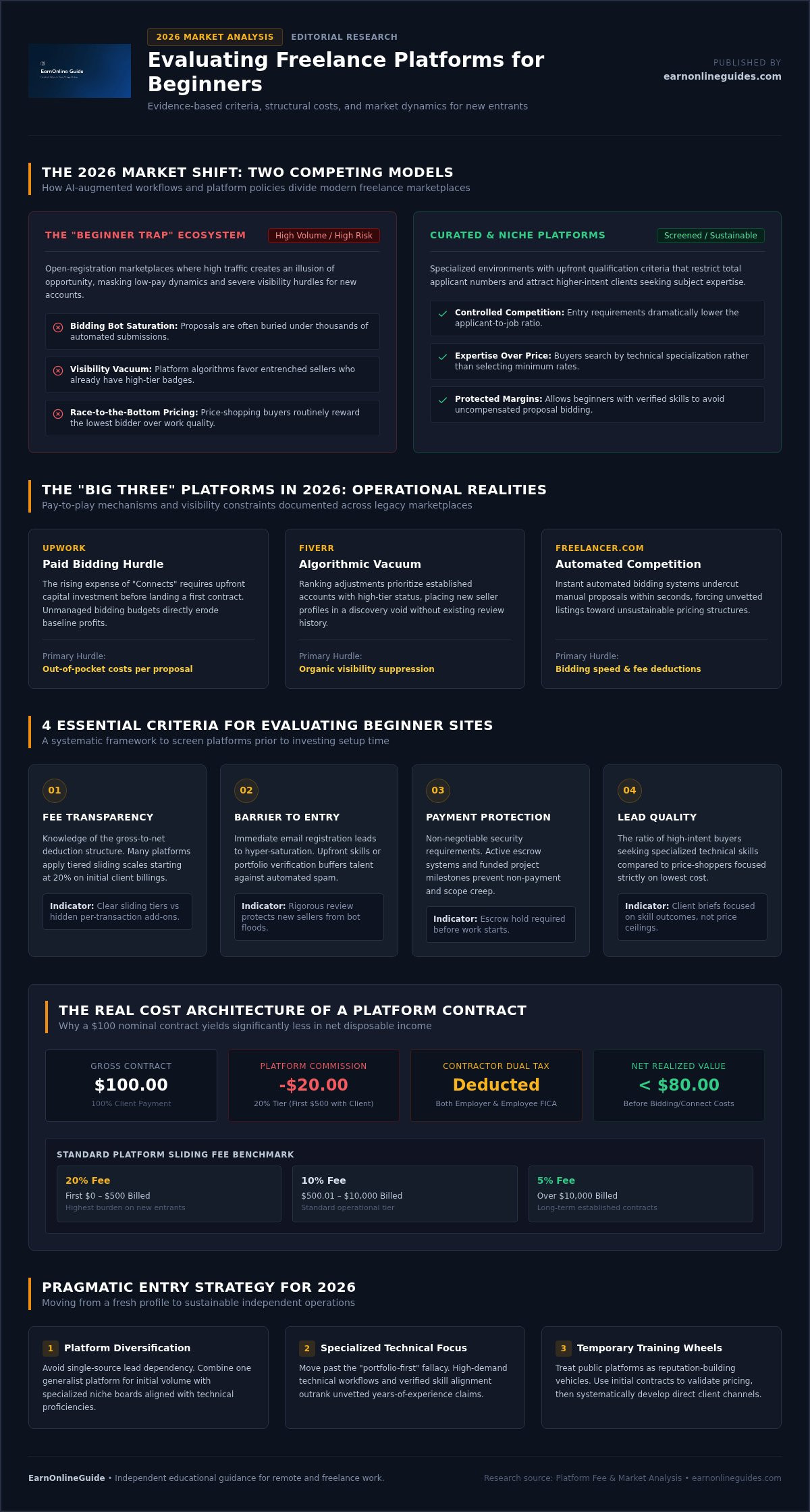
Many beginners assume the only way to compete on the best freelance websites for beginners is to offer the lowest price. This strategy is fundamentally flawed because it attracts low-quality clients and leads to rapid burnout. To bypass this "race to the bottom," you must shift your focus from general availability to specific problem-solving. Success in 2026 relies on your ability to differentiate yourself from the millions of other users through precise positioning and a realistic understanding of market dynamics.
The "Portfolio-First" fallacy often prevents capable individuals from starting. You don't need ten years of experience or a massive body of work to look professional. In the current market, clients value a demonstration of current capability over historical longevity. Three high-quality, relevant samples that solve a specific problem are more effective than twenty generic ones. Specialization remains the most reliable path to higher margins. A "Virtual Assistant" is seen as a commodity, whereas an "E-commerce Operations Specialist" is viewed as a strategic asset. In 2026, micro-niches such as AI-assisted content auditing allow beginners to enter the market with a competitive edge by leveraging tools that established professionals might be slow to adopt.
Establishing a sustainable timeline is essential for long-term growth. Stabilizing your business doesn't happen overnight; it follows a predictable progression:
Shift the focus of your profile from your interests to client outcomes. Clients don't hire based on your hobbies; they hire to solve a business pain point. Your bio should explicitly state the value you provide and the results you've achieved, even if those results came from personal projects. You can use the best AI writing tools for freelancers to audit your profile for clarity and impact. To build social proof without gaming the system, offer a slightly lower introductory rate for your first few projects in exchange for a detailed, honest review upon successful completion.
Profitability requires a strict calculation of your Minimum Acceptable Rate (MAR). This number must account for unbillable time spent on marketing, administration, and platform browsing. If you spend 25% of your week looking for work, your billable hours must carry that weight. We recommend using our realistic income model to determine your actual take-home pay after platform fees and taxes are deducted. You should never guess your rates; instead, use data to ensure your business remains solvent. Before you submit your next proposal, use our freelance rate calculator to establish your pricing floor.
While identifying the best freelance websites for beginners is a necessary first step, you shouldn't view these marketplaces as a permanent home. They function as training wheels for your business. They provide a structured environment with built-in payment protection and a steady stream of leads, but they also charge significant commissions. A sustainable career requires a transition toward direct client acquisition. This shift allows you to reclaim the revenue usually lost to platform fees and gives you full control over your client relationships.
Diversifying your presence beyond a single marketplace is a requirement for long-term security. If a platform changes its algorithm or suspends your account, your income shouldn't drop to zero. You must build an off-platform presence through a professional LinkedIn profile and a dedicated personal website. These assets serve as your independent storefront. They allow you to showcase your expertise without the distraction of nearby competitor profiles and bidding wars. Direct clients often provide higher margins and more stable, long-term contracts compared to the gig-based nature of open marketplaces.
As you move away from platform-managed workflows, you'll need to implement your own tech stack. This includes tools for professional invoicing, accurate time tracking, and basic customer relationship management (CRM). You should prioritize tracking your net profit rather than just gross revenue. Understanding the difference between what you bill and what you keep is the hallmark of a professional. You can explore digital skills for beginners to learn how to integrate these administrative tools into your daily workflow without overcomplicating your operations.
Moving from research to action requires a structured approach. Follow this 3-step plan over the next 48 hours to launch your business:
Before you commit to this path full-time, use the 1099 vs W2 tool to understand the true cost of self-employment compared to traditional employment. For a comprehensive roadmap, refer to our guide on how beginners start freelancing online. Treating your first bid as a business transaction rather than a casual experiment is the most effective way to ensure long-term sustainability.
Identifying the best freelance websites for beginners is the first step in a career that requires constant verification and data-backed decision-making. Success in the 2026 market doesn't come from following "get-rich-quick" hype but from choosing platforms that align with your specific technical skills and margin requirements. You've learned that generalist marketplaces are valuable visibility tools, but they shouldn't be your only strategy for long-term sustainability.
Every recommendation in this guide has been vetted by the EarnOnlineGuides Research Team and updated with current 2026 platform fee data to ensure accuracy. Protecting your profit margins from hidden costs and self-employment taxes is what separates a professional business from a series of casual gigs. Identifying the right ecosystem early allows you to build a reputation that serves as a launchpad for direct client acquisition later.
Before you submit your next proposal, calculate your target freelance rate with our 2026 Margin Protector. This tool provides a necessary reality check to ensure your bids cover your operational costs and tax obligations. By prioritizing sustainability over immediate gratification, you're building a foundation that can survive algorithmic shifts. Your path to professional independence is achievable through deliberate planning and informed choices.
Fiverr is often considered one of the best freelance websites for beginners because it allows you to "productize" a specific service. Unlike bid-based sites, you define exactly what you'll deliver for a set price. This structure removes the stress of competing against high-volume bidders in open job posts. Beginners can start with small, low-risk tasks to establish the initial social proof needed for more complex and higher-paying projects in the future.
Most of the best freelance websites for beginners remain free to join, but they often monetize through internal credits or service fees. For example, Upwork requires "Connects" to submit proposals, which essentially creates a pay-to-play model for active bidding. Some niche platforms like FlexJobs charge a subscription fee to access a manually vetted directory. You should always calculate these overhead costs and platform commissions before committing to a specific platform's ecosystem to ensure profitability.
Initial earnings typically range from $15 to $30 per hour depending on the technical complexity of the niche. While some marketing materials suggest immediate high income, the reality is that your first few months will focus on building a reputation rather than maximizing profit. Once you have five to ten positive reviews, you can realistically transition to higher-margin contracts. Using a rate calculator helps you ensure that your bids cover both your labor and platform commissions properly.
Major platforms are generally safe if you follow their communication and payment protocols strictly. Scams usually occur when a client attempts to move the conversation to an encrypted messaging app or asks for a "security deposit." Legitimate clients will never ask you to pay them for the privilege of working. Staying within the platform's escrow system provides a layer of protection that ensures you're paid for the specific milestones you successfully complete for the client.
You don't need a formal college degree to secure work on most freelance marketplaces. Clients in 2026 prioritize verified skills and relevant work samples over academic credentials. If you can demonstrate your ability to solve a specific problem through a small portfolio or a technical test, you can compete effectively with degree holders. Success is based on your ability to deliver measurable results and maintain professional communication throughout the project lifecycle rather than your educational history.
High-demand skills in 2026 include AI-assisted content auditing, e-commerce operations, and technical SEO support. These roles are less likely to be fully automated and require a human-in-the-loop for quality control. Beginners should focus on specialized micro-niches rather than generalist categories like "Virtual Assistant" to command higher rates. Learning these specific digital skills through structured paths allows you to enter the market with a competitive edge that justifies a professional fee from your first contract.
As an independent contractor, you're responsible for paying self-employment tax, which covers both the employer and employee portions of Social Security and Medicare. It's essential to set aside roughly 25 to 30 percent of your gross earnings to cover these federal obligations. You should track your income and expenses meticulously from your first paycheck. Using a specialized 1099 tax calculator can provide a clear estimate of your quarterly payments and prevent unexpected financial burdens at year-end.

Article by
EarnOnlineGuides Editorial Team
The EarnOnlineGuides Editorial Team creates practical, research-driven educational content about making money online, remote work, freelancing, side hustles, digital skills, AI tools, online business, and self-employment. Our goal is to help readers understand their options, compare realistic opportunities, avoid misleading claims, and make better-informed decisions. We prioritize accuracy, transparency, practical guidance, and responsible reporting, and we regularly review our content to keep it useful and up to date.
The information provided in this article is for general educational and informational purposes only and should not be considered financial, investment, tax, legal, or professional advice. Earnings, income examples, costs, fees, and other figures may vary and are not guaranteed. Always conduct your own research and consult a qualified professional when appropriate.
Some articles on EarnOnlineGuides may contain affiliate links. If you click a link and make a purchase or sign up for a service, we may receive a commission at no additional cost to you. This does not influence our editorial standards or recommendations.
We strive to keep our information accurate and up to date, but products, services, fees, policies, laws, and market conditions can change. Please verify important information directly with the relevant provider before making financial or business decisions.
Educational information only. This article is not financial, tax, or legal advice. Platform fees and policies change; always confirm current rates in the marketplace's official fee documentation before making decisions.
Explore low cost digital side hustles you can test in 2026. Compare freelance work, digital goods, and reselling while managing hidden platform fees and time.

Learn how to open a freelance business bank account step by step. Explore document checklists, compare bank options, and keep business finances organized.

Learn how to write affiliate product reviews readers can trust. Discover a practical process for honest testing, balanced pros and cons, and clear disclosures.