
Low-Cost Digital Side Hustles: Practical Ways to Start in 2026
Explore low cost digital side hustles you can test in 2026. Compare freelance work, digital goods, and reselling while managing hidden platform fees and time.
October 13, 202618 min read

Did you know that a single sale generated through an Etsy Offsite Ad can result in total platform fees exceeding 25% of your item's price? It's understandable why many sellers feel the platform's complex math is designed to erode their thin margins. Between the baseline transaction cut and the shifting thresholds of the advertising program, the actual take-home pay often feels like a moving target. This guide provides a data-driven breakdown of every fee, ad cost, and hidden expense impacting your 2026 margins. While a functional etsy fee calculator is essential for daily operations, understanding the logic behind those numbers is what ensures long-term business legitimacy. We'll analyze the mandatory fee landscape, distinguish between transaction and processing costs, and provide a 5-step framework for pricing for profit. Our goal is to provide a protective filter for your finances by emphasizing verification and evidence-based claims over marketplace hype.
Professional selling requires a shift in perspective from creative production to data-driven management. In 2026, the marketplace environment is increasingly crowded, making fractional fee management the primary differentiator between a sustainable business and a struggling hobby. Understanding Etsy's business model reveals a structure designed to generate revenue at multiple touchpoints of the transaction. If you don't account for these intersections, your gross revenue will quickly evaporate into platform costs. Establishing business legitimacy starts with a verified net profit figure, which is why a reliable etsy fee calculator is a mandatory prerequisite for any serious seller's pricing strategy.
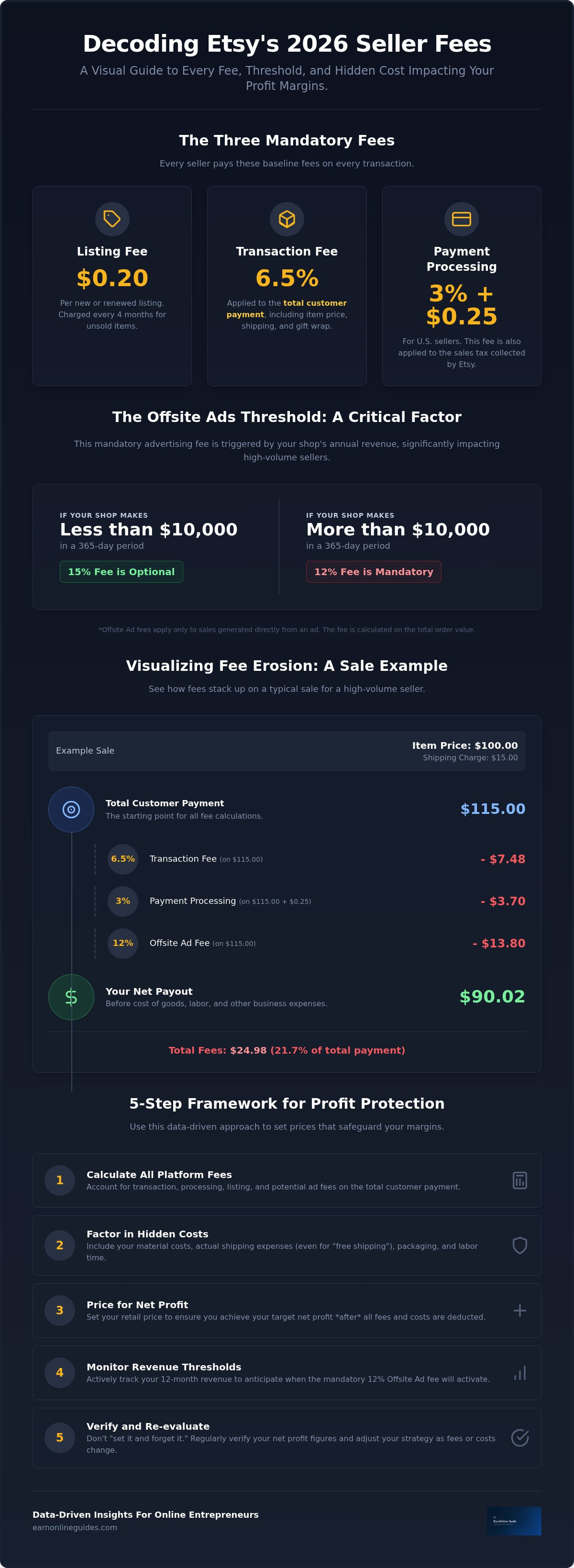
Every seller faces a baseline set of expenses that apply regardless of sales volume or marketing choices. The $0.20 listing fee is the first hurdle; it applies when you publish a new item and triggers again every four months if the item doesn't sell or is renewed. While twenty cents seems negligible, high-volume shops with hundreds of SKUs find this cost compounds quickly. The 6.5% transaction fee represents the platform's primary cut of your success. It's critical to understand that this percentage applies to the total amount paid by the customer, including shipping costs and gift wrapping charges. Finally, US-based sellers must account for the payment processing fee, which remains at 3% plus a flat $0.25 per transaction in 2026. These figures represent the non-negotiable price of platform access.
Visible fees are easy to track, but eroding expenses often hide within marketing decisions. Many sellers offer free shipping to improve search visibility, but this is rarely free for the merchant. If you don't bake the actual postage cost and the associated 6.5% transaction fee on that cost into your retail price, your margins will suffer. These fractional percentages compound over dozens of sales, creating a significant gap between expected and actual earnings. You can reference the Online Selling Fee Index 2026 to see how these costs compare across different marketplaces. Using an etsy fee calculator allows you to perform a reality check on your pricing, ensuring that your business remains profitable after every invisible deduction is satisfied. Success in this marketplace isn't just about high sales volume; it's about the surgical precision of your accounting.
Calculating your net take-home pay requires a granular look at the two primary mandatory deductions. The 6.5% transaction fee is calculated on the total amount the buyer pays. This includes the item price, shipping fees, and any gift-wrapping costs. If you sell a $50 item with $10 shipping, your transaction fee is $3.90, not $3.25. Many sellers make the error of ignoring the shipping component, which leads to a distorted view of their actual margins. Referencing Etsy's official fee policy confirms that this percentage is non-negotiable and applies regardless of whether you use the platform's labels or your own shipping methods.
A secondary layer of cost is the payment processing fee. For US-based sellers in 2026, this is 3% of the total transaction plus a flat $0.25 per order. A subtle but impactful detail is that this fee is also applied to the sales tax collected by Etsy. While you don't keep the sales tax, the platform treats it as part of the total payment handled by their financial infrastructure. This means your effective fee rate is slightly higher than the surface percentages suggest. Using a dedicated etsy fee calculator helps you account for these fractional losses before you commit to a specific price point.
It's helpful to view the transaction fee as the rent paid for access to the marketplace audience and the payment processing fee as the cost of the secure banking infrastructure. Etsy bills these as separate line items because the transaction fee covers platform access while the processing fee facilitates the secure transfer of funds from the buyer to your bank account. If you're looking to optimize your broader financial strategy, you might find it useful to check your projected liabilities with a self-employment tax calculator to ensure your net profit covers your tax obligations.
In 2026, tax reporting requirements have become more stringent, with the IRS 1099-K thresholds requiring higher levels of transparency for online merchants. These regulations mean that your gross sales figures reported to the government include the fees you paid to Etsy. You must deduct these fees as business expenses to avoid overpaying on your taxes. A precise etsy fee calculator ensures your internal records match the platform's reporting, providing the data integrity needed for an audit-proof business. You may also want to explore our income calculator to see how these platform costs fit into your long-term revenue goals.
Advertising is the most volatile variable in the 2026 Etsy ecosystem. While the 6.5% transaction fee is a known constant, ad costs can fluctuate and, in some cases, become a mandatory deduction you cannot opt out of. For sellers who've earned less than $10,000 in the past 365 days, Offsite Ads remain optional at a 15% success fee. However, once your shop crosses that $10,000 threshold, participation is mandatory for the lifetime of the account, though the fee percentage drops to 12%. This shift represents a permanent change in your business's financial structure that requires a total re-evaluation of your pricing model.
Reviewing the breakdown of Etsy fees and taxes shows that these ad fees are calculated on the total order amount, which includes shipping and gift wrap. If you offer free shipping, you're essentially paying a 12% to 15% commission on the postage costs you've already absorbed. A reliable etsy fee calculator is necessary to find your breakeven ad spend, ensuring you don't spend more to acquire a customer than the customer is worth to your bottom line. Success in 2026 depends on your ability to absorb these spikes without eroding your foundational profit.
Internal Etsy Ads function as a standard pay-per-click (PPC) system where you control the daily budget and bid strategy. You pay for the traffic regardless of the outcome. Offsite Ads operate on a success fee model, meaning you only pay when a click results in a sale within 30 days. This sounds low-risk, but the lack of control over which listings are promoted can be dangerous for items with thin margins. You must determine if your product can survive an additional 15% cut before scaling your inventory. Use an etsy fee calculator to run simulations for both scenarios to see which model supports your growth targets.
Consider a $50 sale. Without ads, your platform fees total roughly $5.20 for a US-based seller. If that same sale is attributed to an Offsite Ad at the 15% tier, your fees jump to $12.70. This represents a 25.4% total platform cut before you've even accounted for materials or labor. For high-volume, low-margin shops, these ad spikes can lead to negative cash flow on specific orders. We recommend building a 10% to 15% safety margin into your 2026 pricing model to absorb these costs. This protective filter ensures your business remains sustainable even when the algorithm drives high-cost traffic to your shop.
Establishing a sustainable 2026 pricing strategy requires moving beyond simple estimation. Many sellers fail because they treat platform fees as an afterthought rather than a primary expense. To build a resilient business, you must follow a methodical framework that accounts for every cent of erosion. This process ensures that your final retail price isn't just competitive, but mathematically sound. Utilizing a data-driven etsy fee calculator during this stage allows you to simulate different price points and their impact on your take-home pay before you ever publish a listing.
A frequent error in online selling is the narrow definition of material costs. To find your true COGS, you must include invisible overhead such as shipping tape, tissue paper, and the ink used for label printing. These fractional expenses can total several dollars per order. More importantly, your hourly labor rate is a non-negotiable component of your base cost. If you don't pay yourself for production time, your business is merely a subsidized hobby. The Sovereign Margin for handmade sellers is the net profit remaining after all platform fees and raw material costs are satisfied, representing the true value of the artisan's time.
Not every product deserves a permanent place in your shop. You should maintain a "Kill List" of items that consistently fail to meet your minimum margin targets after accounting for the 2026 fee structure. While some shops use Loss Leaders to drive traffic, this must be a sober, intentional choice rather than an accidental loss. You can compare your findings against a realistic income model to see if your current inventory can actually support your financial goals. If an item cannot survive a mandatory 12% Offsite Ad fee while maintaining a 30% net profit, it is a liability to your long-term growth.
To optimize your margins, follow these five steps for every listing:
Achieving business legitimacy starts with accurate accounting. You can access our full suite of selling fee calculators to verify your numbers and protect your 2026 profit margins.
Our tool acts as a protective filter for your shop’s financial health by moving beyond surface-level math. While many platforms offer basic estimation, the EarnOnlineGuides etsy fee calculator is built on a foundation of data integrity and professional financial logic. It requires you to input specific variables that many sellers overlook, such as fractional packaging costs and the cumulative impact of payment processing on sales tax. By providing a verified net profit figure, you can move away from the "guess-and-check" method of pricing and integrate your findings directly into a sustainable 2026 business plan.
Understanding the difference between net profit and gross margin is essential for business longevity. Your gross margin represents the percentage of revenue remaining after accounting for materials and labor. However, your net profit is the actual take-home amount after every platform deduction is satisfied. If your gross margin is 50% but your net profit is only 10%, your business is dangerously over-leveraged on platform dependencies. The EarnOnlineGuides etsy fee calculator highlights this gap, giving you the data needed to pivot before a pricing error becomes a significant financial liability.
We prioritize realistic outcomes over marketing hype by ensuring our logic remains grounded in platform documentation. Our methodology involves cross-referencing official 2026 platform rates with real-world seller data to ensure accuracy. You can access our full list of selling fee calculators to audit different revenue streams and verify your projections. This commitment to verification ensures that the financial models you build today remain functional as your volume increases. We provide a sober assessment of the costs involved, helping you avoid the common trap of overestimating your take-home pay.
Mastering the math of a specific marketplace is a foundational step in a broader digital skill path. Financial precision is a core competency for successful remote work and digital entrepreneurship. Once you've stabilized your Etsy margins, you can explore other avenues for growth that rely on similar analytical rigor. Our guide on online side hustles provides a roadmap for diversifying your income streams legitimately. Success is a result of methodical planning and informed decision-making; it's not a matter of speed or luck. By treating your fee calculations with professional rigor, you build the business legitimacy required for long-term sustainability.
Sustainable success on Etsy requires a departure from optimistic estimation in favor of evidence-based accounting. We've established that the 6.5% transaction fee is merely the entry point. The real challenge lies in managing the 12% to 15% Offsite Ad success fees and the cumulative impact of payment processing on your total revenue. By applying a 5-step optimization framework, you ensure that your pricing accounts for every fractional expense, from shipping tape to labor rates. This methodology transforms your shop from a creative project into a legitimate business entity with a verified net profit figure.
Your next step is to verify your current inventory against the platform's 2026 financial realities. Our tool utilizes professional financial logic and vetted 2026 data to act as a protective filter for your margins. We prioritize realistic outcomes over industry hype, ensuring you build a foundation for growth without the distraction of get-rich-quick claims. You can Calculate Your Real Profit with the 2026 Etsy Fee Calculator today to confirm your viability. Precision is the most reliable path to long-term remote work success. We wish you a productive and profitable selling season.
The amount Etsy takes depends on your marketing and location, but the baseline for US sellers is approximately 9.5% plus $0.45 per transaction. This figure includes the 6.5% transaction fee, the 3% plus $0.25 payment processing fee, and the $0.20 listing fee. If a sale is attributed to an Offsite Ad, the platform takes an additional 12% or 15%. Utilizing an etsy fee calculator is the most efficient way to determine the exact deduction for your specific price points.
No, the listing fee is a non-refundable cost of entry for the marketplace. You are charged $0.20 the moment you publish a new listing, regardless of whether a customer makes a purchase. This fee grants you platform visibility for a four-month cycle. If the item remains unsold after this period, the listing expires, and you must pay another $0.20 to renew it. These fractional costs are mandatory and apply to every unique item in your shop.
You can only opt out if your shop has generated less than $10,000 in sales over the trailing 365 days. Sellers in this lower revenue tier can disable the feature in their shop settings to avoid the 15% success fee. However, once your shop crosses the $10,000 threshold, participation becomes mandatory for the life of the account. At this point, the fee decreases to 12% per attributed sale, and there's no option to disable the service.
Yes, the 6.5% transaction fee applies to the entire amount paid by the customer at checkout. This total includes the retail price of the item, the shipping charges, and any gift-wrapping fees. The platform implemented this policy to ensure that sellers do not circumvent fees by underpricing products and overcharging for shipping. You must account for this deduction in your pricing strategy, especially if you offer free shipping and absorb the postage costs yourself.
The transaction fee is the commission paid to Etsy for the use of its marketplace and audience access. The payment processing fee is a separate charge for the financial infrastructure required to handle the buyer's credit card or digital wallet payment. While the transaction fee is a flat 6.5%, the processing fee for US sellers is 3% plus $0.25. These are billed as separate line items because they cover distinct operational aspects of the platform's service.
A beginner should aim for a minimum net profit margin of 30% after all platform fees, labor, and material costs are satisfied. This margin acts as a protective filter against unexpected expenses such as returns, damaged goods, or mandatory ad spikes. If your net profit is below 20%, your business is at risk of negative cash flow during high-volume periods. Using a precise etsy fee calculator allows you to verify these margins before you commit to scaling your inventory.
The percentage rates remain the same, but the flat fees will consume the majority of your revenue. On a $1.00 sale, the $0.20 listing fee and the $0.25 processing fee already total $0.45, or 45% of the gross sale. Once you add the 6.5% transaction fee and the 3% processing percentage, you are left with less than half of your revenue. This structure makes low-priced items difficult to sustain unless they are sold in larger bundles or high volumes.
Yes, all platform fees are considered legitimate business expenses and are typically tax-deductible for US sellers. This includes listing fees, transaction commissions, ad costs, and subscription charges. Since Etsy reports your gross sales on Form 1099-K, you must keep detailed records of these fees to ensure you only pay taxes on your actual net income. We recommend tracking these deductions throughout the year to maintain an audit-proof record of your shop's financial performance.

Article by
EarnOnlineGuides Editorial Team
The EarnOnlineGuides Editorial Team creates practical, research-driven educational content about making money online, remote work, freelancing, side hustles, digital skills, AI tools, online business, and self-employment. Our goal is to help readers understand their options, compare realistic opportunities, avoid misleading claims, and make better-informed decisions. We prioritize accuracy, transparency, practical guidance, and responsible reporting, and we regularly review our content to keep it useful and up to date.
The information provided in this article is for general educational and informational purposes only and should not be considered financial, investment, tax, legal, or professional advice. Earnings, income examples, costs, fees, and other figures may vary and are not guaranteed. Always conduct your own research and consult a qualified professional when appropriate.
Some articles on EarnOnlineGuides may contain affiliate links. If you click a link and make a purchase or sign up for a service, we may receive a commission at no additional cost to you. This does not influence our editorial standards or recommendations.
We strive to keep our information accurate and up to date, but products, services, fees, policies, laws, and market conditions can change. Please verify important information directly with the relevant provider before making financial or business decisions.
Educational information only. This article is not financial, tax, or legal advice. Platform fees and policies change; always confirm current rates in the marketplace's official fee documentation before making decisions.
Explore low cost digital side hustles you can test in 2026. Compare freelance work, digital goods, and reselling while managing hidden platform fees and time.

Learn how to open a freelance business bank account step by step. Explore document checklists, compare bank options, and keep business finances organized.

Learn how to write affiliate product reviews readers can trust. Discover a practical process for honest testing, balanced pros and cons, and clear disclosures.