
Low-Cost Digital Side Hustles: Practical Ways to Start in 2026
Explore low cost digital side hustles you can test in 2026. Compare freelance work, digital goods, and reselling while managing hidden platform fees and time.
October 13, 202618 min read

Marketplace fees are the largest predictable cost in online selling, and the platforms structure them very differently. eBay charges a final value fee calculated on the total amount of the sale plus a per-order fee. Etsy layers a transaction fee, payment processing and — for orders it attributes to its own offsite ads — an advertising fee on top of a per-listing charge. Amazon combines a category referral fee with fulfilment and storage charges. Comparing those structures side by side is the only reliable way to see which platform lets you keep more of each sale.
This guide compares how eBay, Etsy and Amazon charge US sellers in 2026, using each platform’s own published fee documentation, and shows where the commonly missed costs sit: fees charged on shipping and sales tax, advertising, subscriptions, returns and cross-border selling. It explains the fee landscape rather than calculating it for you — when you want to run the numbers on a specific item, use our selling fee calculators, and for a category-by-category rate table see the Online Selling Fee Index 2026. Rates below are the published figures at the time of writing and can change, so confirm them on the platform’s own fee page before you price a listing.
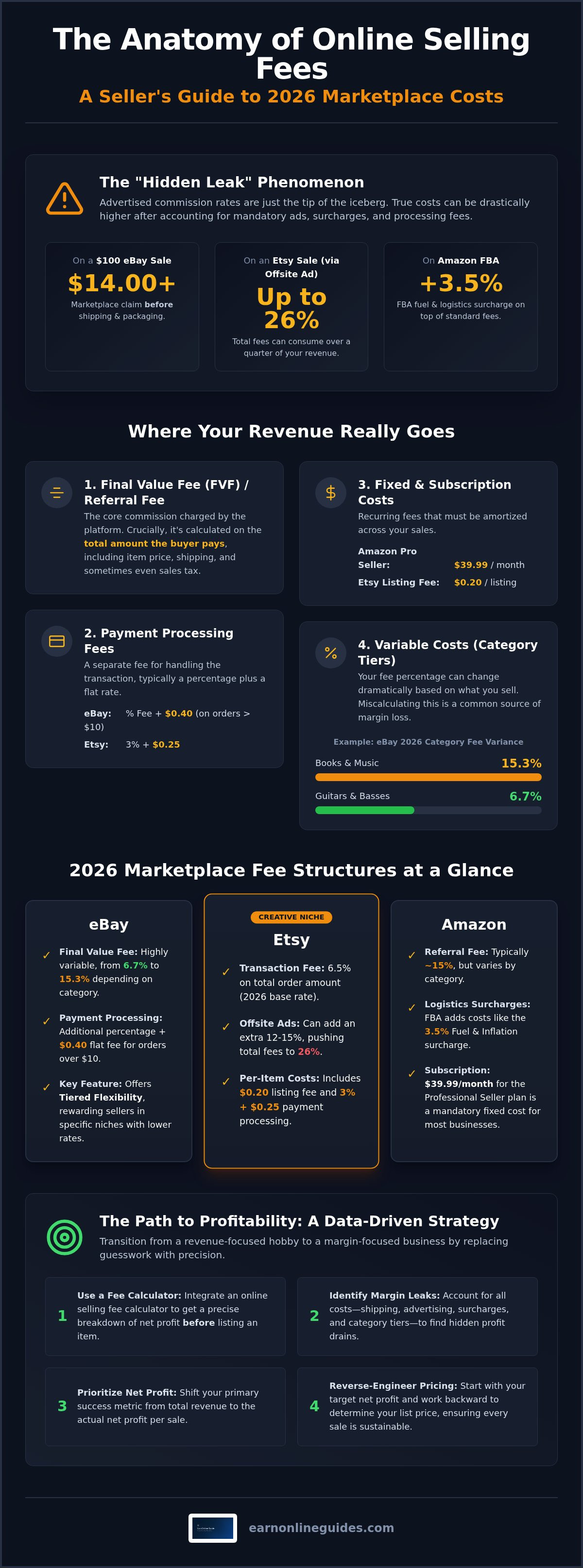
Success in reselling often starts with a simple calculation: price minus cost of goods. However, the 2026 marketplace environment has introduced layers of complexity that make this basic math obsolete. Many sellers fall victim to the "Hidden Leak" phenomenon. A headline referral fee of 15% can land far higher in practice once shipping adjustments, fulfilment surcharges and ad-attributed orders are included — how much higher depends entirely on your category, weight and advertising exposure. Working from each platform’s published fee schedule is no longer optional for anyone moving from a revenue-focused hobby to a margin-focused business. High volume without accurate fee math simply means growing revenue while profit shrinks. We must look beyond the price tag to secure actual profit.
Small errors in your fee assumptions don't just stay small. When managing high-volume inventory, a 2% discrepancy in category fees compounds into a significant financial deficit over hundreds of transactions. This inaccuracy affects cash flow and creates unforeseen tax liabilities. Math overrides intuition.
Understanding how eBay documents its selling fees in 2026 means recognizing that these platforms prioritize their own operational costs. They pass expenses to you through dynamic adjustments and logistics surcharges. Feeling profitable is a high-risk strategy that fails to account for the lag between sales and actual disbursements, often leaving you with a negative balance after shipping costs are finalized.
To build sustainable income, you must shift your primary KPI to net profit. This requires rigorous data integrity. Before sourcing inventory, use our Selling Fee Calculators to validate ROI based on current indexes. Manual spreadsheets often fail because they lack real-time updates for carrier price hikes or tiered commission changes. Precision is the priority.
Establishing a baseline for your minimum acceptable margin ensures you don't waste time on low-reward items. If the math doesn't support a specific margin in a selling fee calculator, the inventory isn't worth the risk. Sustainable growth is the result of disciplined planning, not optimistic guessing. By verifying every cost before the listing goes live, you protect your business from the friction of hidden marketplace fees.
Revenue is a vanity metric; net margin is the only figure that ensures business longevity. When utilizing a selling fee calculator, you must account for the Final Value Fee (FVF). This is the core commission charged on the gross amount the buyer pays. It is vital to remember that "total" includes the item price, shipping costs, and often the sales tax. This leads to the phenomenon of Marketplace Facilitator Taxes. Platforms collect sales tax from the buyer and remit it to the state. However, they still calculate their percentage based on that inflated total. You essentially pay a commission on money that never enters your bank account.
Payment processing adds another layer of friction. Most online selling platforms now use native processing systems, such as eBay Managed Payments or Etsy Payments. These typically involve a percentage based fee plus a flat per-order charge. eBay applies a per-order fee that steps up above a low order value, while Etsy’s US payment processing is a percentage plus a flat per-order charge; both are set out on their fee pages (eBay, Etsy). Distinguishing these from the platform's referral fee is necessary for accurate bookkeeping. You can cross-reference these specific costs in our Online Selling Fee Index 2026 to see how they impact different niches.
Category-specific tiers can shift your fee percentage by more than 8% depending on what you sell. For instance, eBay’s published rate for Books and Music is higher than its rate for categories such as Guitars and Basses, which sits in the mid single digits (see eBay’s fee table). If you ignore these category distinctions, your break-even point will be fundamentally flawed. Fixed costs like Amazon's $39.99 Professional Seller monthly subscription or Etsy's $0.20 listing fee must be amortized across your total sales volume to understand their true weight. Verify your specific category rates before sourcing new inventory to avoid suppressed margins.
The 2026 economy has shifted marketplaces toward a "pay-to-play" model. Advertising is no longer just an optional boost. It's often a mandatory expense. Etsy charges an Offsite Ads fee of 12% or 15% only on orders it attributes to one of its own offsite ads, and participation becomes mandatory once a shop passes $10,000 in sales over a 12-month period (see Etsy’s fee policy). It is not applied to every order, so the effective rate depends on how much of your traffic Etsy attributes to ads. Add promoted listing spend on eBay or Amazon and total platform costs can rise well above the headline commission. An selling fee calculator that fails to include these ad spends will provide a dangerously optimistic view of your business health. You must treat these as primary costs rather than secondary marketing expenses.
Selecting a platform based on popularity rather than mathematical logic is a common error that compromises long term sustainability. In 2026, eBay remains a primary choice for resellers due to its tiered commission structure. For most categories the final value fee sits around the low-to-mid teens as a percentage of the total amount of the sale, with media categories charged at a higher rate, plus a small per-order fee. Because eBay adjusts these tiers, treat the official fee table as the source of truth for your category. This structure rewards flexibility but requires a precise selling fee calculator to manage the variance across different inventory types.
Etsy positions itself as a creative community, but this comes with a distinct "Handmade" premium. Beyond the 6.5% transaction fee, US sellers pay a 3% processing fee plus $0.25 per order. Adding the $0.20 listing fee, the mandatory platform take on a standard order generally lands in the region of 10% to 12%. A one-time shop set-up fee also applies when opening a shop in some regions and currencies rather than universally, so check Etsy’s Fees & Payments Policy for your location. Amazon offers a different path through its Individual and Professional plans. Amazon’s published Professional selling plan costs $39.99 per month and removes the per-item fee charged on the Individual plan, which makes it the cheaper option once monthly volume is high enough. Amazon also applies fulfilment surcharges that it revises periodically, so check its current fee schedule rather than assuming last season’s numbers.
Secondary platforms like Mercari and Poshmark have gained traction in the 2026 landscape by simplifying fee structures for specific niches like fashion and local electronics. While these platforms often have higher flat commissions, they sometimes offer lower friction regarding shipping logistics or return policies. Choosing between these options requires a comparative analysis of your specific business model.
The ideal platform depends heavily on your product's margin and value. High value electronics might thrive on eBay where fee caps exist, whereas low margin collectibles could be erased by Amazon’s FBA minimums. International selling adds another layer: eBay applies an additional international fee on cross-border transactions, with the rate depending on the buyer’s location. To see the granular breakdown for your specific category, reference our Online Selling Fee Index 2026. This data allows you to prioritize platforms where your specific inventory retains the most equity.
Store subscriptions and ecosystem fees are often overlooked until they appear on a monthly statement. You should calculate the exact sales volume needed to justify a $20 or $50 monthly store subscription; if the fee discount doesn't exceed the subscription cost, you're losing money. Additionally, you must factor in the "return friction" of each platform. Return shipping and the inability to charge restocking fees on some marketplaces reduce net profit too; as a planning assumption we suggest reserving a few percent of revenue for it and then replacing that estimate with your own measured return costs. Global sellers should also watch for currency conversion charges, which apply when funds are converted and are set out in each platform’s fee policy.
Pricing is not a creative exercise; it's a mathematical calculation that determines the viability of your business. If you set a list price based on competitor averages without consulting a selling fee calculator, you risk inheriting their poor margins. The most effective strategy is reverse-engineering your price. Start with your desired net profit per unit, then incrementally add the cost of goods sold (COGS), platform commissions, and shipping expenses. This ensures that your "take-home" pay is protected before the listing even goes live.
This approach often reveals the conflict between the "Psychological Price Point" and the "Mathematical Reality." A price of $19.99 might attract more clicks than $21.50, but if that $1.51 difference covers your 2026 per-order fees and packaging costs, the lower price is a liability. You must also account for promotional windows and seasonal shifts. For example, Amazon applies higher holiday peak fulfilment fees over the Q4 period, which is a reason to raise your floor price during those months rather than holding a static one; the exact dates and amounts are published in Amazon’s current fee schedule. To see how these variables impact your yearly growth, utilize our Income Calculator to set evidence-based financial targets.
Knowing your financial floor is the only way to safely navigate marketplace discounts. Every item in your inventory has a specific threshold where it ceases to be an asset and becomes a drain on cash flow. The break-even point is reached when your gross sales revenue exactly equals the sum of your cost of goods sold, marketplace fees, shipping expenses, and overhead. If you cannot reach this threshold while remaining competitive, the inventory should be liquidated or avoided in future sourcing cycles.
Packaging materials, such as tape, boxes, and protective dunnage, are frequently overlooked "fees" that can shave 2% to 5% off your margin. When you combine these with the 2026 carrier rate increases and surcharges, the cost of fulfillment becomes a primary concern. You must decide between "Free Shipping" and "Buyer Pays" based on data rather than trends. Using a selling fee calculator allows you to model both scenarios. This helps you determine if the potential increase in sales volume from a free shipping offer actually offsets the increased fulfillment cost. To ensure you aren't losing money on every shipment, validate your pricing with our selling fee tools.
Moving from theoretical knowledge to operational consistency requires a disciplined approach to your daily workflow. The 2026 reselling environment doesn't forgive broad estimates or rounded numbers. To maintain a sustainable margin, you must integrate our selling fee calculators into every stage of your process, from the initial thrift store scan to the final bookkeeping entry. This systematic verification acts as a protective filter, ensuring that only profitable inventory moves through your pipeline.
The most critical time to use a selling fee calculator is at the point of sourcing. Whether you're at a garage sale or a thrift store, the "Quick Check" method allows you to validate an item's viability before spending capital. This process helps you identify "Red Flag" items, such as heavy, low-value goods that are mathematically impossible to flip profitably once the 2026 carrier surcharges are applied. If the calculator doesn't show a clear path to your minimum margin, leave the item behind. Discipline in sourcing is the foundation of long-term success.
As you grow, fee tracking should become a seamless part of your monthly bookkeeping. Understanding the granular details of marketplace friction allows you to transition into more lucrative online side hustles with a realistic expectation of net income. This level of scrutiny separates professional resellers from hobbyists who are often surprised by negative balances. The EarnOnlineGuides calculator is a compass, not just a tool; it provides the direction needed to navigate a crowded marketplace while keeping your business's financial integrity intact.
Marketplace success in 2026 is defined by mathematical discipline rather than sales volume. You've seen how hidden leaks, such as tiered category shifts and logistics surcharges, can erode your gross revenue. Transitioning to a margin-focused model ensures that your business remains sustainable despite platform fluctuations. By integrating a selling fee calculator into your sourcing and pricing workflow, you replace optimistic guessing with empirical data.
Our tools are designed to act as a protective filter for your equity. You can access our full suite of Selling Fee Calculators here to validate your next inventory batch. These resources are vetted by reselling experts and fully updated for 2026 fee structures, including the latest marketplace facilitator tax logic. There's no sign-up required for basic calculations, allowing you to audit your potential ROI immediately. When you prioritize evidence over intuition, you build a foundation for legitimate growth. Start protecting your margins today and ensure every transaction contributes to your long-term success.
Multiply the gross sale price, which includes shipping and sales tax, by the platform's referral percentage. Then, add the flat per-order fees and payment processing rates. On eBay that means applying your category’s final value percentage to the total, then adding the per-order fee. Manual math works for a single item; a calculator is simply faster once you are handling tiered categories and cross-border fees.
Most eBay categories carry a final value fee in the low-to-mid teens as a percentage of the total amount of the sale, with media, jewellery and watches charged at their own rates, plus a small per-order fee that steps up above a low order value. Rates differ by category and change over time, so check eBay’s fee page for your exact category. These are the baseline figures before any optional advertising.
Generally yes, and it matters for your margin. Under Marketplace Facilitator laws, platforms collect tax from the buyer and remit it to the state. However, they still calculate their referral fee based on the gross total, which includes that tax. If you don't include this inflated total in your calculations, your final profit projections will be inaccurate by a few percentage points on every transaction.
Discrepancies often occur when sellers overlook variable costs like packaging materials, returns, or mandatory advertising programs. If Etsy attributed your sale to an offsite ad, an additional 12% or 15% applies to that order specifically. Check too whether an Amazon fulfilment surcharge or eBay’s international fee applied to the transaction. Precision requires tracking every potential line item.
Promoted listings represent a strategic trade-off between inventory turnover and net margin. For new sellers with low organic visibility, paying a 2% to 10% ad rate can help build the sales history needed for long-term ranking. You should only use these programs if your math confirms that your net profit remains viable after the ad spend. It's better to accept a slower sale than to prioritize speed at a financial loss.
You can lower your effective fee rate by optimizing your subscription choices and seller status. On Amazon, the $39.99 Professional plan removes the per-item fee charged on the Individual plan, so it pays for itself above a certain monthly volume. On eBay, qualifying Top Rated Plus listings receive a discount on the final value fee. Choosing categories with lower published commissions also keeps more of each sale, and both platforms document the current rates on their fee pages (Amazon, eBay).
Yes. Marketplace fee tables ignore supplies entirely, and our calculators let you enter your own costs for boxes, tape and dunnage. These materials can cost between $0.50 and $3.00 per order, which significantly impacts your net margin. Failing to account for these micro-costs is a common reason why side hustles fail to reach long-term sustainability. Always treat packaging as a primary business expense rather than an optional afterthought in your math.
A transaction fee is the commission paid to the marketplace for the platform and audience — Etsy’s published transaction fee is 6.5% of the order total. A payment processing fee covers moving the money itself, quoted by Etsy for US sellers as a percentage plus a flat per-order amount. While some platforms bundle these into a single charge, others list them as separate line items. Understanding this distinction helps you identify exactly where your revenue is being diverted during the settlement process.

Article by
EarnOnlineGuides Editorial Team
The EarnOnlineGuides Editorial Team creates practical, research-driven educational content about making money online, remote work, freelancing, side hustles, digital skills, AI tools, online business, and self-employment. Our goal is to help readers understand their options, compare realistic opportunities, avoid misleading claims, and make better-informed decisions. We prioritize accuracy, transparency, practical guidance, and responsible reporting, and we regularly review our content to keep it useful and up to date.
The information provided in this article is for general educational and informational purposes only and should not be considered financial, investment, tax, legal, or professional advice. Earnings, income examples, costs, fees, and other figures may vary and are not guaranteed. Always conduct your own research and consult a qualified professional when appropriate.
Some articles on EarnOnlineGuides may contain affiliate links. If you click a link and make a purchase or sign up for a service, we may receive a commission at no additional cost to you. This does not influence our editorial standards or recommendations.
We strive to keep our information accurate and up to date, but products, services, fees, policies, laws, and market conditions can change. Please verify important information directly with the relevant provider before making financial or business decisions.
Educational information only. This article is not financial, tax, or legal advice. Platform fees and policies change; always confirm current rates in the marketplace's official fee documentation before making decisions.
Explore low cost digital side hustles you can test in 2026. Compare freelance work, digital goods, and reselling while managing hidden platform fees and time.

Learn how to open a freelance business bank account step by step. Explore document checklists, compare bank options, and keep business finances organized.

Learn how to write affiliate product reviews readers can trust. Discover a practical process for honest testing, balanced pros and cons, and clear disclosures.