
Low-Cost Digital Side Hustles: Practical Ways to Start in 2026
Explore low cost digital side hustles you can test in 2026. Compare freelance work, digital goods, and reselling while managing hidden platform fees and time.
October 13, 202618 min read

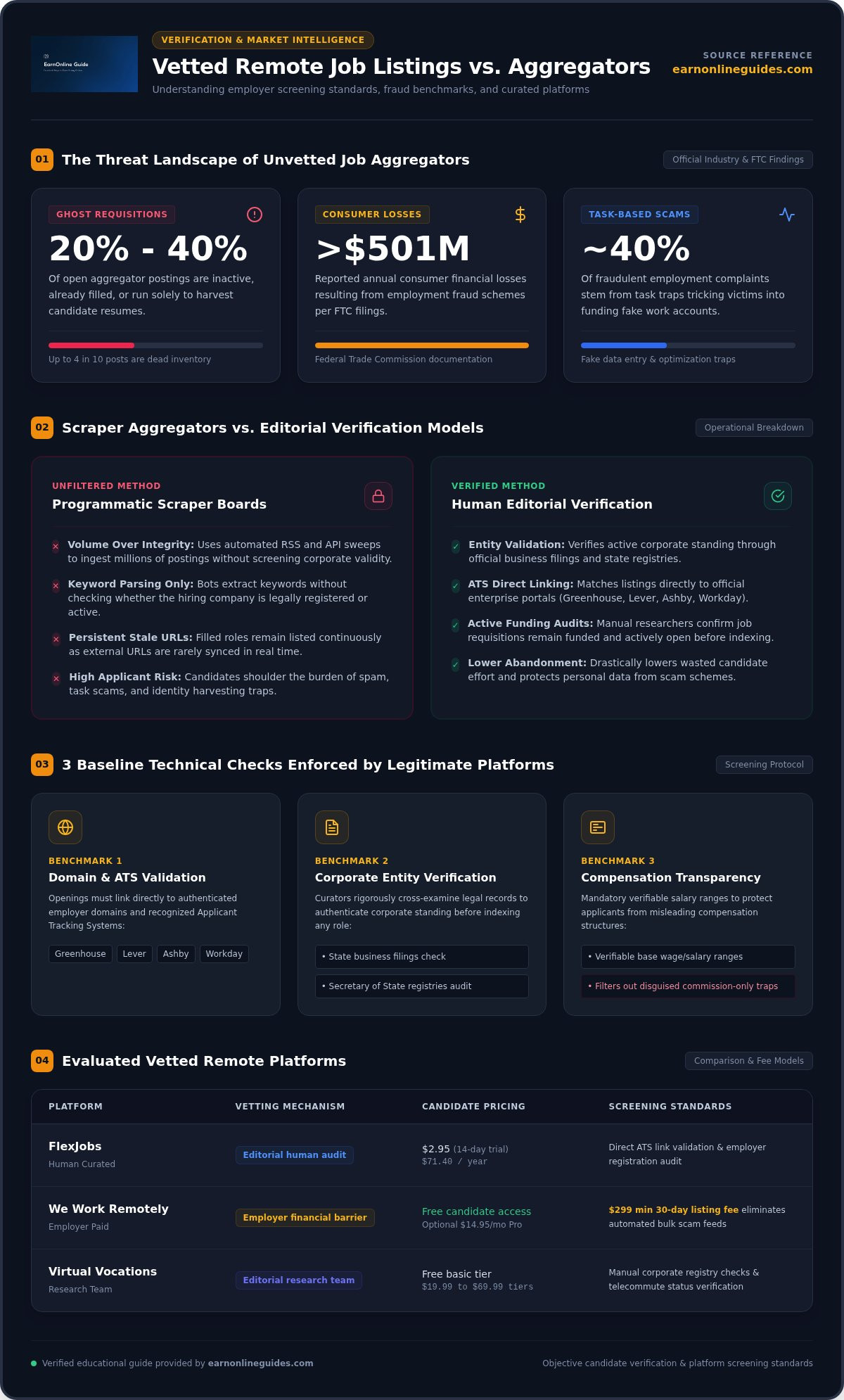
Industry recruitment analyses reveal that between 20% and 40% of postings on open job aggregators are ghost jobs: roles that are inactive, already filled, or maintained purely to harvest resumes. Finding legitimate, vetted remote job listings has consequently shifted from a simple search into an exhausting defensive drill against deceptive recruitment schemes and unmonitored web scrapes.
If you're tired of submitting customized applications into digital voids or fielding suspicious recruitment messages on personal chat apps, your skepticism is completely warranted. The reality is that open boards rarely authenticate hiring claims, leaving job seekers to shoulder the risk of spam and identity harvesting.
You don't have to rely on guesswork to find stable employment. Discovering thoroughly evaluated remote platforms starts with understanding how legitimate boards screen employers and verify open requisitions. Learning an objective verification methodology allows you to audit opportunities independently, evaluate true net pay across 1099 and W-2 classifications, and protect your personal data.
Below, we review the most reliable curated remote job platforms, outline a four-step verification protocol to confirm any posting before you apply, and detail the key benchmarks required to safeguard your remote search.
Truly vetted remote job listings represent verified, active openings that have undergone systematic technical and operational review. Open job aggregators prioritize volume over integrity, utilizing programmatic scrapers to ingest millions of unfiltered postings across the web. In contrast, genuine curation requires validating that a hiring entity exists, possesses active corporate standing, and is directly soliciting applications for a live vacancy.
The operational gap between these approaches is stark. Federal Trade Commission reporting documents that annual consumer losses from employment fraud exceed $501 million. Simultaneously, task-based scams, where victims are tricked into funding accounts for fake data-entry or optimization work, now represent roughly 40% of fraudulent employment complaints. Automated aggregators rarely filter these traps because their bots parse text keywords rather than verifying corporate legitimacy. Understanding how distributed teams structure remote work arrangements requires recognizing the screening benchmarks that separate authentic employers from fraudulent operations.
Legitimate vetting protocols enforce three baseline technical checks before an opening is listed:
Programmatic scrapers query corporate index pages via automated RSS and API sweeps. If an employer fills a position but forgets to remove the external URL, the scraper continues displaying it as an open requisition. Recruitment audits indicate that unmonitored feeds carry between 20% and 40% ghost listings. These closed, stale, or candidate-harvesting posts waste applicant effort and artificially inflate aggregator inventory.
Editorial verification models eliminate this dead inventory through scheduled manual audits. Human researchers independently verify that the job requisition remains funded and active with the employer. For applicants targeting authentic opportunities, relying on human-audited feeds drastically lowers application abandonment rates and eliminates the security risks tied to unvetted digital listings.
Different employment platforms solve verification challenges through distinct operational models. Some shift verification costs to hiring managers via steep listing fees, while others charge candidates subscription fees to fund dedicated research teams. Evaluating these sources requires understanding their underlying moderation criteria and fee structures.
| Platform | Vetting Mechanism | Candidate Cost | Key Screening Standards |
|---|---|---|---|
| FlexJobs | Editorial human audit | $2.95 14-day trial; $71.40/yr | Direct ATS link validation, employer registration audit |
| We Work Remotely | Employer financial barrier | Free (optional $14.95/mo Pro) | $299 minimum 30-day listing fee eliminates bulk scam feeds |
| Virtual Vocations | Editorial research team | Free basic; $19.99 to $69.99 tiers | Manual corporate registry checks, telecommute verification |
| EarnOnlineGuides Directory | Editorial integrity filter | Free access | Zero paid-placement bias, ATS matching, 1099/W-2 auditing |
The core trade-off centers on cost versus friction. While free aggregators attract unverified submissions, platforms that impose economic or operational friction consistently surface reliable vetted remote job listings.
Subscription databases like FlexJobs and Virtual Vocations employ dedicated researchers to verify corporate identities and active ATS postings before publication. FlexJobs charges $2.95 for a 14-day trial (auto-renewing at $23.95 every four weeks, or $71.40 annually), supported by a 14-day satisfaction guarantee. Paying this subscription fee is justifiable during an active search cycle, as it eliminates defunct postings. As detailed in the Federal Trade Commission guide on job scams, fraudulent postings thrive where publishing barriers don't exist. Subscription platforms effectively insulate candidates from advance-fee and fake check schemes.
Candidates don't always need to pay for vetted remote job listings. Employer-funded boards such as We Work Remotely charge companies a base rate of $299 per 30-day listing. This baseline financial friction effectively prices out mass-automated scammers and phantom recruiters. Specialized niche communities and professional Slack networks also offer community-moderated listings, though candidate due diligence remains necessary. If you want a structured resource without monthly fees, explore our curated list of legitimate remote jobs to target verified, active employers directly.
A primary failure point in candidate research involves overlooking the legal classification of an advertised role. Genuinely vetted remote job listings explicitly state whether an engagement operates under W-2 employment or 1099 independent contracting. Deceptive postings frequently blur this boundary, marketing commission-only or variable freelance arrangements as stable "work-from-home career positions."
The structural distinction dictates your tax liability, legal protections, and operational overhead. A W-2 employee receives statutory benefits, unemployment protections, and standard employer payroll contributions. Conversely, a 1099 contractor operates as an independent business entity, bearing full operational responsibility and self-employment tax obligations. Before committing to an offer, evaluate net take-home pay using our comprehensive 1099 vs W2 compensation analysis.
Independent contractors face mandatory self-employment taxes (SECA) totaling 15.3%, consisting of 12.4% for Social Security and 2.9% for Medicare. While an employer covers half (7.65%) of these payroll contributions for W-2 staff, 1099 contractors pay the entire 15.3% directly, though they can deduct the employer-equivalent half when calculating adjusted gross income. Contractors must also self-fund health coverage, retirement contributions, hardware, software licenses, and unpaid leave.
Because of these added expenses, an advertised 1099 hourly rate must sit substantially higher than an equivalent W-2 wage to achieve net financial parity. Accepting a contractor role at standard payroll rates results in a hidden pay cut.
Federal standards, specifically the IRS worker classification guidelines and Department of Labor rules, govern whether a worker is legally an employee or contractor. Regulatory evaluations center on behavioral control and economic reality. Look for these warning signs in job descriptions:
Transparent platforms filter out roles that blur these legal lines. Verifying classification terms before submitting an application prevents severe tax surprises and uncovers non-viable wage proposals early.
Relying on external platforms is never enough. Even when sourcing positions through curated channels, candidates must apply an independent audit before submitting sensitive data. Sifting through vetted remote job listings requires a disciplined screening routine to ensure an opening has not expired or been impersonated by digital bad actors.
Follow this systematic four-step protocol to independently verify any remote opportunity:
For a detailed breakdown of deceptive hiring tactics, review our framework on how to spot remote job scams.
Authentic distributed businesses manage applicant pipelines through recognized Applicant Tracking Systems like Greenhouse, Lever, Ashby, or Workday. If an application form redirects to an unbranded submission page, treat it with caution. Run the prospective employer's web domain through an ICANN WHOIS lookup tool. If a domain claiming to represent an established mid-sized company was registered only three weeks ago, close the tab immediately.
Timing matters when sharing sensitive records. Legitimate employers never request Social Security numbers, dates of birth, or banking details during the screening stage. These identifiers are strictly required after you review and execute a formal, written offer letter. If you want to refine your vetting process and secure verified applications quickly, follow our proven steps to find legitimate remote jobs fast.
Securing employment through vetted remote job listings requires replacing mass-application tactics with an organized, direct-to-employer pipeline. Submitting dozens of generic resumes across unmoderated boards often results in silence or automated rejections. A targeted strategy focuses on authenticated openings, allowing you to track measurable progress rather than chasing ghost requisitions. Streamlining your workflow begins by referencing pre-screened opportunities, such as our curated Remote Job Directory 2026, before validating company credentials.
Maintain an active pipeline log to record submission dates, ATS requisition codes, and direct recruiter touchpoints. If an organization fails to acknowledge an application within 14 business days, mark the lead cold and advance other opportunities. Tracking response windows keeps your momentum steady and prevents lingering emotional attachment to stale postings.
Effective job hunts operate like structured sales funnels. Build an index of 20 to 30 remote-first employers known for consistent hiring integrity. Instead of relying exclusively on secondary boards, subscribe to updates from their native career portals or check their Greenhouse and Lever boards weekly. Tailor your resume to match each role's explicit technical requirements. This targeted approach reduces application volume while significantly improving interview conversion rates.
Successful candidates treat compensation evaluation and skill alignment as data exercises. Pair your active applications with research into verified legitimate remote jobs across high-demand specialties to benchmark competitive market rates accurately. When an offer arrives, audit its schedule expectations, worker classification, and net pay against statutory standards rather than accepting verbal promises at face value.
Combining vetted remote job listings with an independent candidate audit ensures you pursue positions that offer genuine security, sustainable compensation, and authentic career growth without exposure to fraudulent schemes.
Finding legitimate remote work requires shifting from high-volume guessing to disciplined verification. By prioritizing genuinely vetted remote job listings, you immediately eliminate the risks of ghost requisitions, resume harvesting, and predatory advance-fee scams. Evaluating whether an opportunity operates as a W-2 or 1099 role ensures your real compensation accounts for statutory benefits, equipment overhead, and self-employment tax obligations.
Protecting your search means pairing a rigorous candidate audit with platforms that enforce transparent standards. At EarnOnlineGuides, we maintain zero tolerance for pay-to-work schemes, applying a multi-point editorial screening framework and objective financial modeling tools to validate authentic roles. When you're ready to bypass unmonitored aggregators, explore verified openings in the Remote Job Directory. A sustainable, legitimate remote career starts with taking a methodical approach to every application you submit.
A remote role is truly vetted when human curators or financial verification barriers confirm the hiring company's legal standing, direct applicant tracking system connection, and transparent wage parameters. Rather than relying on unmonitored scrapers, trustworthy platforms authenticate corporate business filings and ensure the specific requisition ID is active. This process eliminates ghost listings, commission-only schemes, and identity-harvesting scams before candidates spend time applying.
Paid boards justify their cost if you need to eliminate ghost listings and protect your personal data during an active search cycle. Platforms charging candidate fees use that subscription revenue to employ human research teams who manually verify corporate registries and direct application links. However, free resources like employer-funded job boards and curated directories also supply genuine openings without recurring candidate fees. Match your choice to your budget and timeline.
You can identify a ghost listing by checking the hiring employer's direct careers portal to confirm whether the specific job requisition ID exists. If an aggregator displays an opening but the company's native applicant tracking system lacks the role, the post is likely defunct or retained solely for resume harvesting. Stale listings open for months, recurring repost cycles, and descriptions lacking concrete departmental goals also signal ghost requisitions.
Legitimate employers never send checks for equipment purchases because advance-fee checks represent the standard mechanism for counterfeit financial fraud. In these schemes, the fraudulent check temporarily credits your account before ultimately bouncing, leaving you personally liable for money sent to a fake supplier. Authentic remote employers either courier pre-configured hardware directly to your address or reimburse approved expenses through standard payroll channels after your official start date.
The safest verification method is requiring the recruiter to email you directly from an authenticated corporate email domain, then cross-referencing that requisition on the company's public career site. Scammers routinely clone legitimate recruiter profiles using automated tools. Never accept interview requests routed through Telegram, WhatsApp, or unsecured text chats. Always confirm the recruiter appears as an active corporate employee before sharing professional documents.
W-2 remote jobs include employer payroll tax contributions and statutory protections, whereas 1099 contract roles place the full 15.3% self-employment tax burden on the worker. Evaluating vetted remote job listings requires calculating net take-home pay rather than gross advertised rates. Because independent contractors must fund their own health coverage, hardware, and unpaid time off, a 1099 hourly rate must sit significantly higher than an equivalent W-2 wage to achieve financial parity.

Article by
EarnOnlineGuides Editorial Team
The EarnOnlineGuides Editorial Team creates practical, research-driven educational content about making money online, remote work, freelancing, side hustles, digital skills, AI tools, online business, and self-employment. Our goal is to help readers understand their options, compare realistic opportunities, avoid misleading claims, and make better-informed decisions. We prioritize accuracy, transparency, practical guidance, and responsible reporting, and we regularly review our content to keep it useful and up to date.
The information provided in this article is for general educational and informational purposes only and should not be considered financial, investment, tax, legal, or professional advice. Earnings, income examples, costs, fees, and other figures may vary and are not guaranteed. Always conduct your own research and consult a qualified professional when appropriate.
Some articles on EarnOnlineGuides may contain affiliate links. If you click a link and make a purchase or sign up for a service, we may receive a commission at no additional cost to you. This does not influence our editorial standards or recommendations.
We strive to keep our information accurate and up to date, but products, services, fees, policies, laws, and market conditions can change. Please verify important information directly with the relevant provider before making financial or business decisions.
Educational information only. This article is not financial, tax, or legal advice. Platform fees and policies change; always confirm current rates in the marketplace's official fee documentation before making decisions.
Explore low cost digital side hustles you can test in 2026. Compare freelance work, digital goods, and reselling while managing hidden platform fees and time.

Learn how to open a freelance business bank account step by step. Explore document checklists, compare bank options, and keep business finances organized.

Learn how to write affiliate product reviews readers can trust. Discover a practical process for honest testing, balanced pros and cons, and clear disclosures.