
Low-Cost Digital Side Hustles: Practical Ways to Start in 2026
Explore low cost digital side hustles you can test in 2026. Compare freelance work, digital goods, and reselling while managing hidden platform fees and time.
October 13, 202618 min read

Reported losses to employment fraud exceeded $750 million in recent reporting cycles, with the median victim losing over $1,500 to increasingly sophisticated tactics. It's understandable if you feel a sense of anxiety every time an unsolicited recruiter reaches out on LinkedIn or via SMS. The shift toward AI-generated job descriptions and synthetic audio interviews has made it difficult to distinguish a legitimate career move from a calculated identity theft attempt. You don't have to rely on guesswork or intuition to protect your professional reputation.
You can regain confidence by adopting a data-driven verification protocol that treats every offer as a technical audit. This guide will show you exactly how to spot remote job scams by teaching you to audit domain registration dates, analyze email syntax for typosquatting, and perform out-of-band identity checks. We will provide a repeatable 2026 verification checklist, explain the realistic salary benchmarks for remote roles, and outline the specific steps required to confirm an employer's legitimacy before you share any sensitive personal information. By following this structured methodology, you can filter out fraudulent listings and focus your energy on legitimate opportunities that offer long-term career sustainability.
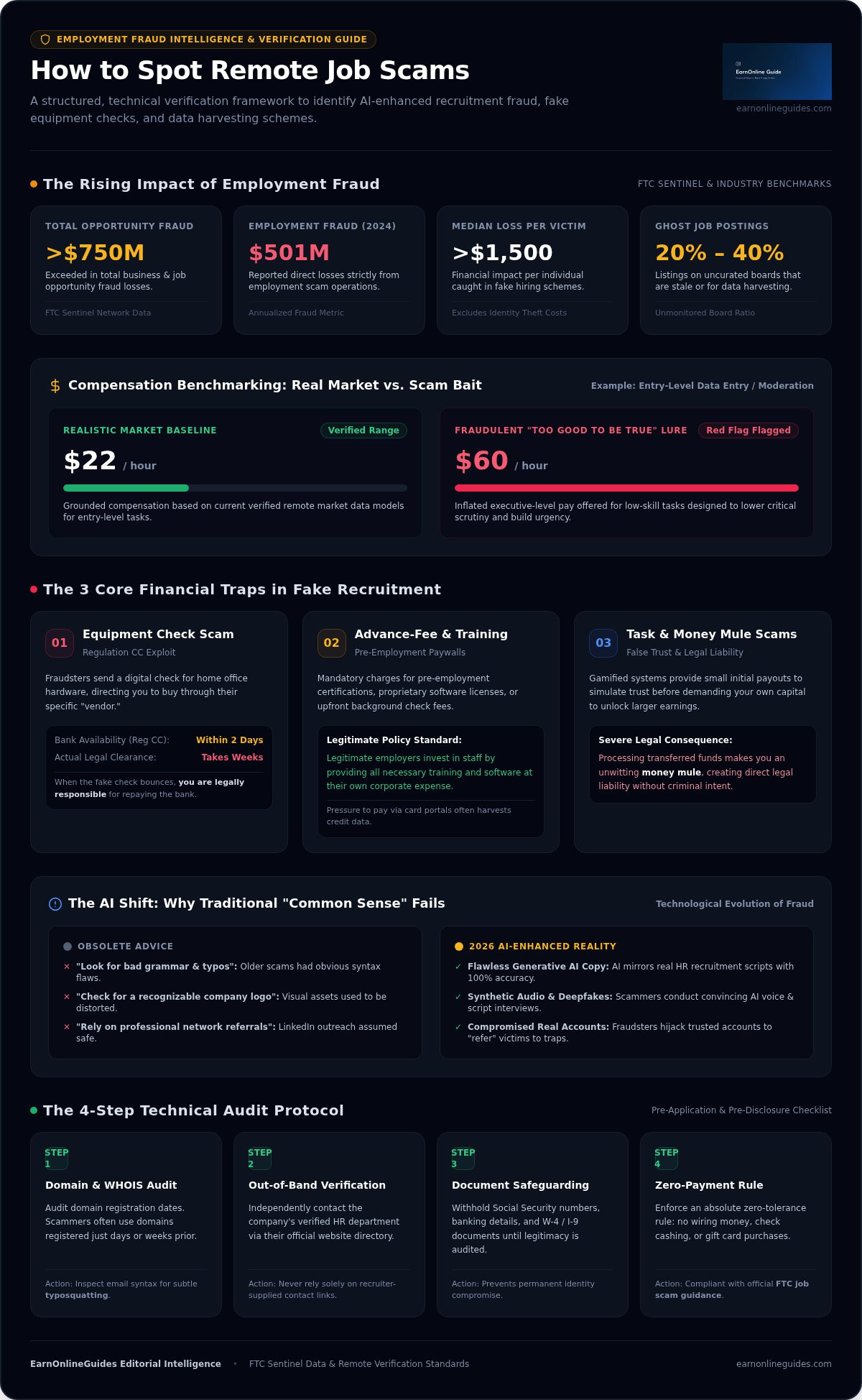
Remote job scams have transitioned from clumsy emails into highly professional phishing and financial fraud operations. Reported losses to employment fraud reached $501 million in 2024, while total business and job opportunity fraud exceeded $750 million according to the FTC Consumer Sentinel Network. In 2026, the primary challenge in understanding how to spot remote job scams is that the lack of a physical office removes the traditional "walk-in" verification method. Scammers exploit this gap by creating "Ghost Jobs." Industry research indicates that 20% to 40% of listings on uncurated job boards are actually stale or unmonitored postings used specifically for malicious data harvesting. While older work-at-home schemes focused on small upfront fees, modern operations aim for total identity theft or large-scale financial compromise.
Scammers now utilize generative AI to mirror corporate branding and recruitment scripts with 100% accuracy. The old advice to look for "poor grammar" is obsolete. Professional-grade AI writing tools produce flawless job descriptions that are indistinguishable from those written by HR professionals. Social engineering on platforms like LinkedIn has become a primary vector. Fraudsters often use compromised accounts to "refer" victims to fake roles, lending a false sense of legitimacy to the interaction. Learning how to spot fake remote job listings requires moving beyond visual cues toward technical verification of the recruiter's identity and the company's digital infrastructure.
The consequences of a successful scam extend far beyond a drained bank account. Victims face permanent identity compromise, as scammers collect Social Security numbers and banking details through fake W-4 or I-9 forms. There is also the risk of unwitting involvement in "money mule" activity. In these scenarios, a victim is tricked into processing stolen funds, which can lead to direct legal liability even if the individual had no criminal intent. The resulting cycle of job search fatigue and emotional distress makes it significantly harder for candidates to pursue legitimate ways to work from home. Protecting your career requires a shift from passive trust to active, data-driven verification.
Financial manipulation remains the most direct way to identify a fraudulent offer. Most how to spot remote job scams protocols begin with a simple rule: if you're asked to send money to receive money, the role isn't legitimate. Scammers often use "Equipment Check" schemes where they send a digital check for a home office setup and instruct you to pay their "vendor" for the hardware. Under federal banking law, specifically Regulation CC, banks often make funds available within two business days, but this doesn't mean the check has legally cleared. When the bank eventually discovers the check is counterfeit, which can take weeks, you're legally responsible for repaying the full amount. This is a core component of FTC guidance on job scams, which warns that no legitimate employer will ever ask you to wire money or buy gift cards for equipment.
Advance-fee requirements for mandatory training or pre-employment certifications are equally disqualifying. A legitimate company invests in its workforce by providing the necessary training at their own expense. If a recruiter insists you pay for a specific software license or a background check fee through their proprietary portal, they're likely harvesting your credit card data or simply stealing the fee. These interactions often feel urgent, but pressure to pay is a hallmark of fraud.
Data is your best defense against "too good to be true" offers. Scammers lure victims by offering executive-level compensation for entry-level tasks like data entry or social media moderation. You can use Remote Work Statistics to cross-reference the average pay for specific roles in the current market. If a listing offers $60 per hour for a role that typically pays $22, you're likely looking at a scam. Applying a Realistic Income Model helps you ground your expectations in market reality rather than speculative hype. If you're unsure about a pay rate, it's helpful to check our income calculator to see how the numbers align with industry standards.
Fraudsters frequently use the Independent Contractor or 1099 status to bypass the rigorous onboarding requirements of W-2 employment. While many legitimate remote roles are freelance, scammers use this classification to avoid providing benefits or verifying their own tax standing. It's essential to use a 1099 vs W-2 Breakeven Tool to determine if the offered rate actually covers your self-employment taxes and overhead. A legitimate company hiring a contractor will still require a formal W-9 and provide a valid Employer Identification Number (EIN). If an employer is evasive about their tax documentation or insists on paying only via untraceable methods like cryptocurrency, terminate the interaction immediately.
Legitimate hiring processes require time and multiple human touchpoints. A primary indicator of how to spot remote job scams is the presence of artificial urgency. If a recruiter offers you a position after a single text-based chat or claims you can start tomorrow without a formal live interview, you're likely engaging with a fraudster. While some modern startups utilize platforms like Slack or Discord for initial coordination, they'll always transition to a secure, face-to-face or live video environment before extending a formal offer. The Federal Trade Commission's guide on job scams emphasizes that legitimate employers don't hire via encrypted messaging apps alone.
Technical audits of communication channels are essential for verification. You should use public ICANN or WHOIS databases to verify the age of a company's domain. If a business claiming a decade of history is operating from a domain registered within the last 30 days, it's a red flag. Scammers often use typosquatting, such as "careers-company.com" instead of the official "company.com," to deceive candidates. Additionally, professional recruiters rarely use personal addresses from @gmail.com or @outlook.com. If the email header doesn't match the official corporate domain exactly, treat the interaction as high-risk. This scrutiny should extend to LinkedIn profiles; look for generic AI-generated photos, low connection counts, and a lack of recent company-specific activity.
The 2026 threat landscape includes synthetic media. Scammers now use deepfake video interviews and voice-cloned HR representatives to bypass traditional skepticism. Understanding how to spot remote job scams in the age of synthetic media requires a heightened level of technical skepticism. You can often spot these by looking for specific glitches in the video feed:
Always request a live, interactive element during the call. Ask the interviewer to hold up a specific object or turn their head to the side to break the AI's rendering loop. Voice-only interviews are increasingly dangerous; if a company refuses to appear on camera, they may be using AI-generated audio to mask their identity. Refer to our guide on how to spot fake remote job listings for more on these technical markers. If you're ever pressured to provide sensitive data before a confirmed live interaction, terminate the process immediately.
Applying for a remote position in 2026 requires more than a casual review of a job board. You must implement a structured verification protocol to ensure your personal data remains secure. This five step process provides a technical framework for how to spot remote job scams before you commit to an interview or share sensitive information.
You should never apply through a third-party link without first verifying the origin. Scammers frequently use "Impersonation Scams," where they use the names and logos of real, reputable companies to front their operations. They may even use the names of real HR directors found on public profiles. To mitigate this risk, prioritize using legitimate remote job sources that perform their own employer vetting. If you find a role on a public board, manually type the company's URL into your browser rather than clicking a provided link to avoid redirected phishing sites.
The timeline for the best work from home careers 2026 typically spans two to four weeks and involves multiple rounds of live interaction. Fraudulent operations move much faster to prevent you from performing due diligence. You should also maintain a strict "Sensitive Info" threshold. Never provide your Social Security number, birth date, or banking details before you have a signed, verified contract in hand. Be wary of "test projects" that require significant time or produce usable work for the company without compensation. This is often a tactic to obtain free labor under the guise of a skills assessment. If you are ready to move beyond public boards, you can learn how to find legitimate remote jobs fast using our curated directory.
Transitioning to a remote career doesn't have to be a high-risk gamble. While knowing how to spot remote job scams is a vital defensive skill, your best long-term strategy is to migrate your search to curated environments. Public boards are "open" systems that prioritize volume, which often means they lack the resources to vet every listing in real-time. You can significantly reduce your risk profile by using a curated Remote Job Directory 2026, where employers are screened before their listings are published. Unlike high-volume public platforms, EarnOnlineGuides provides a protective layer of human oversight to ensure that every opportunity meets a baseline of legitimacy before it reaches your screen.
Your online presence also dictates the type of recruiters you attract. Scammers target profiles that appear desperate or lack specific technical markers. By utilizing a Digital Skills Matrix, you can align your profile with the specific requirements of legitimate employers. This shift in positioning makes you a target for real corporate recruiters rather than automated phishing bots. Additionally, you should tighten your privacy settings on professional networking sites. Avoid listing your personal phone number, home address, or birth date on public resumes, as these are the primary data points used in identity theft operations.
Curated directories differ from open boards by employing human researchers to verify company legitimacy and pay transparency. This is especially important when searching for non-phone work from home jobs, which are historically more prone to scams due to their high demand and low barrier to entry. Legitimate non-phone roles, such as asynchronous writing or data analysis, still require a rigorous interview process. If you find a role through a "Skeptical Mentor" platform or a vetted community, you're benefiting from a collective layer of security that public boards simply cannot provide.
If you've already shared sensitive information or lost funds, immediate damage control is essential. You should contact your bank to stop any pending transactions and inform them that your account may be compromised. For identity protection, contact the major credit bureaus to place a freeze on your credit report. This prevents scammers from opening new accounts in your name. You must also report the incident to the proper authorities to help others learn how to spot remote job scams in the future:
Reporting these incidents provides the data necessary for federal agencies to pursue civil penalties against fraudulent operations. While the emotional toll of a scam is significant, taking these structured steps will help secure your finances and allow you to return to a safe job search with a more resilient verification protocol.
The transition to remote work requires a shift from passive trust to technical verification. You've learned that modern fraud operations utilize synthetic media and sophisticated domain spoofing to harvest personal data. By mastering how to spot remote job scams through technical audits and out-of-band verification, you've built a protective filter for your career. Legitimate employers prioritize transparency and follow standard HR timelines that include multiple live interactions. If a process feels rushed or avoids face-to-face contact, it's a signal to pause and audit the source.
Data remains your most effective tool for navigating this landscape. Use our updated 2026 Remote Work Statistics to ground your salary expectations and apply the 1099 vs W2 Breakeven Tool to every contract offer you receive. These sober, evidence-based guides ensure that your professional decisions are based on reality rather than hype. If you're ready to bypass the risks of unmonitored public boards, explore our Vetted Remote Job Directory 2026 to find safe, legitimate opportunities. You have the tools and the protocol to move forward with confidence. Your next career move should be as secure as it is rewarding.
Yes, a remote job offer can be a scam even on reputable platforms like LinkedIn or Indeed. Scammers frequently use "Ghost Jobs" to harvest data or impersonate legitimate corporate recruiters by cloning their profiles. While these platforms have moderation teams, the sheer volume of listings makes manual vetting impossible for every post. You should always cross-reference any listing found on a public board with the company's official career portal to ensure the role exists.
It is never normal for a remote company to send you a check to purchase equipment from their specific vendor. This is a classic "Fake Check Scam" that exploits federal banking laws regarding funds availability. While the bank may credit your account within 48 hours, the check can take weeks to be identified as fraudulent. Legitimate employers either ship equipment directly to your residence or provide a secure internal procurement system that does not involve personal banking.
You can verify a 1099 remote contract by requesting the company's Employer Identification Number (EIN) and a formal W-9 request. Legitimate businesses will have a verifiable digital footprint and a structured onboarding process that includes a signed contract. You should use a 1099 vs W-2 breakeven tool to ensure the offered rate covers your self-employment taxes. If an employer is evasive about tax documentation or insists on payment via cryptocurrency, the opportunity is likely fraudulent.
In 2026, scammers frequently target high-demand, low-barrier roles such as "Data Entry Clerk," "Virtual Administrative Assistant," and "App Optimization Specialist." These titles are chosen because they appeal to a wide audience and often don't require specialized degrees. Scammers also use these generic titles to mask "task scams" where victims are asked to perform repetitive digital actions for small initial payouts. Always be skeptical of entry-level roles that offer compensation significantly above current market benchmarks.
You should never pay for a background check, software license, or mandatory training as a condition of employment. Legitimate companies treat these costs as business expenses and handle the logistics internally. If a recruiter directs you to a specific portal to pay an "onboarding fee," they are either stealing the fee or harvesting your credit card information. This is a primary indicator of how to spot remote job scams, as real employers invest in their workers rather than charging them.
If a recruiter insists on communicating exclusively via WhatsApp or Telegram, you should terminate the interaction immediately. While some startups use Slack for internal coordination, legitimate hiring processes always involve a secure corporate email and a live video interview. Scammers prefer encrypted messaging apps because they can easily delete their history and evade platform-level moderation. A professional recruiter will always be willing to move the conversation to an official corporate domain or a verified meeting platform.
To verify a company without a physical office, you must audit their digital infrastructure. Perform a WHOIS search to check the domain registration date; a new domain for an established company is a red flag. Additionally, look for a consistent history of activity on professional networks and verified business filings with the Secretary of State. Understanding how to spot remote job scams involves confirming that the company's digital presence matches its claims of longevity and professional standing in the industry.
Yes, re-shipping or package handler roles are almost universally fraudulent. These positions are typically "money mule" or "stolen goods" operations where you are unwittingly used to process items purchased with stolen credit cards. Legitimate logistics companies don't hire individuals to receive and forward packages from their personal residences. Engaging in these schemes can lead to direct legal consequences and financial liability for the stolen goods. If a job involves handling physical inventory from home, it is a scam.

Article by
EarnOnlineGuides Editorial Team
The EarnOnlineGuides Editorial Team creates practical, research-driven educational content about making money online, remote work, freelancing, side hustles, digital skills, AI tools, online business, and self-employment. Our goal is to help readers understand their options, compare realistic opportunities, avoid misleading claims, and make better-informed decisions. We prioritize accuracy, transparency, practical guidance, and responsible reporting, and we regularly review our content to keep it useful and up to date.
The information provided in this article is for general educational and informational purposes only and should not be considered financial, investment, tax, legal, or professional advice. Earnings, income examples, costs, fees, and other figures may vary and are not guaranteed. Always conduct your own research and consult a qualified professional when appropriate.
Some articles on EarnOnlineGuides may contain affiliate links. If you click a link and make a purchase or sign up for a service, we may receive a commission at no additional cost to you. This does not influence our editorial standards or recommendations.
We strive to keep our information accurate and up to date, but products, services, fees, policies, laws, and market conditions can change. Please verify important information directly with the relevant provider before making financial or business decisions.
Educational information only. This article is not financial, tax, or legal advice. Platform fees and policies change; always confirm current rates in the marketplace's official fee documentation before making decisions.
Explore low cost digital side hustles you can test in 2026. Compare freelance work, digital goods, and reselling while managing hidden platform fees and time.

Learn how to open a freelance business bank account step by step. Explore document checklists, compare bank options, and keep business finances organized.

Learn how to write affiliate product reviews readers can trust. Discover a practical process for honest testing, balanced pros and cons, and clear disclosures.