
Low-Cost Digital Side Hustles: Practical Ways to Start in 2026
Explore low cost digital side hustles you can test in 2026. Compare freelance work, digital goods, and reselling while managing hidden platform fees and time.
October 13, 202618 min read

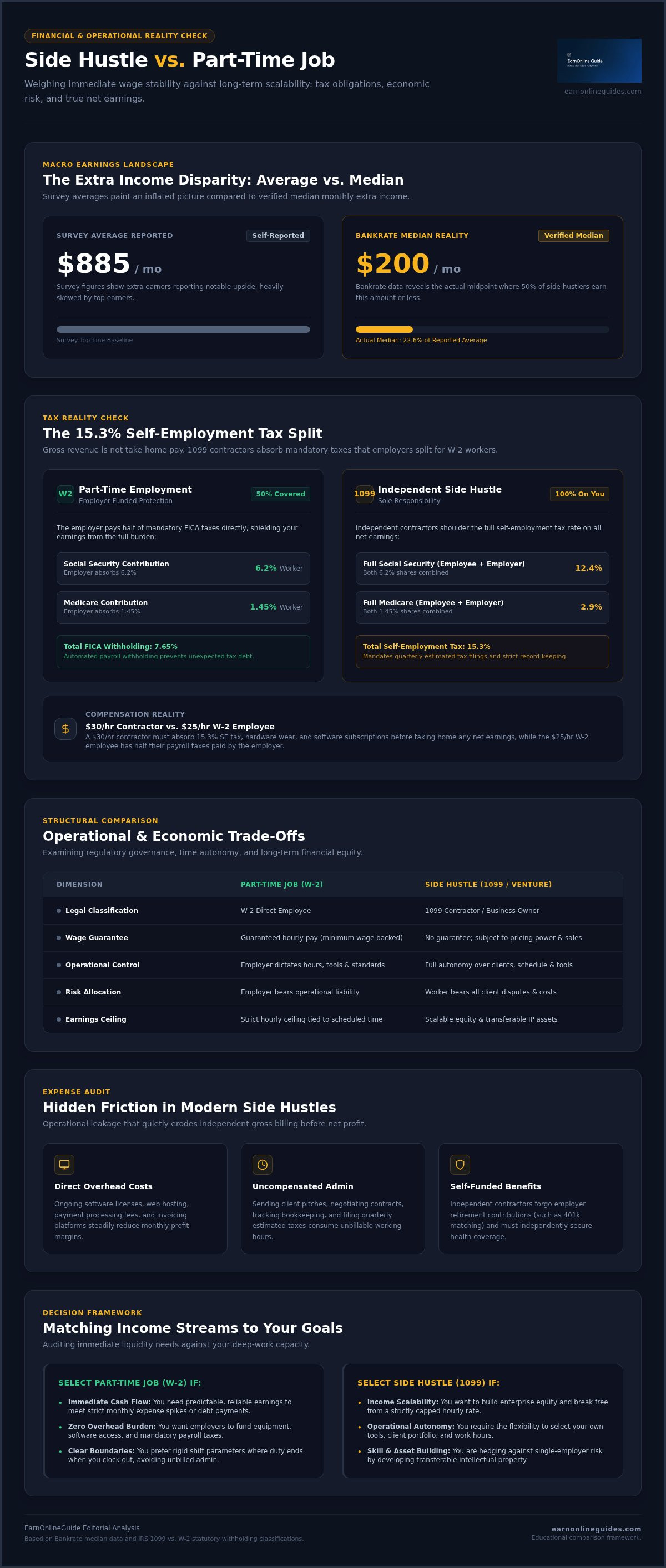
While survey figures show extra earners report an average of $885 per month, Bankrate data reveals that the median side hustle income is actually just $200. If you are weighing a side hustle vs part time job to combat persistent inflation, that disparity illustrates why this decision involves far more than picking up spare hours. It is fundamentally a trade-off between immediate wage stability and long-term income scalability.
You already know that taking on extra work stretches your calendar thin, and you shouldn't have to absorb surprise 15.3% self-employment taxes or chronic burnout just to protect your budget. This guide breaks down the verifiable financial realities of both models, giving you the exact criteria needed to protect your schedule and maximize your net take-home pay. Ahead, we will compare true hourly returns, administrative overhead, and career equity so you can commit to the right path for your 2026 goals.
Mainstream employment advice often reduces this comparison to the number of hours you log each week. That framing misses the structural legal divide that dictates your real financial exposure. When evaluating a side hustle vs part time job, the core distinction lies in operational control, regulatory classification, and who bears the economic risk. Distributed work environments have blurred these boundaries, allowing both options to run entirely from a laptop, yet their foundational mechanics remain entirely separate.
Today, secondary income paths serve different strategic functions. Workers no longer seek extra hours simply to cover utility spikes. Many pursue secondary ventures to hedge against single-employer risk, test enterprise concepts, or build portable skill sets. Selecting the correct model requires looking past gross earnings and evaluating the underlying legal frameworks outlined in our 1099 vs W-2 analysis.
A part-time job is an employer-led W-2 employment relationship. The employer establishes your operating hours, dictates performance standards, and assumes primary operational liabilities. In return, you receive guaranteed hourly compensation protected by federal and state minimum wage statutes. Employers must fund mandatory payroll contributions, carry workers' compensation coverage, and provide the software licenses or equipment required to execute your duties. This setup offers predictable downside protection: every hour you log converts directly into reliable, scheduled pay.
A side hustle operates as an individual-led venture governed by a 1099 contractor arrangement or direct ownership structure. Moving past routine participation in the standard gig economy, building a modern freelance practice or digital product business grants you complete pricing power and operational autonomy. You decide which clients to accept, which tools to deploy, and how to structure your deliverables.
That flexibility shifts all operational overhead directly to you. You are entirely responsible for client acquisition, hardware upgrades, unpaid contract disputes, and quarterly tax filings. While a side business introduces revenue volatility, it removes the standard wage ceiling, creating transferable intellectual property and long-term equity that a scheduled hourly job cannot match.
Gross revenue is often mistaken for actual take-home earnings. When evaluating a side hustle vs part time job, looking strictly at the top-line dollar figure creates a distorted financial picture. A traditional W-2 employer absorbs mandatory payroll costs by funding half of your FICA contributions (6.2% for Social Security and 1.45% for Medicare). In contrast, 1099 independent contractors shoulder the entire 15.3% self-employment tax burden on their net business earnings.
The gap becomes stark when comparing compensation directly. A contractor billing $30 an hour must cover self-employment taxes, software subscriptions, and hardware wear before taking home a single dollar. Meanwhile, an employee earning $25 an hour receives direct tax withholding alongside employer-paid payroll taxes. The IRS independent contractor vs. employee classification sets these obligations strictly, which is why calculating true take-home pay requires modeling all deductions. You can stress-test your numbers directly with a 1099 vs W2 calculator to uncover your exact breakeven target.
Operating an independent venture introduces recurring operational leakage that quickly cuts into gross earnings:
W-2 employment eliminates operating overhead and delivers clean financial clarity. Employers automatically handle income tax withholdings, preventing end-of-year tax debt. Certain employers also extend pro-rated 401(k) matching or statutory paid leave to part-time staff. Because the company funds operational tools, your gross hourly wage translates into predictable net pay without business reinvestment demands.
Work-life integration often breaks down when secondary commitments collide with your primary career. Choosing between a side hustle vs part time job requires an honest audit of your cognitive bandwidth and scheduling discipline. Over eight million Americans hold multiple jobs according to Bureau of Labor Statistics multiple jobholding data, representing more than 5% of the total national workforce. Sustaining that workload without professional burnout hinges on how cleanly your secondary work separates from your personal life.
Part-time W-2 positions establish a distinct operational boundary. Once your shift ends, your legal and mental responsibilities conclude immediately. You don't field customer complaints during family dinners or debug software tools on weekends. A side business operates under entirely different psychological conditions. Client communications, pipeline maintenance, and fulfillment issues can easily bleed into every open hour. Our ongoing analysis of remote work statistics shows that remote contractors without firm boundary protocols experience significantly higher rates of boundary fatigue than shift-based workers.
Autonomy delivers immense utility only if you can defend your calendar. Side hustles provide the freedom to work early mornings, late evenings, or during fragmented pockets around childcare duties. Yet unmanaged flexibility quickly collapses into operational chaos. Successful independent operators rely on strict time-blocking to isolate productive sprint sessions from baseline administrative overhead. In contrast, part-time jobs enforce rigid shift assignments. While that rigidity limits spontaneous schedule shifts, it protects your downtime by completely removing off-clock performance obligations.
Thriving with online side hustles demands internal self-direction. No supervisor tracks your weekly output or reminds you to complete administrative tasks. If you prefer external checkpoints, an employer-led part-time role provides structural clarity that reduces executive fatigue:
A part-time job enforces a fixed mathematical ceiling: your earnings equal your agreed hourly rate multiplied by the hours you log. You cannot scale that output without working longer shifts. When evaluating a side hustle vs part time job through the lens of multi-year wealth creation, a side venture breaks this constraint by allowing you to decouple revenue from direct labor. By packaging services into recurring digital assets or exploring proven passive income ideas, you create systems that yield returns long after the initial setup phase.
Independent initiatives act as a live beta test for broader enterprise operations. Instead of waiting for internal corporate promotions, launching a commercial venture compels you to integrate advanced technical workflows immediately. Mastering high-leverage AI skills allows a solo operator to handle copywriting, data analysis, and workflow automation at the capacity of an entire department, driving up your effective hourly rate far beyond traditional wage scales.
Corporate part-time positions develop depth within a single operational silo, such as inventory control, customer support, or localized bookkeeping. While valuable, this isolated experience limits cross-functional competence. Running a side venture forces comprehensive skill stacking across four critical domains:
Every billable hour committed to a traditional employer builds company value for the business owner. Conversely, self-directed ventures yield permanent digital assets, organic search visibility, and proprietary client lists that you own outright. That commercial equity can eventually be packaged and sold. Realizing that value requires sustained operational consistency; most independent projects demand 12 to 18 months of disciplined execution before yielding dependable returns. Map your milestones against our realistic timeline to replace full-time income to build an execution plan grounded in measurable benchmarks.
Selecting the wrong vehicle creates friction that undermines both your bank account and your primary career. Instead of relying on passion-centered advice, choosing between a side hustle vs part time job requires an objective operational framework based on liquidity, time availability, and risk tolerance.
An employer-led W-2 position is the optimal choice under clear operational conditions:
Launching a 1099 venture or digital business is warranted when specific foundational assets exist:
Deciding between a side hustle vs part time job isn't about chasing generic trends or defaulting to traditional shifts. It is an intentional operational calculation. If you require immediate, deterministic cash flow without administrative drag, a structured W-2 role provides strong downside protection. If your priority is compounding long-term equity and uncapped pricing leverage, building an independent venture justifies the upfront operational friction.
Making the right commitment requires actual figures rather than rough estimates. Factor in updated 2026 tax data, evaluate opportunities in our vetted remote job directory, and stress-test your capacity against data-driven income models. Ready to see the real numbers? Use our 1099 vs W-2 Breakeven Tool to compare your net earning potential and select the path that best supports your financial independence.
A part-time job is generally simpler and shields you from self-employment taxes. Employers cover half of mandatory FICA taxes (7.65%), whereas side hustlers must pay the full 15.3% self-employment rate on net profits. However, side hustlers can deduct qualifying business expenses and mileage to lower taxable income. For pure predictability and minimal administrative stress, a W-2 part-time job carries far less tax risk.
Yes, you can operate both simultaneously provided your employment agreements permit outside work. Many people combine a steady part-time wage for guaranteed liquidity with an asynchronous digital venture to build scalable equity. Always review company policies regarding non-compete clauses or moonlighting limitations. Keeping your client projects isolated on personal devices ensures your independent venture never conflicts with your employer's property.
Low-overhead digital services offer the lowest financial barrier and strongest skill-building potential for beginners. Content strategy, freelance technical writing, workflow automation setup, and digital product creation require minimal capital. When evaluating a side hustle vs part time job, these digital models allow you to test commercial demand without taking on operational debt, letting you increase pricing as your execution speed improves.
Dedicating 8 to 12 focused hours per week is the most sustainable baseline for an independent venture. Committing more than 15 hours alongside existing responsibilities significantly increases cognitive fatigue and burnout risk. Structuring this time into two 90-minute weekday focus blocks and a single weekend operational sprint protects your health while keeping your project moving forward at a reliable pace.
Some employers provide health coverage to part-time staff, but eligibility varies widely by organization. Under federal rules, employers are only required to offer coverage to staff averaging at least 30 hours per week. However, select national corporate employers and retail chains extend partial health packages to employees working 20 hours weekly. Always request official benefits documentation during onboarding to verify exact qualification thresholds.
Yes, the IRS classifies all 1099 independent contractor earnings as self-employment income. If you earn net profits of $400 or more during the calendar year, you must legally report that revenue on Schedule C and pay self-employment tax. You operate as a sole proprietor by default, which means you are responsible for monitoring gross revenue, organizing deductions, and submitting quarterly estimated tax payments.
Your venture is truly profitable only when your net hourly return exceeds your baseline expenses and tax reserves. Determine profitability by subtracting direct tool subscriptions, platform fees, and a 25% to 30% tax allowance from gross receipts. Then divide that figure by your total invested time, making sure to include unbillable hours spent on lead generation, client communications, and basic accounting.
The risk of a side hustle vs part time job centers on revenue uncertainty and capital exposure. A part-time job guarantees hourly compensation with zero financial overhead. In contrast, an independent venture risks negative initial cash flow through software expenses and operational tools before generating consistent sales. It also carries the psychological weight of unpaid labor if your offering takes time to find its market.

Article by
EarnOnlineGuides Editorial Team
The EarnOnlineGuides Editorial Team creates practical, research-driven educational content about making money online, remote work, freelancing, side hustles, digital skills, AI tools, online business, and self-employment. Our goal is to help readers understand their options, compare realistic opportunities, avoid misleading claims, and make better-informed decisions. We prioritize accuracy, transparency, practical guidance, and responsible reporting, and we regularly review our content to keep it useful and up to date.
The information provided in this article is for general educational and informational purposes only and should not be considered financial, investment, tax, legal, or professional advice. Earnings, income examples, costs, fees, and other figures may vary and are not guaranteed. Always conduct your own research and consult a qualified professional when appropriate.
Some articles on EarnOnlineGuides may contain affiliate links. If you click a link and make a purchase or sign up for a service, we may receive a commission at no additional cost to you. This does not influence our editorial standards or recommendations.
We strive to keep our information accurate and up to date, but products, services, fees, policies, laws, and market conditions can change. Please verify important information directly with the relevant provider before making financial or business decisions.
Educational information only. This article is not financial, tax, or legal advice. Platform fees and policies change; always confirm current rates in the marketplace's official fee documentation before making decisions.
Explore low cost digital side hustles you can test in 2026. Compare freelance work, digital goods, and reselling while managing hidden platform fees and time.

Learn how to open a freelance business bank account step by step. Explore document checklists, compare bank options, and keep business finances organized.

Learn how to write affiliate product reviews readers can trust. Discover a practical process for honest testing, balanced pros and cons, and clear disclosures.