
Low-Cost Digital Side Hustles: Practical Ways to Start in 2026
Explore low cost digital side hustles you can test in 2026. Compare freelance work, digital goods, and reselling while managing hidden platform fees and time.
October 13, 202618 min read

While 53% of Gen Z workers now participate in freelancing, contributing to a $1.5 trillion economy, the path for a beginner remains clouded by exaggerated claims of effortless wealth. You likely feel the pressure to jump into the market but worry about being scammed or failing to manage the complex legalities of self-employment. It's a valid concern; learning how to start freelancing with no experience requires more than just a laptop and a profile on a platform. It demands a methodical approach to skill verification and financial planning.
This guide offers a grounded roadmap for building a legitimate career from scratch by prioritizing long-term sustainability over immediate gratification. We'll provide a verified list of entry-level skills for 2026, a data-backed framework for pricing your work, and a clear breakdown of the 15.3% self-employment tax. You'll gain a thorough understanding of the 1099 vs W-2 trade-off, helping you manage financial risks with the precision of a researcher rather than the guesswork of an amateur. We'll examine the specific steps needed to turn a lack of professional history into a portfolio that proves your actual value to clients.
Understanding how to start freelancing with no experience begins with a fundamental shift in perspective. You aren't looking for a traditional job; you're establishing a business-to-business relationship. To understand What is a freelancer?, you must view yourself as a vendor providing a specific service to a client. Clients in 2026 don't buy resumes; they buy outcomes. If you can provide a solution to a problem, your lack of a professional history becomes secondary to your ability to deliver documented results.
The 2026 landscape is defined by the heavy integration of AI tools. While 45% of freelancers now use AI to streamline their workflows, this technology has created a dual effect. It's easier than ever to produce basic content or code, but the market value for average work has plummeted. To build a sustainable career rather than a temporary side hustle, you must use these tools to enhance your unique human oversight and quality control. The barrier to entry is lower, but the bar for professional-grade output is significantly higher.
Legitimate remote jobs no experience required exist, but they're rarely easy. If a platform or guru promises high pay for minimal effort, it's almost certainly a scam. True entry-level freelancing involves identifying roles with low technical barriers but high demand for reliability. Examples include AI prompt testing, data verification, or specialized administrative support. Success requires a grounded mindset. You must prioritize building a reputation for consistency over chasing immediate, high-dollar gratification that lacks a foundational skill set.
Transitioning from a W-2 employee to a 1099 independent contractor involves a significant shift in legal and financial responsibility. You're now responsible for the employer's portion of taxes, which contributes to a total self-employment tax rate of 15.3% on net earnings. Before taking your first contract, use a 1099 vs W-2 comparison to understand your actual take-home pay after expenses.
Your first 12 months should focus on sustainability rather than peak earnings. Many beginners fail because they don't account for the real cost of doing business, such as software subscriptions and health insurance. A realistic path involves several specific financial habits:
Learning how to start freelancing with no experience is essentially a project in information triage. You must filter out high-cost, low-value "guru" courses that promise shortcuts to six-figure contracts. Instead, use a data-driven approach like the Digital Skills Matrix to identify roles where the demand outweighs the supply of experienced professionals. This framework allows you to visualize which skills have a low barrier to entry but offer a clear pathway toward specialization.
In 2026, AI literacy is no longer an optional add-on; it is a mandatory foundational skill. Research shows a 109% year-over-year growth in demand for AI-tagged freelance skills. This does not mean you need to become a developer. It means you must demonstrate an ability to use AI tools to produce higher-quality output with greater efficiency. As you begin this journey, you should also account for the administrative realities of your future business, such as managing self-employment taxes from your very first dollar earned.
If you prefer a structured entry point, consider non-phone work from home jobs such as data verification, AI prompt auditing, or technical documentation. These roles allow you to build a professional track record without the high pressure of client-facing sales. To maximize your marketability, focus on the best AI skills to learn 2026, specifically those related to workflow automation and AI-augmented content editing. These skills act as force multipliers, allowing a beginner to compete with more experienced generalists who have not yet updated their technical toolkit.
A legitimate learning path moves from general digital literacy to a specialized skill. Avoid the trap of perpetual learning by adopting a "build-in-public" methodology. This involves documenting your learning process on professional networks to create a visible track record before you ever land a formal client. You can validate your skill level by completing small-scale personal projects or offering pro-bono services to non-profits. This practical application provides the "Proof of Skill" that replaces the traditional resume in the freelance economy. For a more detailed breakdown of these steps, you might explore our guide on digital skills for beginners to help structure your first 90 days.
A common error when learning how to start freelancing with no experience is setting a rate that mirrors a previous W-2 salary. If you earned $30 per hour as an employee, a $30 freelance rate will result in a significant net loss. As an independent contractor, you're responsible for overhead that an employer previously covered, including health insurance, equipment, software, and the full 15.3% self-employment tax. To identify a sustainable starting point, you must use a 1099 vs W-2 breakeven analysis to determine your minimum viable rate.
Your billable hours represent only a fraction of your total workload. Administrative tasks, marketing, and skill development are non-billable but essential. A structured freelance rate calculator can help you factor in these "hidden" hours. While value-based pricing is the goal for high-margin work, beginners typically start with hourly or project-based rates. The key is to ensure your floor rate accounts for approximately 25% to 30% of non-billable time. Clients pay for outcomes, but your business survives on margins.
Beginners often feel pressured to undercut the market to land their first contract. This strategy is counterproductive; it attracts low-quality clients and sets a low anchor for your future value. Instead, look at how to price freelance work based on the specific problem you solve. If a project takes you five hours but saves a client twenty hours of manual labor, your price should reflect that saved time rather than just your hourly effort. This shift from "selling time" to "selling solutions" is the foundation of a sustainable freelance career.
Understanding how to start freelancing with no experience also means becoming your own chief financial officer. The IRS requires most freelancers to make quarterly estimated tax payments. Failing to do so can result in an underpayment penalty, which is currently 7% for 2026. To manage this, implement the "Tax Bucket" method. Immediately transfer 30% of every client payment into a dedicated savings account. This ensures funds are available for the April, June, September, and January deadlines. Utilizing a 1099 tax calculator allows you to project these liabilities with accuracy based on your expected annual net profit.
Business expenses can offset your taxable income, but they must be ordinary and necessary for your trade. Common deductions for digital freelancers include software subscriptions, home office costs, and hardware depreciation. Documenting these expenses meticulously from day one is a requirement for long-term fiscal health and tax compliance.
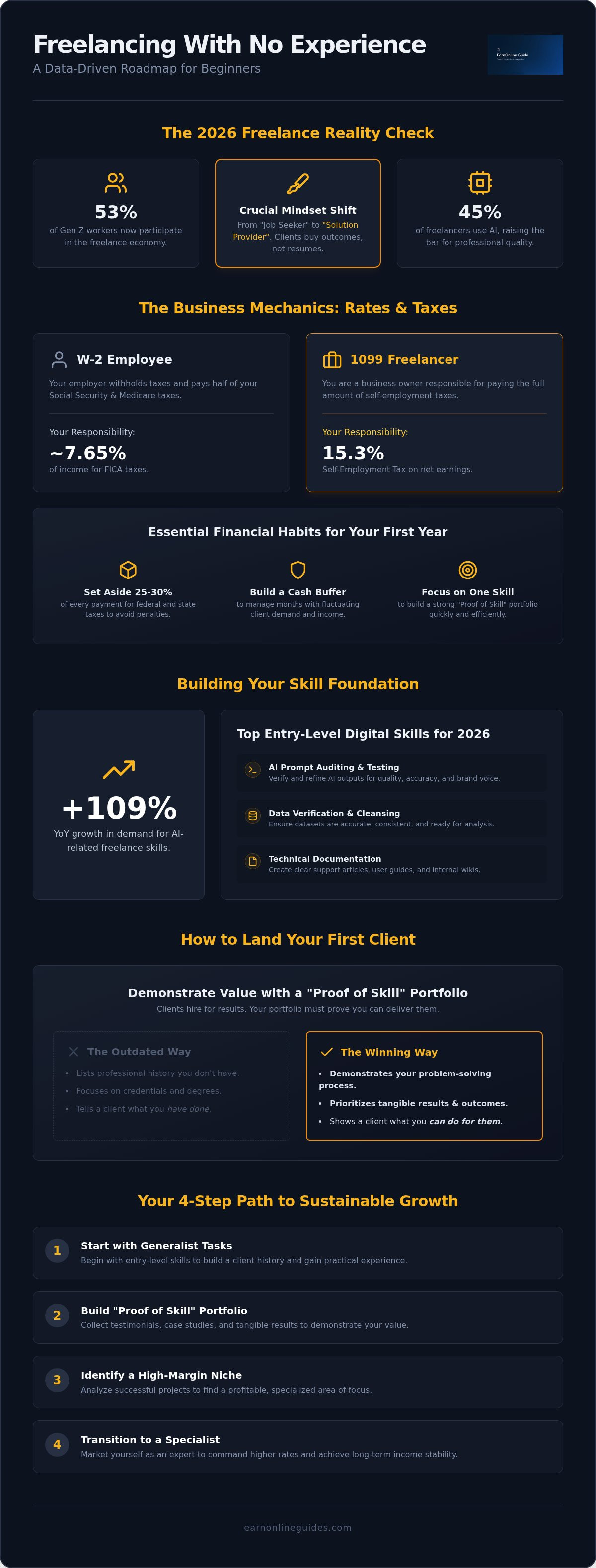
When you're learning how to start freelancing with no experience, your biggest hurdle isn't a lack of talent; it's a lack of trust. Traditional job seekers rely on resumes to prove their history, but as a freelancer, you must rely on a portfolio that proves your process. Clients in 2026 are increasingly skeptical of polished final products that could be entirely AI-generated. To differentiate yourself, your portfolio should document the "how" behind your work. Show the initial problem, the steps you took to solve it, and the specific tools you used to reach the conclusion.
Stop searching for "jobs" and start identifying "problems." A job search is passive; a solution-oriented approach is proactive. This requires vetting potential clients with the same scrutiny they apply to you. Legitimate opportunities are rarely found in the comments of social media posts or via unsolicited direct messages promising "easy tasks." Instead, utilize a vetted remote job directory to find companies that have already been screened for legitimacy. This protective filter is essential for avoiding the non-paying "opportunities" that frequently target beginners.
A successful pitch focuses 90% on the client's pain point and only 10% on your service. If you can articulate a client's problem better than they can, they'll automatically assume you have the solution. Use the "Small Win" strategy to lower the barrier to entry. Offer a low-risk, fixed-price trial project that solves one specific, narrow problem. This allows you to demonstrate value without requiring the client to commit to a long-term contract. You can use AI writing tools for freelancers to help personalize these pitches at scale, ensuring you address the specific nuances of each client's industry while maintaining a professional, human-led tone.
Marketplaces like Upwork or Fiverr provide a layer of escrow protection, but they aren't immune to fraud. You must know how to spot fake remote job listings, such as those asking for "interview fees" or requesting that you purchase equipment from a specific vendor. Optimize your profile for specific search discovery by using descriptive terms like "non-phone work" or "technical data verification" rather than generic titles like "Virtual Assistant."
While platform fees can range from 10% to 20%, they provide a necessary safety net for beginners. Don't attempt to move clients off-platform until you have a signed, independent contract and a reliable invoicing system in place. If you're ready to begin your search with a higher level of security, browse our directory of vetted remote job listings to find your first legitimate contract today.
After the initial phase of learning how to start freelancing with no experience, your focus must shift from acquiring any client to acquiring the right clients. While 18% of U.S. freelancers now earn six figures annually, these high earners rarely remain generalists. Transitioning to a specialist role allows you to increase your margins because you're solving a specific, high-value problem for a narrow audience. This transition is a core component of a realistic income model, where you stop trading hours for dollars and start trading expertise for outcomes.
To scale sustainably, you must avoid the "Freelancer Trap." This occurs when you're so busy with billable client work that you neglect business development. A professional freelancer dedicates at least 15% to 20% of their week to marketing, refining their internal systems, and updating their technical toolkit. Reinvesting a portion of your profits into advanced tools or specialized training is a requirement for foundational growth. This disciplined approach ensures you aren't perpetually starting from zero when a single contract ends.
Long-term success depends on aligning your current projects with the best work-from-home careers 2026. Networking plays a critical role here, but it's not about generic outreach. It's about building relationships with other professionals in your niche who can offer peer verification and referrals. These connections often lead to contracts that bypass public job boards entirely. Additionally, you must set firm boundaries regarding your working hours from day one. Without these constraints, the flexibility of remote work quickly turns into a 24/7 cycle of availability that isn't sustainable for a multi-year career.
Once your freelance income is stable, you can begin exploring the best passive income ideas for beginners as a supplement to your active billable work. Use the data you've gathered from your freelance clients to validate an online business idea that addresses a recurring market gap. This data-driven approach reduces the risk of failure by ensuring there is existing demand for your solution. Remember that the realistic timeline to replace full-time income online typically spans 12 to 24 months of consistent effort. Patience and methodical planning are more valuable than speed during this scaling phase.
Transitioning into the independent workforce is a significant professional evolution that requires more than just basic digital literacy. Success depends on your ability to document your problem-solving process and manage the fiscal responsibilities of a business owner. Understanding how to start freelancing with no experience involves moving past the "gig" mindset and adopting a long-term strategy for foundational growth. You're building a business, not just finding a flexible job.
Before you accept your first contract, you must validate the financial viability of your move. Our 1099 vs W-2 Breakeven Tool has been used by over 50,000 career changers to find their minimum profitable rate. It's updated with 2026 tax data and vetted by independent financial researchers to ensure your projections are grounded in reality. Calculate your target freelance rate with our 1099 vs W-2 Breakeven Tool to ensure your new career path is sustainable from day one.
Building a legitimate career takes time and deliberate planning. With the right data and a commitment to skill verification, you can successfully navigate this transition and achieve lasting professional autonomy.
Yes, starting with no professional history is possible if you focus on delivering specific outcomes rather than relying on a traditional resume. You must build a portfolio that demonstrates your process through personal projects or volunteer work. This documented "Proof of Skill" acts as your primary credential in the freelance market. Success requires identifying entry-level roles with low technical barriers but high demand for reliability and consistency in 2026.
High-demand skills for 2026 include AI prompt auditing, technical documentation, and specialized data verification. Beginners should also explore non-phone work from home jobs like administrative support or content editing. Learning how to start freelancing with no experience is more effective when you focus on AI-augmented workflows. These skills allow you to produce professional-grade results faster, giving you a competitive edge over generalists who lack modern technical literacy.
You can avoid scams by identifying red flags such as requests for "interview fees" or requirements to purchase equipment from specific vendors. Legitimate clients won't ask you to pay for the opportunity to work. To increase your safety, utilize a vetted remote job directory rather than searching through unmoderated social media posts. Always verify a company's history and ensure all payments are handled through secure, established platform escrow systems.
Most freelance roles don't require a formal degree or specific certification, as clients prioritize your ability to solve their immediate problems. While a degree can provide a foundational background, your portfolio is the primary factor in landing contracts. If you can demonstrate a clear problem-solving process and a history of reliable delivery, your educational background becomes secondary. Focus on building visible evidence of your skills through practical, documented projects.
Realistic earnings for a beginner typically range between $20 and $40 per hour depending on the complexity of the service. Your total annual income depends on the number of billable hours you secure and your ability to manage overhead. It's important to remember that gross pay is not net profit. You must account for the 15.3% self-employment tax and other business expenses when calculating your actual take-home pay during your first year.
The primary difference involves tax responsibility and legal status. A W-2 employee has taxes withheld by an employer, while a 1099 freelancer is responsible for paying the full self-employment tax. Additionally, 1099 contractors don't receive employer-sponsored benefits like health insurance or 401(k) matching. You must use a 1099 vs W-2 comparison tool to understand the higher gross rate required to match your previous net salary as an employee.
You should price your services by first calculating your total business overhead and tax liabilities. Start with a breakeven analysis to find your minimum viable rate, ensuring you don't undercut your own sustainability. Factor in non-billable time spent on marketing and administration, which usually accounts for 25% of your workweek. Avoid the "race to the bottom" on pricing platforms; instead, set a rate that reflects the specific value you provide to the client.
AI is automating repetitive tasks, but it's also creating new opportunities for human-led oversight and quality control. While some basic roles are disappearing, the demand for freelancers who can effectively use AI tools is growing rapidly. You don't need to fear replacement if you focus on higher-level skills like AI prompt engineering or technical editing. Learning how to start freelancing with no experience today requires integrating these tools into your workflow to remain competitive.

Article by
EarnOnlineGuides Editorial Team
The EarnOnlineGuides Editorial Team creates practical, research-driven educational content about making money online, remote work, freelancing, side hustles, digital skills, AI tools, online business, and self-employment. Our goal is to help readers understand their options, compare realistic opportunities, avoid misleading claims, and make better-informed decisions. We prioritize accuracy, transparency, practical guidance, and responsible reporting, and we regularly review our content to keep it useful and up to date.
The information provided in this article is for general educational and informational purposes only and should not be considered financial, investment, tax, legal, or professional advice. Earnings, income examples, costs, fees, and other figures may vary and are not guaranteed. Always conduct your own research and consult a qualified professional when appropriate.
Some articles on EarnOnlineGuides may contain affiliate links. If you click a link and make a purchase or sign up for a service, we may receive a commission at no additional cost to you. This does not influence our editorial standards or recommendations.
We strive to keep our information accurate and up to date, but products, services, fees, policies, laws, and market conditions can change. Please verify important information directly with the relevant provider before making financial or business decisions.
Educational information only. This article is not financial, tax, or legal advice. Platform fees and policies change; always confirm current rates in the marketplace's official fee documentation before making decisions.
Explore low cost digital side hustles you can test in 2026. Compare freelance work, digital goods, and reselling while managing hidden platform fees and time.

Learn how to open a freelance business bank account step by step. Explore document checklists, compare bank options, and keep business finances organized.

Learn how to write affiliate product reviews readers can trust. Discover a practical process for honest testing, balanced pros and cons, and clear disclosures.