
Low-Cost Digital Side Hustles: Practical Ways to Start in 2026
Explore low cost digital side hustles you can test in 2026. Compare freelance work, digital goods, and reselling while managing hidden platform fees and time.
October 13, 202618 min read

The side hustle that seems closest to teaching isn’t always the easiest to fit around a school week. Tutoring, for example, uses familiar skills but often requires scheduled sessions. Creating lesson materials may offer more flexibility, but it can take time to find buyers. A side hustle for teachers should fit your available time and energy, not just your résumé.
It’s reasonable to be cautious about adding work when the school year already leaves limited room to recharge. The right choice depends on what you can offer, how much setup it requires, and whether you need predictable hours or can tolerate uneven demand.
This guide compares 10 practical options by skill fit, schedule, setup effort, and income uncertainty, from tutoring and curriculum writing to freelance work and digital products. You’ll also find a manageable way to test one idea before committing more time, plus a reminder to review any school-employer rules that may apply.
A practical side hustle for teachers is paid work alongside teaching that respects real limits on schedule and energy. The goal isn’t to fill every open hour. It’s to find work that uses skills you already have without creating a second workload that becomes hard to sustain during the school year.
Teaching involves more than delivering lessons. Teachers explain complex ideas, plan sequences of work, communicate with different audiences, assess progress, and adjust when someone needs another approach. These skills can transfer to paid work, but having a skill doesn’t guarantee demand. Potential clients need a clear service or deliverable, and finding them can take time. Earnings, demand, and the time needed to build a client base vary.
A side hustle may involve scheduled shifts or appointments, such as tutoring at a set time. Other work is project-based or asynchronous, meaning you complete it on your own schedule within an agreed deadline. Neither format is automatically easier: live work requires availability, while flexible projects may involve finding clients, clarifying scope, and managing deadlines.
For a general overview of what a side hustle is, consider how it differs from a full-time role. It is additional paid work, not necessarily a predictable or passive source of income. Teachers can compare options and formats in this guide to online side hustles.
Explaining a difficult concept in clear steps can support tutoring, test-preparation instruction, educational writing, or instructional content. Planning and organization may apply to curriculum support, editing, or project-based services. Assessment skills can help you identify where a learner is stuck and tailor feedback. The commercial value of any skill depends on whether an audience needs the outcome and whether you can deliver it reliably.
Start by identifying the hours you can realistically spare during the school year, then note when your schedule may be more flexible. Decide whether live appointments, independent tasks, or occasional projects suit your energy and home responsibilities. Before accepting work, review relevant employer or district policies. Keep side work separate from school duties, and protect student privacy and professional boundaries.
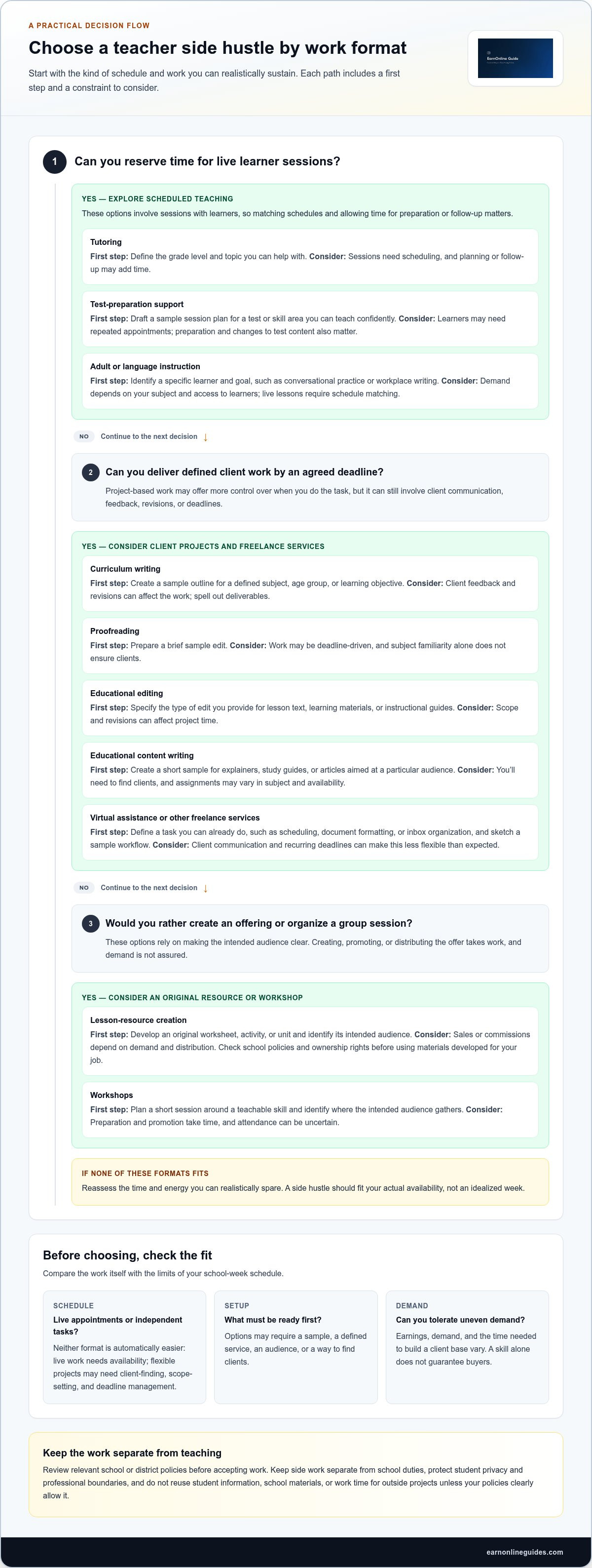
These options are grouped by the kind of work involved, not by projected earnings. For each, consider the first task required to get started and the main constraint. The right side hustle for teachers depends on subject fit, schedule, and whether you’re prepared to find clients or an audience.
For a broader view of teachers’ work environments and job outlook, see the Bureau of Labor Statistics’ profile of high school teachers. To compare additional formats beyond education, explore this guide to online side hustles.
The best comparison is about trade-offs, not a universal ranking. Appointment-based services tie work to specific times, while project work may give you more control over when tasks get done. Digital products can be sold without live appointments, but they still require creation, distribution, and upkeep. Use the table to identify which demands fit your school-year schedule.
| Work format | Schedule flexibility | Client interaction | Setup work | Income variability |
|---|---|---|---|---|
| Tutoring or test preparation | Lower; sessions happen at agreed times. | High; instruction and follow-up involve direct contact. | Define a subject, learner, and session plan. | Can depend on client availability, repeat bookings, and seasonal demand. |
| Workshops or adult instruction | Mixed; sessions are scheduled, but may be occasional. | High during instruction, plus promotion beforehand. | Develop a focused session and reach the intended audience. | Attendance and audience access can vary. |
| Editing, proofreading, or educational writing | Often higher; tasks may be completed asynchronously by a deadline. | Moderate; clients still need to clarify scope and review work. | Prepare a clear service description and sample. | Depends on finding assignments and maintaining client relationships. |
| Curriculum or lesson-resource projects | Often higher, subject to milestones and delivery dates. | Moderate; project feedback and revisions may be part of the work. | Set the deliverable, audience, and revision boundaries. | Project availability and repeat work are uncertain. |
| Digital educational products | Creation is self-scheduled; updates and customer needs still take time. | Usually less direct interaction, though support may be needed. | Create original material and plan how people will find it. | Demand depends on audience reach, product fit, and ongoing distribution. |
Tutoring and live instruction require agreed appointment times, so you need dependable availability. Editing and writing may be done asynchronously, but a flexible deadline is still a commitment. Estimate the full task, including communication and revisions, before accepting it. Schedule control only helps if the workload fits the time you actually have.
Service work generally starts with a defined offer and a way to reach potential clients. Product work starts with creating something useful, then requires distribution and possible maintenance. Neither model removes the need to build demand. Results can vary with subject, experience, audience, client discovery, and available hours, so treat early interest as something to test rather than assume.
A small test can show whether a side hustle fits your teaching schedule before you invest heavily in it. Use this sequence to assess the idea:
For example, instead of building a full library of classroom materials, create one original resource for a clearly defined learner or educator. If you plan to sell it online, account for platform deductions before setting expectations. Online selling fee calculators can help you estimate fees. Confirm actual terms with the platform because they can change.
Choose one audience, one problem, and one offer. A science teacher might test a sample review session for a specific topic, while an experienced editor might share a short before-and-after editing sample. Keep the pilot narrow enough to fit your available time. Record inquiries, hours spent, expenses, and feedback. These observations help you evaluate the test, but they don’t guarantee future demand or income.
Set a realistic weekly capacity before accepting work, and pause new commitments when school demands increase. Keep student records, school materials, and side-hustle files separate. Don’t use student information or school resources for outside work unless applicable policies explicitly permit it. Review employer or district rules before starting. For tax questions, use relevant official sources; for platform terms, review the platform’s own policies.
After a small test, compare the time it took with the response you received. If you want a structured way to assess a broader idea, use this guide to validating an online business idea.
Choose one idea by weighing four factors: how well it uses your skills, whether its schedule fits your teaching week, how much setup it requires, and whether it respects your personal boundaries. A side hustle for teachers should begin as a limited test, not an open-ended commitment. Decide what you’ll deliver and when you’ll review the experience before accepting more work.
Write down who the offer is for, what problem it addresses, and how you’ll deliver it. For example, an educator creating a resource might specify its intended audience, learning goal, and format. A tutor might define the subject and session format. Keep the initial scope small enough to complete within your actual availability.
Set a capacity limit based on time, not a hoped-for earnings target. Then track the hours spent, any expenses, inquiries, feedback, and whether people express interest in repeat work. At your review point, ask whether the work was manageable and whether the evidence justifies another test. Early interest is useful information, not a reliable forecast of future results.
Reassess if side work repeatedly cuts into rest, teaching responsibilities, or personal commitments. If people are interested but misunderstand what you provide, clarify the offer or narrow its scope. If the work takes more time than you can reasonably protect, reduce the commitment or pause it. Stopping a test that doesn’t fit is a valid outcome, not a reason to take on more work.
Before expanding, compare the actual workload with your original limit. Consider whether feedback points to a specific improvement and whether there’s evidence of ongoing interest, rather than relying on assumptions about future demand.
For a wider comparison of options, explore the Online Side Hustles guide. Use it to identify another possibility only if your first test shows that you have room to evaluate one.
The right side hustle for teachers is one that fits your skills and real-life capacity. Tutoring and live instruction offer direct interaction but require scheduled availability. Project work may offer more control over when you work, while digital products still need creation, distribution, and upkeep.
Before taking on more, define a small offer and a realistic time limit. Track the hours, expenses, feedback, and signs of repeat interest, then decide whether to adjust, continue, or pause. A modest test gives you useful information without assuming demand or income will grow.
Choosing a sustainable option takes careful comparison. EarnOnlineGuides offers beginner-friendly guides and tools for evaluating online income options with an evidence-conscious approach that avoids guaranteed-income claims. Explore practical online side hustle ideas to compare additional possibilities at your own pace.
One thoughtful first step is enough. Choose an idea that respects your time, and let what you learn guide what comes next.
Tutoring can be a good fit for teachers who want to use subject knowledge in scheduled one-to-one or small-group sessions. Before committing, account for preparation and follow-up time as well as the appointment itself. Consider whether you can reliably reserve those hours during the school year, whether there’s demand for your subject, and how comfortable you are communicating with clients. Recurring sessions may be a poor fit if your availability changes often.
Teachers can create and sell original educational resources, but producing a useful item is only part of the work. You may also need to organize, describe, and promote it so potential buyers understand its purpose. Review employer policies and ownership terms before using classroom materials, and never include identifiable student information. Demand and sales are uncertain, so treat an initial resource as a test rather than a forecast of ongoing income.
There isn’t one best option for every teacher. A side hustle for teachers should match subject strengths, energy, schedule, and boundaries. Asynchronous writing or editing may suit someone who needs flexible work blocks, while tutoring may fit someone who prefers direct instruction and can reserve appointment times. Compare the full time commitment, including preparation, client communication, delivery, and revisions. Then test a limited offer before accepting ongoing work.
Side-hustle earnings vary with the service, demand, experience, hours worked, expenses, and how consistently clients or buyers are available. No published estimate can predict an individual teacher’s results. Track payments alongside time and costs to understand what a trial actually produces. Don’t treat early interest or one strong month as a reliable forecast. For questions about tax obligations, consult official IRS information or a qualified tax professional.
Whether approval is required can depend on an employer’s or district’s policies, a contract, and the type of outside work. Review the applicable rules before accepting work, especially if it involves students, teaching services, school materials, or school resources. This general guidance can’t determine what applies to an individual teacher. For a specific case, consult the relevant policy or appropriate official contact, and keep outside work separate from school duties.
Start with one offer for one audience, and limit the initial workload. Estimate time for preparation, communication, delivery, and follow-up, not only the paid task. Set a capacity limit that fits your week, keep school responsibilities separate, and review the experience before expanding. If the work repeatedly reduces rest or interferes with teaching, cut back or reconsider the fit. A small test can provide useful information without requiring a long-term commitment.

Article by
EarnOnlineGuides Editorial Team
The EarnOnlineGuides Editorial Team creates practical, research-driven educational content about making money online, remote work, freelancing, side hustles, digital skills, AI tools, online business, and self-employment. Our goal is to help readers understand their options, compare realistic opportunities, avoid misleading claims, and make better-informed decisions. We prioritize accuracy, transparency, practical guidance, and responsible reporting, and we regularly review our content to keep it useful and up to date.
The information provided in this article is for general educational and informational purposes only and should not be considered financial, investment, tax, legal, or professional advice. Earnings, income examples, costs, fees, and other figures may vary and are not guaranteed. Always conduct your own research and consult a qualified professional when appropriate.
Some articles on EarnOnlineGuides may contain affiliate links. If you click a link and make a purchase or sign up for a service, we may receive a commission at no additional cost to you. This does not influence our editorial standards or recommendations.
We strive to keep our information accurate and up to date, but products, services, fees, policies, laws, and market conditions can change. Please verify important information directly with the relevant provider before making financial or business decisions.
Educational information only. This article is not financial, tax, or legal advice. Platform fees and policies change; always confirm current rates in the marketplace's official fee documentation before making decisions.
Explore low cost digital side hustles you can test in 2026. Compare freelance work, digital goods, and reselling while managing hidden platform fees and time.

Learn how to open a freelance business bank account step by step. Explore document checklists, compare bank options, and keep business finances organized.

Learn how to write affiliate product reviews readers can trust. Discover a practical process for honest testing, balanced pros and cons, and clear disclosures.