
Low-Cost Digital Side Hustles: Practical Ways to Start in 2026
Explore low cost digital side hustles you can test in 2026. Compare freelance work, digital goods, and reselling while managing hidden platform fees and time.
October 13, 202618 min read

A receipt alone doesn’t make a purchase deductible. The business purpose, how you used the item, and the records supporting it all matter. This self-employment tax deductions checklist for 2026 helps you review potential expenses without assuming every work-related purchase qualifies.
It can be difficult to distinguish business costs from personal or mixed-use expenses, and to tell which items belong on Schedule C versus elsewhere on your return. Start by documenting the business connection and any personal-use portion for each cost.
Use the checklist to review common categories such as supplies, software, travel, vehicle use, and home office costs. It also separates operating expenses from items such as the deductible portion of self-employment tax and retirement contributions, which may be handled elsewhere. Tax rules and limits can change, so verify 2026 details with current IRS guidance or a qualified tax professional when a situation is unclear.
Use this checklist to identify expenses that may merit review, not to assume that every purchase connected to work is deductible. For each cost, record what you bought, how it supported your business, whether you also used it personally, and what documentation you have. A category on a receipt or bank statement is a starting point, not a tax conclusion.
The IRS standard for a business expense is that it be both ordinary and necessary. In IRS usage, “ordinary” means common and accepted in your trade or business; “necessary” means helpful and appropriate for it. Check the IRS guidance and instructions for the 2026 tax year before filing, since forms and instructions can change.
Start with the business purpose. A freelance designer’s subscription to software used to create client work may be a candidate expense. If the designer also uses it for personal projects, that personal use may affect how the cost is treated. The software label alone doesn’t settle the question. Consider what work it supported, the extent of business use, and the records you kept.
Keep receipts or invoices and payment records. Add a brief note when the business purpose isn’t obvious. If a purchase served both business and personal needs, document how you determined the business portion instead of treating the entire charge as a business cost. Personal, family, and living expenses are generally separate from business expenses. If an exception may apply, check the relevant IRS guidance before classifying the cost.
A tax-related deduction doesn’t automatically belong among operating expenses on Schedule C. A sole proprietor generally reports business income and allowable business expenses on Schedule C. Other tax treatments may appear elsewhere on the individual return, so keep them separate rather than grouping every tax benefit under “business expenses.”
For example, the deduction for one-half of self-employment tax is a separate adjustment to income, not an ordinary operating cost to enter as a Schedule C expense. Its calculation and reporting depend on the applicable tax rules and forms. For the 2026 return, check the IRS instructions for Schedule SE and the individual return. The IRS Self-Employed Individuals Tax Center provides official resources for reviewing self-employment tax information.
Keep personal costs separate unless specific tax guidance provides otherwise. Worker classification is a different question from expense eligibility: receiving a Form 1099 or a W-2 doesn’t, by itself, establish that a particular purchase qualifies. The guide to 1099 versus W-2 tax differences can help clarify classification context, while expense treatment depends on the applicable rules and facts.
As you work through the self-employment tax deductions checklist for 2026, mark each item as a potential business expense, a tax item reported elsewhere, personal, or uncertain. This initial classification makes the next review more precise and highlights questions that need official guidance or professional review.
Once you’ve identified candidate business costs, sort them into categories and match each one to supporting records. This checklist helps you spot expenses to review, not treat every charge as automatically deductible. Eligibility depends on the facts and applicable tax rules.
Review recurring costs alongside invoices, receipts, account statements, and a short note describing the business purpose. Depending on your work and circumstances, candidate categories may include:
For online sales, reconcile transaction reports, refunds, deposits, and platform charges instead of relying on a payout total alone. The online selling fee guide explains how seller fees can appear in business records. Tax treatment still depends on the specific cost and applicable IRS guidance.
A recurring software subscription differs from equipment expected to serve the business over time. A computer, camera, or other asset may receive different tax treatment from routine supplies. Don’t assume the full purchase price can be deducted immediately. Depreciation, Section 179, and bonus depreciation have rules that can change, so verify 2026 treatment and eligibility with IRS materials before reporting an amount.
Business insurance is another category to examine, but the policy type and its connection to the business matter. Keep the policy, invoices, payment evidence, and a note identifying what the coverage protects. If coverage includes personal activity or an asset has mixed use, flag the issue rather than treating the full cost as business-related.
Organize each candidate cost with its supporting records and flag unusual or rule-sensitive items for follow-up. The IRS Self-Employed Individuals Tax Center is a starting point for checking official guidance, forms, and filing information for the 2026 tax year. After organizing expenses, use a self-employment tax calculator as a separate planning step. It doesn’t determine whether an expense qualifies or replace individualized tax advice.
Home workspace, car use, travel, and meals often involve both work and personal activity. For the self-employment tax deductions checklist for 2026, track these costs separately and verify the applicable IRS rules before treating any amount as a business expense.
| Expense type | Business-use evidence to keep | What to verify |
|---|---|---|
| Home office | Workspace measurements, a floor plan or photos, use details, and records of relevant home expenses | Eligibility, exclusive and regular use requirements, and chosen calculation method |
| Vehicle | Date, destination, business purpose, and mileage log; receipts for vehicle costs if using actual expenses | Allowable method, business-use share, and 2026 mileage rate |
| Travel | Dates, itinerary, receipts, and notes connecting the trip to business activity | Whether the travel qualifies as business travel rather than commuting or personal travel |
| Meals | Itemized receipts, date, attendees where relevant, and business purpose | Applicable eligibility, limitation, and substantiation rules |
| Mixed-use items | Usage records and a written allocation calculation | Whether the method reasonably reflects documented business use |
For a home office, record the workspace’s dimensions and how it is used. If you’re reviewing the actual-expense method, retain records of relevant home expenses as well. The 2026 simplified method is $5 per square foot, up to 300 square feet, for a maximum of $1,500. These figures don’t establish eligibility; verify the requirements and method in IRS Publication 587.
For a vehicle, keep a contemporaneous mileage log with dates, destinations, and business purpose. The 2026 standard mileage rate is 72.5 cents per business mile from January 1 through June 30, and 76 cents from July 1 through December 31. If you’re considering actual vehicle expenses instead, organize receipts and records needed to determine business use. Check the IRS’s 2026 guidance before filing.
Document business travel with the itinerary, dates, receipts, and a clear work-related reason. Don’t automatically count a commute or personal portion of a trip as business travel. For meals, keep the receipt and note who attended and the business context. Eligibility and limits depend on the circumstances, so confirm them in IRS Publication 463.
A mixed-use expense needs a defensible allocation: only the documented business portion may qualify, while personal use remains personal. For a phone used for client calls and personal conversations, keep a reasonable usage calculation and supporting records rather than assigning the full bill to the business.
Before reporting these costs, compare your logs and calculations with applicable IRS guidance, including Publication 463 for travel and meals and Publication 587 for business use of a home. Confirm the rules for the 2026 tax year, especially when use is mixed or eligibility is not straightforward.
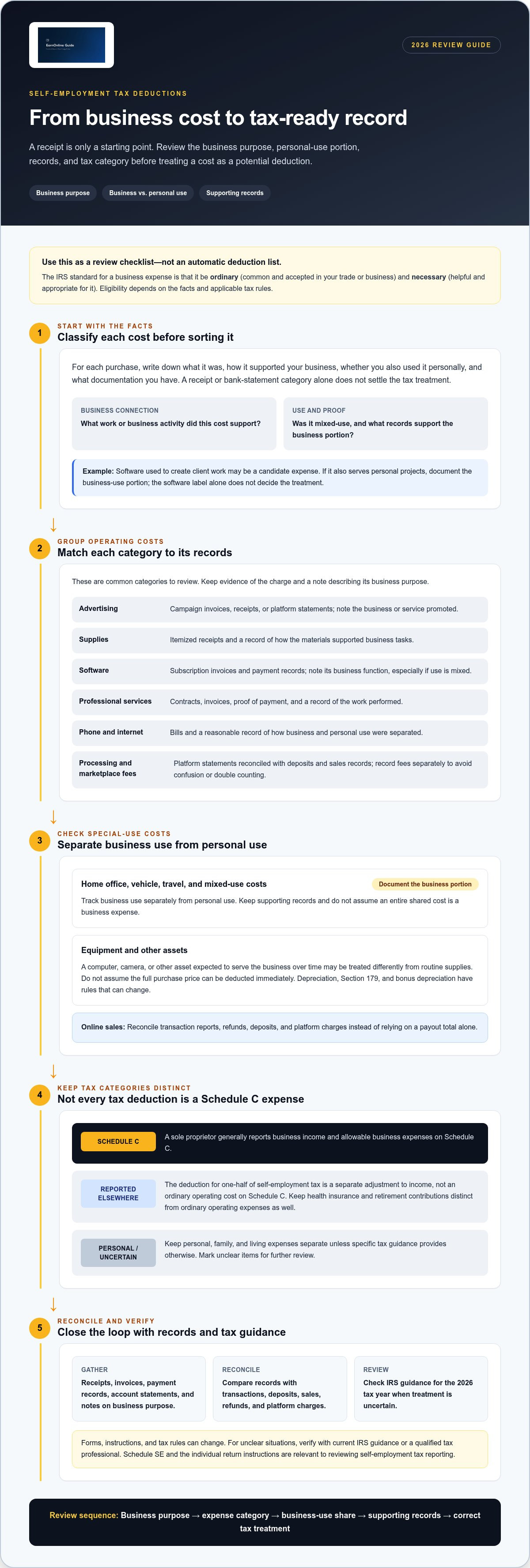
Some tax benefits relate to self-employment income but aren’t ordinary Schedule C expenses. Keep them in separate categories as you organize your records. Health insurance, retirement contributions, and the deduction for part of self-employment tax may be handled elsewhere on the individual return, depending on the applicable rules.
Don’t record health insurance premiums or retirement contributions as routine operating costs simply because you paid them from a business account. Their tax treatment can depend on coverage, plan type, income, and other circumstances. Keep policy statements, proof of premium payments, plan documents, and contribution confirmations so you can identify each item and verify how it should be reported.
Spousal coverage, employees, and different retirement plan arrangements can raise additional eligibility or calculation questions. Contribution limits and reporting instructions may change by tax year. Before filing, consult the IRS instructions applicable to 2026 and consider professional review if your situation involves employees, more than one plan, or coverage through a spouse.
The deductible portion of self-employment tax is a separate adjustment on the individual return, not a purchase or operating expense to include on Schedule C. In general, the deduction is for one-half of self-employment tax, but check the calculation and reporting against the 2026 Schedule SE and individual return instructions. Keep it separate from business expenses so the same amount isn’t misclassified or counted twice.
This distinction matters because reducing business profit with an expense and claiming an adjustment elsewhere are different steps in the tax calculation. One does not turn the other into a deductible purchase. Organize expense totals first, then review tax adjustments and contributions under their own reporting rules.
A 1099 tax calculator can provide a planning estimate based on the information entered, but it can’t determine whether a specific health insurance premium, retirement contribution, or business expense qualifies. An estimate may not reflect every filing detail or individual circumstance. Verify tax-year rules with the IRS Self-Employed Individuals Tax Center and applicable form instructions.
After separating expenses from adjustments, use the 1099 tax calculator as a planning estimate, not as a determination of deduction eligibility or individualized tax advice. For a separate self-employment tax estimate, estimate your self-employment tax and confirm the result against official IRS guidance.
Use this self-employment tax deductions checklist for 2026 to turn a pile of transactions into organized records. Reconcile receipts and statements against business accounts, but don’t assume a charge qualifies just because it was paid from a business account. Each reported amount should be traceable to evidence and applicable tax guidance.
A simple ledger makes year-end review more consistent. For each transaction, capture the date, vendor, amount, category, business purpose, and a link or reference to its supporting record. Keep digital copies of receipts, invoices, statements, and allocation calculations in a consistent, backed-up system. If you divide a cost between business and personal use, record the method and figures used.
Before relying on a tax figure, confirm that the forms and publications apply to tax year 2026. The IRS Self-Employed Individuals Tax Center is a starting point for official guidance; follow the specific IRS instructions for the form or expense in question. If a rule, eligibility condition, or recordkeeping requirement is unclear, consult a qualified tax professional, particularly if your situation involves multiple income sources, employees, mixed-use property, or a complex business structure.
Once your income and expense records are assembled, use the self-employment tax calculator as a separate planning estimate. It can help you consider a potential tax amount based on the information entered, but it doesn’t determine whether an expense is deductible, account for every individual circumstance, or replace IRS guidance or professional tax advice.
Save the reconciled ledger and supporting records together so each reported amount can be traced back to its source. Organized documentation supports careful review; it doesn’t make an ineligible cost deductible.
A tax checklist works best as a routine, not a once-a-year sorting project. Set a recurring time to review new transactions, attach documentation, and flag uncertain items while the purpose is still clear. Regular upkeep can make next year’s records easier to assess and help distinguish documented business activity from expenses that need more research.
Use the self-employment tax deductions checklist for 2026 as a reference, then confirm tax-year-specific questions with official IRS materials or a qualified tax professional. If you’ve organized your income and expenses and want a planning estimate, estimate your self-employment tax with EarnOnlineGuides’s calculator. It’s an educational planning resource, not individualized tax advice or a determination of deduction eligibility.
Clear records won’t answer every tax question, but they give you a stronger starting point for resolving them. Keep the process steady and you’ll be better prepared for the next filing cycle.
Potential write-offs are limited to costs that qualify under tax rules for your business and the 2026 filing year. Treat online deduction lists as prompts for research, not automatic write-offs. Compare each expense with the categories and instructions in the applicable Schedule C materials, then flag anything that doesn’t fit neatly for closer review before preparing your return.
A W-2 job doesn’t automatically rule out reporting a separate business activity. Keep separate records of side-hustle income and costs so they can be reviewed apart from employee wages. Your total tax picture may include both types of income, so don’t assume withholding from your job settles what you may owe on other income. Review IRS guidance on estimated taxes if you expect a balance due.
A home workspace may qualify if it meets the applicable IRS requirements, but working remotely alone isn’t enough. Record when you began using the space for business and whether its use or size changed during the year. These details can matter when selecting a calculation method or explaining changes from prior-year records. Verify the 2026 Form 8829 instructions before calculating or claiming an amount.
Possibly, but the business portion must be determined under the rules for that expense type. For a vehicle, a dated trip log is more useful than trying to reconstruct business travel months later. For phone or internet service, keep the bills and a consistent basis for identifying business use. Check the relevant IRS guidance before applying a method, since documentation and calculation rules differ by expense.
No. They’re separate parts of the tax calculation and shouldn’t be treated as interchangeable entries. A business expense is considered when determining business profit, while the deduction related to self-employment tax is handled elsewhere on the individual return. Keep the supporting calculations separate and follow the applicable 2026 form instructions so you don’t enter an amount in the wrong place or count it twice.
Keep source documents that let you trace reported amounts back to transactions, such as invoices, receipts, account statements, and relevant contracts. Also save annual summaries from payment platforms and copies of filed returns with their supporting workpapers. Don’t discard records based on a single general retention rule; the appropriate period can depend on the record and your tax situation. Check IRS recordkeeping guidance, and get professional help if an audit or correction raises questions.

Article by
EarnOnlineGuides Editorial Team
The EarnOnlineGuides Editorial Team creates practical, research-driven educational content about making money online, remote work, freelancing, side hustles, digital skills, AI tools, online business, and self-employment. Our goal is to help readers understand their options, compare realistic opportunities, avoid misleading claims, and make better-informed decisions. We prioritize accuracy, transparency, practical guidance, and responsible reporting, and we regularly review our content to keep it useful and up to date.
The information provided in this article is for general educational and informational purposes only and should not be considered financial, investment, tax, legal, or professional advice. Earnings, income examples, costs, fees, and other figures may vary and are not guaranteed. Always conduct your own research and consult a qualified professional when appropriate.
Some articles on EarnOnlineGuides may contain affiliate links. If you click a link and make a purchase or sign up for a service, we may receive a commission at no additional cost to you. This does not influence our editorial standards or recommendations.
We strive to keep our information accurate and up to date, but products, services, fees, policies, laws, and market conditions can change. Please verify important information directly with the relevant provider before making financial or business decisions.
Educational information only. This article is not financial, tax, or legal advice. Platform fees and policies change; always confirm current rates in the marketplace's official fee documentation before making decisions.
Explore low cost digital side hustles you can test in 2026. Compare freelance work, digital goods, and reselling while managing hidden platform fees and time.

Learn how to open a freelance business bank account step by step. Explore document checklists, compare bank options, and keep business finances organized.

Learn how to write affiliate product reviews readers can trust. Discover a practical process for honest testing, balanced pros and cons, and clear disclosures.