
Low-Cost Digital Side Hustles: Practical Ways to Start in 2026
Explore low cost digital side hustles you can test in 2026. Compare freelance work, digital goods, and reselling while managing hidden platform fees and time.
October 13, 202618 min read

A remote job doesn’t come with a standard paycheck. The same job title can carry different pay expectations depending on the work, your experience, and where an employer allows you to live. That makes remote work salary expectations harder to pin down, especially when a listing leaves out the range or describes compensation without explaining what’s included.
If you’re comparing conflicting estimates or focusing on base pay alone, that uncertainty is understandable. A salary figure is useful only when it reflects comparable roles and the full compensation package, including bonuses, benefits, and the terms of the work arrangement.
This guide shows you how to research credible comparisons, account for location policies and experience, and turn your findings into a realistic range. You’ll also learn how to state your expectations clearly in an application or conversation. Treat salary estimates as evidence to guide discussion, not guarantees of what an employer will offer.
Remote work salary expectations are a researched target range for a specific role, experience level, and employment arrangement, not a guaranteed offer or a universal rate for working remotely. Use the range to assess whether a role may fit your needs and to prepare for a compensation discussion. It should be grounded in comparable evidence, not a broad average for all remote workers.
Keep three figures distinct. Your target range is what you’re seeking based on research and personal priorities. An employer’s posted budget is the compensation range it says it can offer for that opening. A market estimate summarizes pay data from a defined group of roles or workers. These figures may overlap, but they aren’t interchangeable. Estimates can include different jobs, and an employer’s budget doesn’t determine what every candidate will be offered.
First, identify what the figure measures: annual base salary, hourly pay, or another stated basis. Then consider compensation beyond base pay, such as a bonus, equity, benefits, and paid time off. These components can affect an offer’s overall value, but they aren’t necessarily guaranteed or equivalent to cash salary.
Compare like with like. Don’t directly compare an employee’s annual salary with a contractor’s hourly rate without accounting for differences in work arrangement and compensation structure. Contractors set rates for services, not employee salaries. This freelance pricing guidance can help clarify the distinction.
Remote status describes where work is performed, not what the job requires or how an employer sets pay. A job title may cover different responsibilities, skill requirements, and levels of decision-making. Experience matters, too. Employers may use different pay policies: some set a nationwide range, while others consider the employee’s work location. Don’t assume one model applies to every remote role.
For a useful benchmark, match the role’s duties and seniority, employment type, pay basis, and location assumptions as closely as possible. If those details differ, treat the comparison as a rough reference rather than a direct equivalent.
An estimate describes pay observed or projected for a defined group; an individual offer is an employer’s proposal for a particular role and candidate. Keep that distinction in mind. Use an estimate to inform your target, then evaluate the actual offer and its terms on their own merits.
Remote salary comparisons are useful only when the jobs being compared are genuinely similar. Four factors help explain why figures vary: role requirements, candidate experience, employer pay policy, and compensation structure. Remote status alone doesn’t determine pay, and the same title can describe jobs with different responsibilities or levels of authority.
For broader context on remote-work arrangements and considerations, see the Complete Guide to Remote Work 2026. For salary research, focus on the specific opening and verify what the employer says about eligibility, pay, and work terms.
Compare what a person is expected to do, not just the title. Two “project manager” roles, for example, may differ in project size, decision-making authority, technical requirements, and responsibility for coordinating others. Those differences can make their salary ranges poor matches even when the titles look alike.
Assess the posting against your experience with the required work, specialized skills, and any management duties. A role that expects someone to set direction or lead a team may not be comparable to one focused on carrying out defined tasks. The Bureau of Labor Statistics research examines wage differences between remote and on-site workers. It offers context for comparisons, not a salary estimate for a particular opening or candidate.
Employers may set pay in different ways. A company might use a nationwide range, adjust pay according to an employee’s work location, or apply another policy. Don’t assume one model applies across remote jobs. Review the original posting, and ask how location affects the range if the policy isn’t clear.
Also confirm whether the role is employee or contractor work before comparing compensation. An employee salary and a contractor’s revenue aren’t equivalent measures. The arrangement, pay basis, and benefits may differ. Review the differences between 1099 and W-2 work to understand the distinction. For a meaningful comparison, match the role’s duties, seniority, location policy, employment type, and stated compensation basis.
Build your estimate from sources that describe comparable work, and record what each figure actually measures. A salary range in the employer’s original posting is the most directly relevant evidence for that opening. Government occupational data can provide broader context, while salary-platform estimates may help you spot patterns but can use different samples and methods.
Start with the employer’s posting if it includes a range, and confirm that the range applies to the role and location you’re considering. Use Bureau of Labor Statistics occupational data as context for an occupation, not as a promise of remote-role pay. Salary platforms can offer another reference point, but check when the data was updated and whether the platform explains its methodology.
Use a simple comparison record before drawing conclusions:
| Source | What to check | Typical limitation |
|---|---|---|
| Employer posting | Exact role, seniority, eligible location, posting date, and whether the range is base pay | The range may be broad or unclear about compensation components |
| Government occupational data | Occupation match, reporting period, geography, and pay measure | Occupational data may cover workers beyond remote roles |
| Salary platform | Role match, seniority, update date, sample context, and reported versus estimated figures | Job-title matches or estimates may not reflect the role you’re evaluating |
Record the pay basis before comparing figures: annual salary, hourly pay, or total compensation. Keep base pay separate from variable bonuses, equity, and benefits. If one source reports base salary and another combines salary with other compensation, they aren’t direct comparisons. Note what the employer says about each component and whether it’s guaranteed, conditional, or simply described as available.
Be cautious with small or unexplained samples, broad job-title matches, old postings, and figures that don’t define compensation clearly. Don’t average incompatible estimates to create a precise-looking number. If sources differ, first check whether they cover the same responsibilities, seniority, geography, time period, and pay components. Guidance from Harvard Law School also emphasizes doing research to support a salary discussion.
Salary estimates depend on how each source defines pay, which roles it includes, and how closely those roles match the job you’re considering. They are reference points, not guaranteed offers. Keep that caveat beside your notes as you shape your remote work salary expectations.
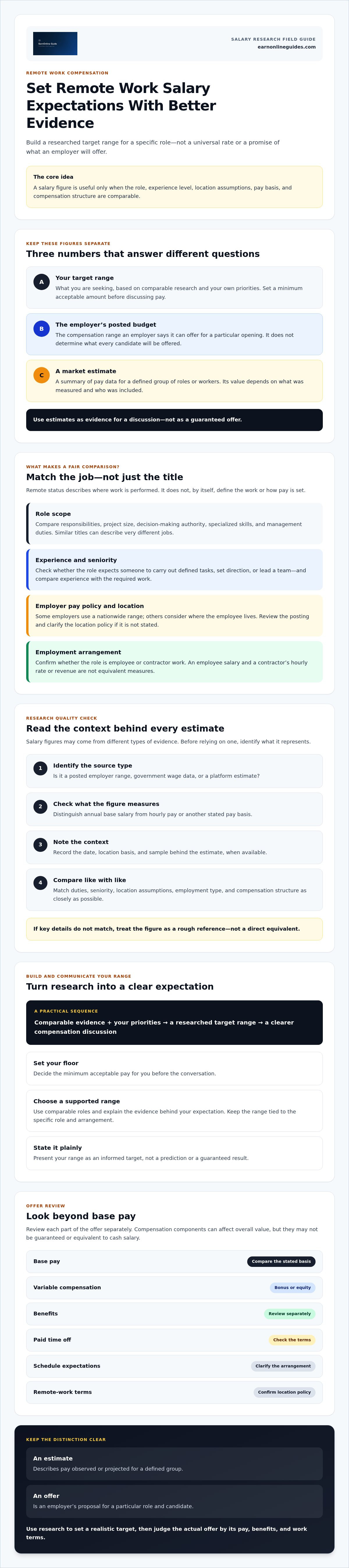
A clear target range helps you communicate your needs without treating a market estimate as a promise. Build it in sequence: match the role, gather relevant evidence, decide what works for you, then prepare wording that leaves room to discuss the full offer.
Your remote work salary expectations should reflect comparable pay evidence and what you need from a potential offer. If sources disagree, check whether they describe the same scope and pay structure before adjusting your target.
If the role is clear and you’ve researched a reasonable range, you can respond with a concise statement such as:
“Based on the responsibilities and my research for comparable roles, I’m targeting a range of [your range] in [annual base salary or hourly pay]. I’m open to discussing the full compensation package and how the role is scoped.”
Use a range you can explain and would genuinely consider. Don’t include a minimum you couldn’t accept, and don’t present an estimate as a guaranteed offer. If an application requires a number before you understand the responsibilities, provide a researched figure only if you’re comfortable doing so. If you can respond in writing or speak with the employer, ask for the budgeted range and clarify the role’s scope first.
For employee roles, discuss salary as compensation for the position. Freelancers price services under a different arrangement, so don’t treat a service rate as directly comparable to employee pay. See this freelance pricing guidance for that distinction.
Once your range is grounded in comparable evidence, explore legitimate remote job listings and assess each posting against the criteria you’ve set.
Compare the written offer with your researched range and personal priorities, but don’t reduce the decision to one salary figure. Review each part of the package separately to see what’s firm, what may change, and whether the work arrangement fits your needs.
Check the offer and any supporting plan documents for the details below. If a term is unclear, ask the employer to explain it in writing before comparing packages.
This breakdown helps you distinguish a strong base salary from a package that depends heavily on variable pay, or spot remote-work terms that may not match your expectations. No package is universally best. The right fit depends on how its components align with your priorities.
Revisit your comparisons if the offered role has a different seniority level, responsibilities, or employment arrangement from your reference roles. If estimates conflict, look for newer and more directly comparable evidence, and check whether sources define pay the same way. An estimate should guide questions, not override the employer’s written terms.
Tax and employment questions can depend on individual circumstances. For advice about your situation, consult a qualified tax or employment professional rather than treating general salary research as individualized guidance.
After assessing the offer against your remote work salary expectations and priorities, continue your search by browsing legitimate remote job listings. A listing is a research starting point, not a promise of placement or a particular salary.
Realistic remote work salary expectations come from comparing similar roles, checking what each source measures, and setting a range that fits your needs. Treat estimates as reference points, then evaluate a written offer by separating base pay, variable compensation, benefits, and remote-work terms.
Your priorities matter as much as the benchmark. If the offer’s employment arrangement raises questions, EarnOnlineGuides’s 1099 vs. W-2 resource can help you understand the differences at a general level. For personal tax or employment advice, consult a qualified professional.
When you’re ready to continue your search, browse EarnOnlineGuides’s remote job directory and use its listings alongside your own salary research. The directory and educational resources can support your next steps, but they don’t guarantee a job or a particular salary. Start with the directory, then compare each promising role with your researched range and priorities.
A reasonable expectation is a researched range for a specific role, experience level, and employer context, not one figure for all remote work. Compare job descriptions with similar responsibilities and check whether each source reports base salary or total compensation. If the employer posts a range for the opening, use it as direct context, then consider the full package and your priorities before deciding what range to communicate.
There’s no reliable universal answer. Remote work alone doesn’t determine whether a job pays more or less. Pay may reflect the role, your experience, the employer’s compensation policy, and how the comparison data was collected. To assess a specific opening, compare responsibilities and compensation definitions, then verify the employer’s stated range. Don’t assume all remote employers use one nationwide pay rule or that office-based comparisons are automatically equivalent.
A researched range can communicate flexibility while making your expectations clear. Set its boundaries using comparable roles and your own needs, rather than a universal formula. If you don’t yet know the role’s scope or compensation structure, ask for the employer’s budgeted range and details about the package before treating an early estimate as final. If an application requires one number, choose a figure you can explain and would genuinely consider.
Start with the employer’s posting and compare it with roles that have similar duties and seniority. Record each source’s date, geographic basis, and pay measure. Government occupational data can provide broader context, while salary-platform figures may be directional estimates. Check how those estimates were produced and what roles they include. If figures conflict, investigate what each measures instead of averaging data that may not be comparable.
Yes, consider benefits as part of the package, but keep them separate from base salary so the comparison stays clear. Review benefits, bonuses, and equity individually, and ask whether each is guaranteed, variable, or subject to written plan terms. Their practical value can differ by candidate, and advertised compensation doesn’t necessarily mean guaranteed cash pay. Clarify the details with the employer before using them to assess an offer.
No. Contractor rates and employee salaries describe different work arrangements, so compare them separately. A contractor may need to account for business expenses, unpaid time, and tax obligations, while an employee package may include benefits. The details depend on the arrangement and individual circumstances. EarnOnlineGuide’s 1099 vs. W-2 resource explains work arrangement differences. Consult a qualified tax professional for advice about your own tax situation.

Article by
EarnOnlineGuides Editorial Team
The EarnOnlineGuides Editorial Team creates practical, research-driven educational content about making money online, remote work, freelancing, side hustles, digital skills, AI tools, online business, and self-employment. Our goal is to help readers understand their options, compare realistic opportunities, avoid misleading claims, and make better-informed decisions. We prioritize accuracy, transparency, practical guidance, and responsible reporting, and we regularly review our content to keep it useful and up to date.
The information provided in this article is for general educational and informational purposes only and should not be considered financial, investment, tax, legal, or professional advice. Earnings, income examples, costs, fees, and other figures may vary and are not guaranteed. Always conduct your own research and consult a qualified professional when appropriate.
Some articles on EarnOnlineGuides may contain affiliate links. If you click a link and make a purchase or sign up for a service, we may receive a commission at no additional cost to you. This does not influence our editorial standards or recommendations.
We strive to keep our information accurate and up to date, but products, services, fees, policies, laws, and market conditions can change. Please verify important information directly with the relevant provider before making financial or business decisions.
Educational information only. This article is not financial, tax, or legal advice. Platform fees and policies change; always confirm current rates in the marketplace's official fee documentation before making decisions.
Explore low cost digital side hustles you can test in 2026. Compare freelance work, digital goods, and reselling while managing hidden platform fees and time.

Learn how to open a freelance business bank account step by step. Explore document checklists, compare bank options, and keep business finances organized.

Learn how to write affiliate product reviews readers can trust. Discover a practical process for honest testing, balanced pros and cons, and clear disclosures.