
Low-Cost Digital Side Hustles: Practical Ways to Start in 2026
Explore low cost digital side hustles you can test in 2026. Compare freelance work, digital goods, and reselling while managing hidden platform fees and time.
October 13, 202618 min read

What separates legitimate side hustle ideas from a polished pitch that costs you time and money? Look at the work itself: who pays, what you need to provide, how payment is calculated, and what costs or risks you take on. It’s reasonable to feel uncertain when an opportunity makes big claims but leaves those details unclear.
This guide compares practical side hustles by the skills they use, their setup requirements, common risks, and how each can generate income. You’ll see how freelancing, online selling, and platform-based gigs differ, so you can focus on work that fits your experience, schedule, and willingness to invest.
Rather than treating any path as guaranteed income, use the comparisons to examine the economics before you commit. The guide also explains what to verify about platform fees and other expenses, then helps you choose a small, testable first step. The goal is not to find a perfect idea on paper, but to identify a credible opportunity you can evaluate with limited risk.
A legitimate side hustle has identifiable work, a clear customer or payer, and a defined way to earn compensation. That doesn’t mean it will be profitable or a good fit. It means you can explain what you’ll do, who pays, and what conditions affect payment without relying on vague promises.
The arrangement matters. Employee work is performed for an employer under its terms. Independent client services, such as bookkeeping or design, involve completing agreed work for clients. Product sales generate revenue when customers buy goods. Audience-based models, such as content creation or affiliate marketing, depend on building an audience and may take time to generate revenue. A platform’s label alone doesn’t determine a worker’s legal classification. If classification matters to your situation, consult relevant official government guidance rather than relying only on a platform’s description.
When comparing legitimate side hustle ideas, separate verifiable details from promotional claims. A written description of the task, payment conditions, and responsibilities is more useful than a claim about what you could earn. Promises of guaranteed income, pressure to pay immediately, or unclear explanations of the work are reasons to pause and investigate.
Before accepting work or signing up, identify the customer, the specific task, how payment is calculated and delivered, and who handles disputes or cancellations. If a company or platform is involved, read its official terms directly, including payment rules, fees, account requirements, and circumstances that could affect access to work. Don’t rely solely on a recruiter’s message or promotional page.
Treat requests for sensitive information or upfront payments cautiously. Some legitimate processes may require identity or payment details, but the reason should be clear and the request should come through a verified, secure channel. If you can’t confirm who is asking or why, don’t provide the information or send money until you’ve independently checked.
Estimate the full commitment, not just the visible task. Depending on the model, you may need to account for time spent finding customers, supplies, software, equipment, travel, marketplace fees, or returns. These costs vary by activity and platform, so check current terms with the official provider before relying on a fee estimate.
Revenue is money received before expenses. Profit is what remains after applicable costs, and take-home income may also be affected by taxes. Keep basic records from the start and consult authoritative tax guidance for your circumstances. A credible opportunity can still be competitive, irregular, or unsuitable for your schedule. Treat claims of risk-free passive income from day one, or certain earnings, with skepticism. For a focused screening checklist, see this guide to spotting fake remote job listings.
These legitimate side hustle ideas use different earning models. A service exchanges your time and skills for payment; selling requires an offer customers want; audience-based work depends on reaching and retaining an audience. Each option below has a distinct workload and limitation, so treat it as a starting point for comparison, not an income forecast.
For platform-based work, read payment and contract terms carefully. The Federal Trade Commission has addressed concerns involving misleading pay claims and contract terms in its work on protecting gig workers. For marketplace sales, compare fees with other selling expenses before estimating what you may keep.
The most useful comparison is not which option sounds easiest, but what it asks you to contribute and what remains uncertain. The table compares the 12 legitimate side hustle ideas by work type, useful skills, setup, schedule, and a key limitation. “Flexible” describes potential control over timing, not a promise of steady work.
| Idea and work type | Useful skills | Typical setup needs | Schedule flexibility | Main uncertainty |
|---|---|---|---|---|
| Freelance writing, service | Writing, research | Samples, client outreach | Often asynchronous | Finding clients and managing revisions |
| Graphic design, service | Visual design, communication | Portfolio, design tools | Often asynchronous | Client demand and revision scope |
| Virtual assistance, service | Organization, administration | Communication and task tools | Depends on client needs | Workload and response expectations |
| Tutoring, service | Subject knowledge, teaching | Lesson materials, scheduling | Appointment-based | Student demand and availability |
| Bookkeeping, service | Accuracy, financial recordkeeping | Relevant software, client process | Often deadline-based | Client trust and skill requirements |
| Resale, products | Sourcing, product research | Inventory, listings, fulfillment | Some control over listing work | Sales demand and unsold stock |
| Handmade goods, products | Crafting, production planning | Materials, product listings | Production can be planned | Demand and time per item |
| Digital products, products | Subject expertise, creation | Product files, sales platform | Creation is flexible | Discoverability and buyer demand |
| Affiliate marketing, audience | Content, audience trust | Publishing channel, useful content | Usually self-scheduled | Audience growth and program terms |
| Content creation, audience | Communication, production | Publishing tools and content plan | Usually self-scheduled | Audience growth and monetization |
| Delivery, task-based | Navigation, reliability | Transportation, platform access | May depend on local availability | Eligibility, demand, and expenses |
| User research, task-based | Communication, careful feedback | Device and access to studies | Task timing varies | Screening and study availability |
Appointment-based tutoring requires you to match a learner’s schedule. Writing or design may allow more asynchronous work, but deadlines and client feedback still shape your week. Delivery and research tasks can be flexible only when assignments are available and you meet eligibility requirements. Start with the hours you can reliably protect, then rule out options whose deadlines, appointments, or availability conflict with them.
Separate essential spending from optional costs. A service provider may need samples and basic tools, while a seller may need inventory or supplies. Paid subscriptions and advertising may be optional at first. Revenue is money received before expenses. Net income reflects revenue minus relevant expenses, and taxes may affect what you ultimately keep. Time to first payment and earnings depend on customer demand, skills, location, and platform rules. Online work isn’t automatically easier or passive: services require client acquisition, while products and content require demand-building. Use the realistic income model guide to consider assumptions and different scenarios rather than treating one outcome as certain.
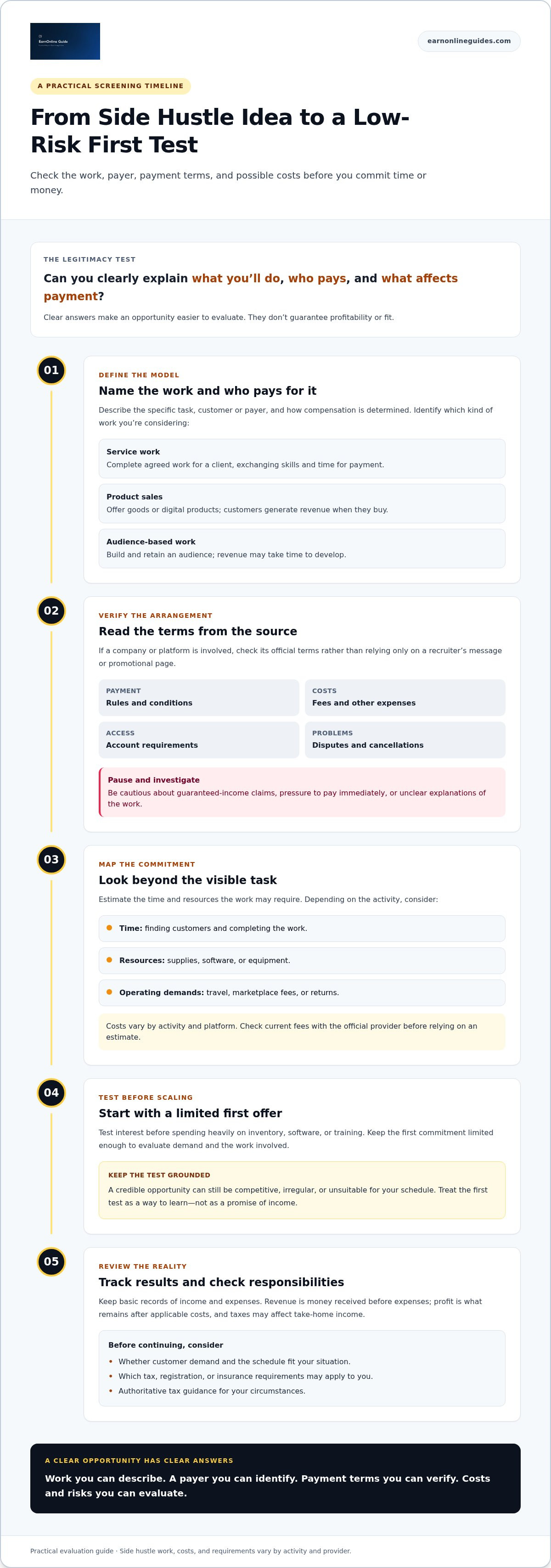
Choose among legitimate side hustle ideas by testing fit and customer demand before making substantial purchases. Use a practical sequence: list your constraints, match your skills, identify a likely customer, test a focused offer, then review what happened. The purpose isn’t to prove an idea will succeed. It’s to learn whether there’s enough evidence to justify another step.
Start with an honest inventory: skills you can use now, hours you can reliably set aside, equipment you already have, and tasks you can complete consistently. Then compare that list with what customers need and how the work is scheduled. If you have limited evening availability, for example, a service requiring daytime appointments may be a poor fit even if you know the subject well.
Separate skills you can demonstrate from skills you would need to learn. A gap doesn’t automatically rule out an idea, but it may mean added preparation before you can make a credible offer. Use the digital skills matrix to identify relevant strengths and learning gaps before choosing where to focus.
Define one narrow offer for one intended customer. For instance, instead of promoting broad “virtual assistant services,” specify a task you can deliver, such as organizing a client’s appointment calendar. For a product idea, describe one item and the customer it is designed for. Keep the test small and reversible: use a sample, talk with potential customers, or create a limited listing before committing to substantial inventory, paid software, or training.
Set a review point in advance, then record evidence rather than relying on enthusiasm alone:
Interpret the results carefully. A few inquiries don’t establish steady demand, and a quiet test may reflect the offer, audience, or way it was presented. If the evidence is weak, revise the offer or pause rather than increasing spending automatically. For a structured approach to testing customer demand, use this online business idea validation guide as your next step.
Start with a limited offer you can deliver reliably, then use real results to decide whether to continue. Keep the scope clear: what you’ll provide, who it’s for, and what’s outside the offer. Avoid expanding into extra services, inventory, or recurring subscriptions until your first test gives you a reason to do so.
Set up a simple recordkeeping system from the beginning. Track inquiries, sales, time spent, direct expenses, refunds, and signs of repeat customer interest. These records help you distinguish activity from progress: a busy week doesn’t necessarily mean the idea is producing a worthwhile return.
Record gross receipts separately from expenses. Gross receipts are amounts received before costs; what remains after business expenses is not necessarily the same as personal take-home income. Applicable taxes and other obligations may also affect what you keep. Use your records to review whether customers responded, how much work fulfillment required, and whether the results justify refining the offer or continuing.
Before operating, check which tax, registration, insurance, and platform requirements apply to your circumstances. These can depend on the activity, location, business structure, and platform. For tax questions, consult current IRS guidance; for registration or insurance, check relevant government sources and policy documents. For a marketplace sale, review the platform’s official fee and seller terms rather than relying on an old estimate.
If you’re freelancing, use beginner resources to understand how to define a service and pricing guidance to account for scope, time, and revisions. If you’re selling through a marketplace, review the official fee schedule and use online selling fee calculators to explore how fees may affect a listing’s potential proceeds. Confirm changing platform details with the provider before making a decision.
Expand only when observed demand, available time, customer feedback, and net results support the next commitment. If the test shows interest but the work takes more time than expected, narrow the offer or adjust the process before adding expenses. If the response is weak, revise or pause rather than treating past spending as a reason to keep investing.
A sustainable side hustle is built through measured decisions, not confident promises. Use practical online income guides to compare assumptions and plan a next step grounded in what you learn.
Legitimate side hustle ideas are easier to assess when the work, customer, and earning model are clear. Compare options by the skills they use, the time and setup they require, and the uncertainties that could affect results. Then choose a focused offer and test it before making a larger commitment.
Track customer interest, time spent, expenses, and what remains after costs. Use those observations to decide whether to refine your offer, continue testing, or move on. No idea guarantees income, but careful evaluation can help you make a more informed choice.
For more guidance on evaluating online income paths, explore practical ways to make money online. Take one manageable next step, and let what you learn guide the next decision.
Beginner-friendly options have clear tasks and a straightforward way to earn, such as freelance writing, virtual assistance, tutoring in a subject you know, resale, or delivery through a platform. The best fit depends on your skills, schedule, and resources. Compare what you’ll do, who pays, how payment works, and what expenses or platform terms apply. No option is automatically easy or consistently in demand.
Yes, some side hustles let you start with skills you already use in everyday life, but you still need to show that you can do the work reliably. For example, you might offer basic administrative support or sell items you understand. Start with a limited task, practice where needed, and create a sample if relevant. Some work, including bookkeeping or specialized tutoring, may require deeper knowledge or qualifications.
Look for a specific description of the work, who pays, how compensation is determined, and what responsibilities you accept. Be cautious if the offer promises guaranteed earnings, pressures you to pay or share sensitive information immediately, or avoids explaining the actual task. Verify a company or platform through its official website and read its terms directly. If you can’t confirm who is behind the offer, pause before proceeding.
Not always. Some service work can begin with skills, equipment, or software you already have, while resale or handmade products may involve supplies or inventory. Separate essential expenses from optional subscriptions, advertising, or training. Before spending, test interest with a sample, a small listing, or conversations with potential customers. Also account for platform fees and other costs that can reduce the amount you keep.
There’s no reliable amount that applies to everyone. Earnings depend on factors such as customer demand, skills, available hours, location, pricing, and platform rules. Track revenue alongside expenses and time spent so you can assess net results and the return on your effort. Early results may be irregular, especially while finding clients or building an audience. Treat projections as planning assumptions, not promised outcomes.
Side hustle income may be taxable, and a platform or client not sending a tax form doesn’t automatically mean the income can be ignored. Tax treatment and filing obligations depend on your circumstances and the type of activity. Keep records of income and relevant expenses from the start, then review applicable IRS guidance for your situation. This is general information, not individualized tax advice.

Article by
EarnOnlineGuides Editorial Team
The EarnOnlineGuides Editorial Team creates practical, research-driven educational content about making money online, remote work, freelancing, side hustles, digital skills, AI tools, online business, and self-employment. Our goal is to help readers understand their options, compare realistic opportunities, avoid misleading claims, and make better-informed decisions. We prioritize accuracy, transparency, practical guidance, and responsible reporting, and we regularly review our content to keep it useful and up to date.
The information provided in this article is for general educational and informational purposes only and should not be considered financial, investment, tax, legal, or professional advice. Earnings, income examples, costs, fees, and other figures may vary and are not guaranteed. Always conduct your own research and consult a qualified professional when appropriate.
Some articles on EarnOnlineGuides may contain affiliate links. If you click a link and make a purchase or sign up for a service, we may receive a commission at no additional cost to you. This does not influence our editorial standards or recommendations.
We strive to keep our information accurate and up to date, but products, services, fees, policies, laws, and market conditions can change. Please verify important information directly with the relevant provider before making financial or business decisions.
Educational information only. This article is not financial, tax, or legal advice. Platform fees and policies change; always confirm current rates in the marketplace's official fee documentation before making decisions.
Explore low cost digital side hustles you can test in 2026. Compare freelance work, digital goods, and reselling while managing hidden platform fees and time.

Learn how to open a freelance business bank account step by step. Explore document checklists, compare bank options, and keep business finances organized.

Learn how to write affiliate product reviews readers can trust. Discover a practical process for honest testing, balanced pros and cons, and clear disclosures.