
Low-Cost Digital Side Hustles: Practical Ways to Start in 2026
Explore low cost digital side hustles you can test in 2026. Compare freelance work, digital goods, and reselling while managing hidden platform fees and time.
October 13, 202618 min read

Your first freelance client is easier to pursue when you stop trying to look established and start showing how you can solve one specific problem. If you’re figuring out how to find your first freelance client, begin with a clear offer, a relevant sample, and focused outreach, not a large portfolio or a perfect pitch.
A lack of client history can make prospects hesitate. You might also be unsure where to look, how to reach out without sounding pushy, or what to do if someone proposes a project with unclear expectations. These are practical problems to work through, not reasons to claim experience you don’t have or expect quick results.
This guide walks you through defining a specific service, finding prospects whose needs match it, and making a professional first approach. You’ll also learn how to agree on a manageable initial project, clarify the scope before work begins, and use the experience to improve your next pitch. The goal is a credible first step toward freelance work, even if it doesn’t lead to an immediate yes.
Finding a first client can be challenging: prospects have little evidence of how you work, and you don’t yet have client history to point to. That doesn’t mean you need to exaggerate your experience. A relevant sample, an accurate description of your background, and a focused offer help a prospect assess whether your skills fit their needs.
Start by defining one service, identifying people or businesses that may need it, and making a specific, professional approach. Freelance outreach is different from applying for a remote employee role. A job application presents you as a candidate for an ongoing position; freelance outreach proposes a defined service or project. If you’re new to the term, this overview of what a freelancer is provides background on independent work.
Create a self-directed sample that demonstrates the kind of deliverable you plan to offer. If your service is editing website copy, for example, prepare a clearly labeled sample edit using text you wrote yourself. Explain the sample’s purpose and context. Don’t describe hypothetical work as a client project or imply that it produced a business result.
You can also show relevant tasks from prior employment or volunteer work, as long as you describe your role accurately and have permission to share the material. If you can’t share the original work, explain the task without disclosing confidential information. The goal is to demonstrate your process and judgment, not to imply a client history you don’t have.
Begin with a skill you can demonstrate, then connect it to a problem a specific type of client can recognize. Narrow your offer by naming the deliverable, intended client, and practical boundaries. For instance, instead of saying “I do marketing,” you might offer to draft email announcements for independent retailers. Specify what you’ll provide and what falls outside the project, so prospects can understand the offer without guessing.
A focused service is easier to explain than a long list of unrelated abilities. It also makes it easier to choose prospects and create a relevant sample. For broader setup guidance, read the beginner guide to starting freelancing online. You can also review this step-by-step guide to starting an online income path for context beyond finding a freelance client.
A freelance offer is easier to evaluate when it names the work, the intended client, and the problem the work addresses. “I can help with writing, marketing, and admin” leaves a prospect to figure out what to hire you for. A defined deliverable gives them something concrete to consider and helps you decide whether an opportunity fits your abilities.
You don’t need to claim years of experience or promise business results. Demonstrate what you can do through a sample, a relevant skill, or a clear explanation of your process. Research from Harvard Business School discusses the surge in the freelance economy and companies’ use of freelance talent. That broader context doesn’t guarantee demand for any particular service. It does underline why a specific offer matters: clients need to understand what you can contribute.
Try this structure: “I help [client type] address [recognizable problem] by providing [specific deliverable].” For example: “I help independent fitness studios keep class updates clear by editing their monthly email newsletter.” This identifies a potential client, a practical need, and a piece of work you can define.
Keep the promise within your control. Editing a newsletter is a deliverable; guaranteeing more sign-ups is an outcome you may not control. Avoid broad claims like “I do everything” or “I’ll grow your business.” A narrower offer helps a prospect understand the scope and helps you judge whether you can complete the work well.
Create a sample from a realistic, non-confidential brief that matches your proposed service. Label it as self-directed, then briefly explain the task, your approach, and the deliverable. For instance, you might show an edited sample newsletter and explain that it demonstrates how you organize information and improve clarity. Don’t invent client feedback, performance results, or a business relationship.
Choose samples for relevance, not volume. A small set that clearly matches your offer is more useful than a collection of unrelated work. If the sample exposes a skill gap, build that capability before pitching the service. The digital skills guide for beginners can help you identify a practical learning direction.
There isn’t one best place for every beginner. The right channel depends on where potential clients gather, how much research or relationship-building you can do, and how much control you want over your approach. To decide how to find your first freelance client, compare the trade-offs instead of relying on promises about response rates or quick results.
| Channel | Access to relevant prospects | Effort required | Control over the approach |
|---|---|---|---|
| Referrals | People in your network may know someone with a relevant need. | Explain your offer and ask for a suitable introduction. | You can guide the conversation, but you don’t control who is introduced or whether they need your service. |
| Marketplaces | Listings and project posts can help you find prospects seeking freelance services. | Set up a profile, identify suitable opportunities, and respond to competition. | The platform sets rules and terms, so review its current policies before committing to work. |
| Professional networks | Industry groups and professional communities can connect you with people discussing relevant work. | Participate consistently and communicate clearly about what you offer. | You can shape how you present your expertise, while group rules and norms still apply. |
| Targeted direct outreach | You select businesses whose visible needs appear to match your service. | Research each prospect and write a tailored message. | You choose whom to contact and what specific observation to raise, but the prospect decides whether to respond. |
Start with people who understand your service or might make a relevant introduction, such as former colleagues, professional contacts, or members of an industry group. Keep the request low-pressure: explain the kind of work you do and ask whether they know someone who might benefit. A contact is a possible lead, not a guaranteed client. In professional networks, contribute usefully and describe your service plainly rather than treating every interaction as a sales pitch.
Marketplaces such as Upwork and Fiverr can help you discover posted projects or present a service, but each has its own rules and terms. Review the platform’s current requirements and costs directly before deciding whether it suits you. Direct outreach gives you more control over prospect selection, but it should be based on a specific, observable business need, not a generic message sent to a broad list.
If a prospect asks about rates, define what the proposed work includes before you quote. Consider the deliverables, expected revisions, communication needs, and time involved. A clear scope makes it easier to explain how your rate relates to the work.
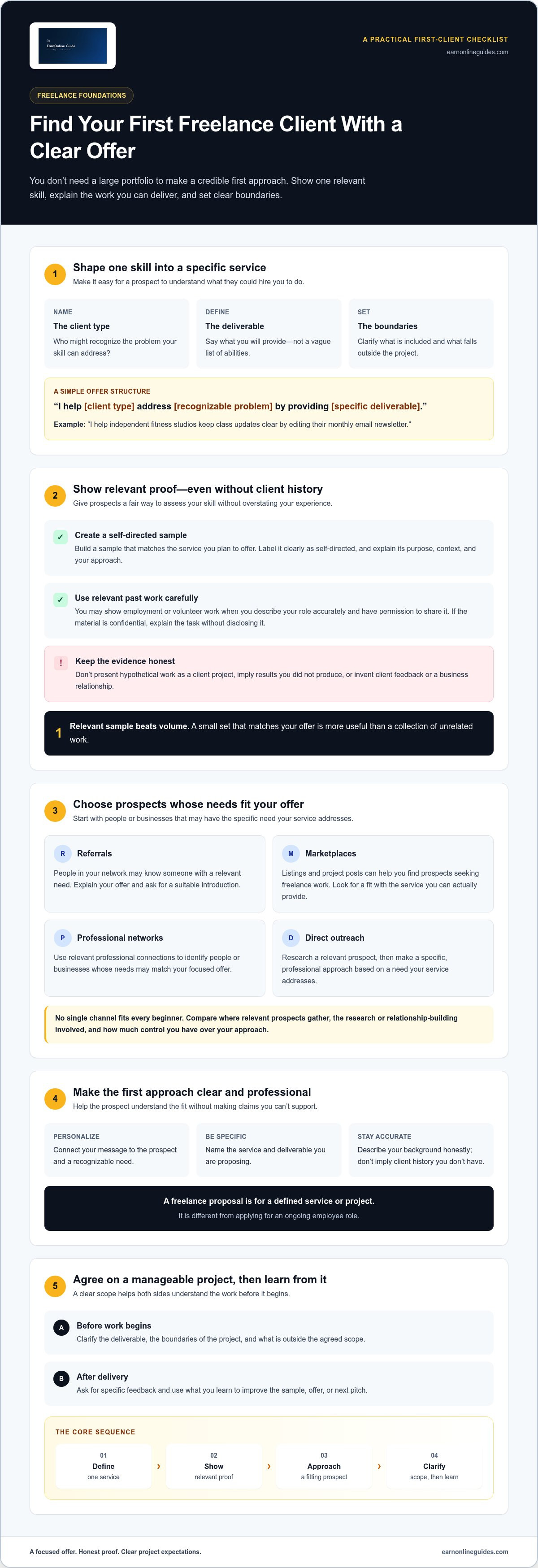
A professional first approach is specific, brief, and easy to respond to. Before contacting someone, look for a plausible match between a visible need and the service you can deliver. Then use this workflow:
Use a subject line or opening that makes the relevance clear, then connect your offer to a specific business observation. For example:
Subject: Editing class updates for your studio newsletter
Hi Jordan, I noticed your site lists several new classes this month. I edit short email announcements for fitness studios and could help make class details easier to scan. Are you planning another newsletter soon, or is someone already handling those updates?
This example doesn’t assume the prospect has a problem or promise a business result. It offers a possible contribution and asks a low-pressure question. Use a detail you’ve actually observed; don’t imply you reviewed materials or found an issue if you haven’t.
If the prospect is interested, clarify the fit before agreeing to begin. Ask what they want the work to accomplish, which materials or deliverables they expect, when they need them, and who will review or approve the work. If the request is vague, summarize your understanding and ask them to correct anything you’ve missed.
Put the agreed scope in writing, including deliverables, revision expectations, communication method, deadlines, payment terms, and any exclusions or assumptions. This gives both sides a shared reference, but it isn’t a substitute for legal advice or a guarantee against disagreements. When it makes sense for both parties, propose a small, well-bounded initial project instead of an open-ended commitment. Don’t start until the essential details are understood.
Before discussing a quote, think through how the project’s scope relates to your rate. For additional practical resources, visit EarnOnlineGuides.
Completing the project is part of learning how to find your first freelance client. The experience gives you practical information for your next conversation. Trust comes from doing the agreed work reliably, communicating clearly, and addressing changes before they become misunderstandings.
At the start, restate the deliverables, deadlines, review points, and communication plan in a message or project document. If the client expects a draft before the finished version, confirm when they’ll receive it and what kind of feedback you need. This creates a shared reference.
During the work, provide progress updates at the agreed milestones. If a task is taking longer than expected or you need information to continue, raise it early and explain what’s affected. Don’t silently take on work beyond the agreed scope. Describe the requested change, clarify its effect on timing or cost, and get agreement before proceeding.
Be accurate about what is finished and what remains. If you make a mistake, explain it and propose a reasonable next step rather than waiting for the client to discover it. Consistent communication won’t remove every project challenge, but it helps keep expectations visible.
Deliver the agreed files or work in the format and manner you discussed. Then ask for specific feedback, such as whether the deliverable met the brief and whether the review process was clear. A focused question is more useful than assuming the client will provide a testimonial or referral.
If you want to show the work publicly or identify the client, ask permission first. Work completed for a client isn’t automatically yours to publish, and respecting their choice is part of professional practice.
Make private notes while the details are fresh: which requirements were clear, where you needed more information, how long each part took, and what you’d change in your process. Use those observations to refine your offer, sample, outreach message, and project scope. One project is useful evidence for learning, not a guarantee of future work.
When planning future projects, consider the time and effort involved as well as the deliverables. Use those details to review whether your pricing assumptions fit the work.
Finding your first client starts with a service people can understand, proof that honestly demonstrates your ability, and a thoughtful approach to prospects who may need that work. Once a project is underway, clear expectations and reliable communication help you deliver professionally and learn what to improve next.
There’s no guaranteed timeline or outcome, so treat each step as a way to build evidence and make better decisions. A sample can strengthen your pitch, and a completed project can help refine your offer, but neither replaces consistent, relevant outreach.
EarnOnlineGuides offers beginner-friendly freelancing and digital-skills guides, along with practical resources designed to support informed decisions and realistic expectations.
Choose one useful service, identify a promising prospect, and make your next step specific and manageable. Explore the beginner guide to starting freelancing online to plan your next move.
Start by offering one specific service you can deliver competently, then look for prospects with a recognizable need for it. A relevant self-directed sample can demonstrate your approach without suggesting you’ve had paid clients. Choose a suitable channel, such as a referral, professional network, marketplace, or personalized direct outreach, and make a clear, low-pressure approach. Finding your first freelance client is a process of testing fit, not a guaranteed or instant result.
Yes. A formal portfolio can help, but it isn’t the only way to show capability. Create a sample that matches the service you’re offering, label it as self-directed, and explain the task and deliverable. You can also describe relevant employment or volunteer work accurately while respecting confidentiality. If you don’t yet have a useful example, make a small sample that lets a prospect assess your work rather than making broad claims about your experience.
Consider referrals, professional networks, freelance marketplaces, and targeted outreach to businesses with an observable need. Referrals may provide a relevant introduction, while networks can help you build familiarity with people in an industry. Marketplaces provide access to posted projects but come with platform-specific terms and competition. Direct outreach lets you select prospects, though researching and personalizing each message takes effort. Choose channels based on your service and the prospects you can identify, not assumed success rates.
Keep the message concise and relevant. Mention a genuine detail you observed about the person’s business, state one way your service could help, and ask a simple question that’s easy to answer. For example, if a business posts regular event updates, you could ask whether it has someone preparing those announcements. Avoid generic pitches, pressure, or promises about results you can’t control. If there’s no reply, one courteous follow-up is reasonable; then move on.
Free work isn’t required to demonstrate your ability. A self-directed sample can show what you can do without taking on an unpaid client project. If you consider a no-cost trial or sample, define its limits in advance, including the task, time involved, and whether the work may be used. Don’t agree to an open-ended assignment in hopes of future paid work. A prospect’s interest in free work doesn’t guarantee a later project or referral.
Put the shared expectations in writing before work begins. Describe the deliverables, deadline or milestones, revision process, communication method, payment terms, and any assumptions or exclusions. Clarify who supplies materials and who reviews or approves the work. If the request changes, discuss how that affects scope, timing, or payment before proceeding. The appropriate form and terms can vary by project and situation, so this general checklist isn’t a substitute for legal advice.

Article by
EarnOnlineGuides Editorial Team
The EarnOnlineGuides Editorial Team creates practical, research-driven educational content about making money online, remote work, freelancing, side hustles, digital skills, AI tools, online business, and self-employment. Our goal is to help readers understand their options, compare realistic opportunities, avoid misleading claims, and make better-informed decisions. We prioritize accuracy, transparency, practical guidance, and responsible reporting, and we regularly review our content to keep it useful and up to date.
The information provided in this article is for general educational and informational purposes only and should not be considered financial, investment, tax, legal, or professional advice. Earnings, income examples, costs, fees, and other figures may vary and are not guaranteed. Always conduct your own research and consult a qualified professional when appropriate.
Some articles on EarnOnlineGuides may contain affiliate links. If you click a link and make a purchase or sign up for a service, we may receive a commission at no additional cost to you. This does not influence our editorial standards or recommendations.
We strive to keep our information accurate and up to date, but products, services, fees, policies, laws, and market conditions can change. Please verify important information directly with the relevant provider before making financial or business decisions.
Educational information only. This article is not financial, tax, or legal advice. Platform fees and policies change; always confirm current rates in the marketplace's official fee documentation before making decisions.
Explore low cost digital side hustles you can test in 2026. Compare freelance work, digital goods, and reselling while managing hidden platform fees and time.

Learn how to open a freelance business bank account step by step. Explore document checklists, compare bank options, and keep business finances organized.

Learn how to write affiliate product reviews readers can trust. Discover a practical process for honest testing, balanced pros and cons, and clear disclosures.