
Low-Cost Digital Side Hustles: Practical Ways to Start in 2026
Explore low cost digital side hustles you can test in 2026. Compare freelance work, digital goods, and reselling while managing hidden platform fees and time.
October 13, 202618 min read

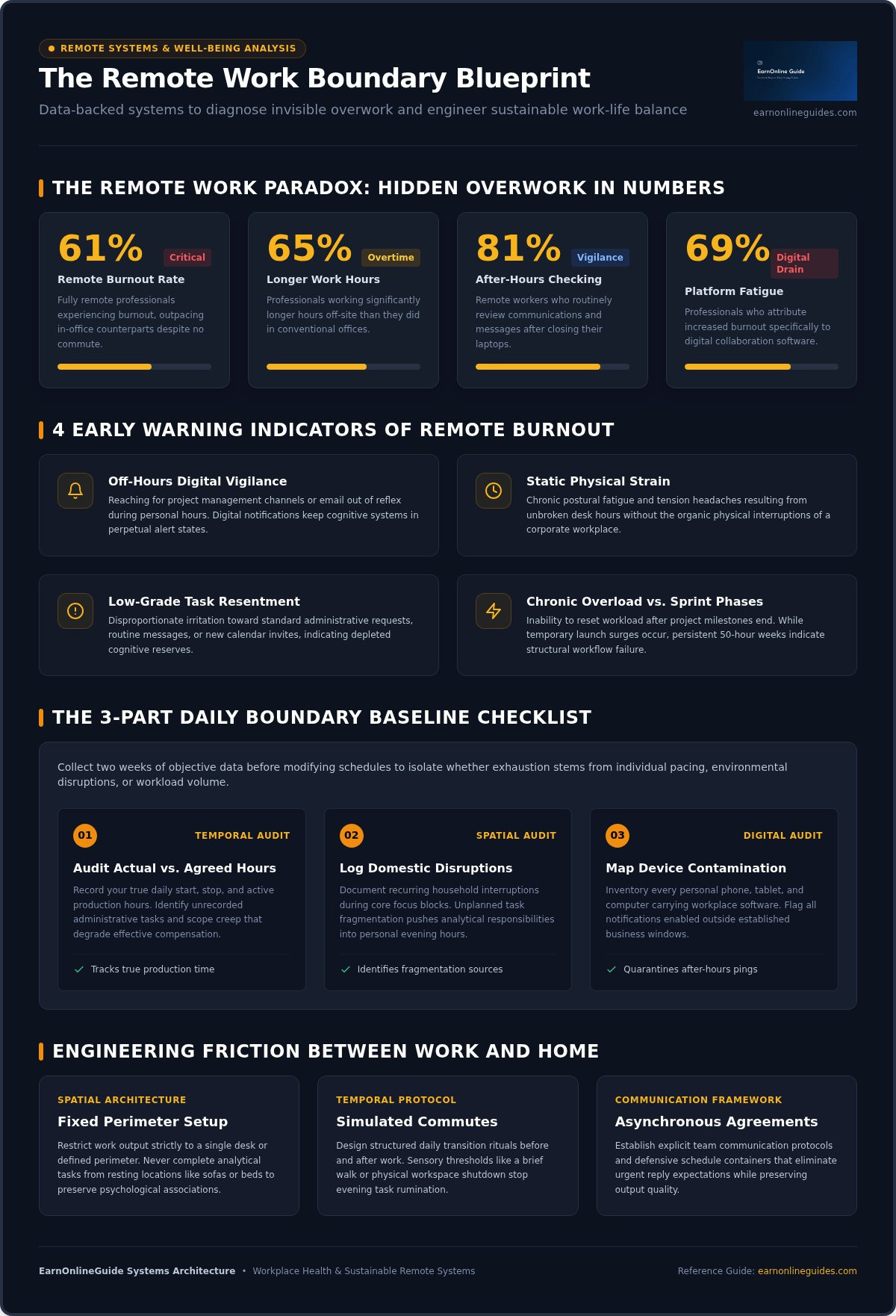
Research reveals a stark paradox in modern employment: 61% of fully remote professionals experience burnout, outpacing their in-office counterparts despite eliminating the daily commute. When your living space doubles as your corporate desk, personal discipline alone cannot protect your personal hours. Finding practical work life balance tips for remote workers requires engineered environmental boundaries and structured digital friction rather than well-intentioned willpower.
You already know the daily toll of unmonitored accessibility. It appears as the persistent reflex to answer late-night platform pings, the physical strain of an unoptimized workspace, and the lingering guilt of stepping away during standard business hours. You can dismantle this cycle and protect your mental bandwidth without compromising your productivity or standing with your team. Below, we lay out an actionable 2026 systems checklist detailing verified shutdown routines, defensible communication protocols, and ergonomic workplace baselines designed for career longevity.
Achieving sustainable professional equilibrium off-site isn't a matter of casual luck; it requires an engineered operational system. When examining what is remote work from an operational perspective, eliminating corporate facilities also removes the external guardrails that once framed the working day. Without deliberate friction, professional responsibilities quietly expand into domestic hours.
Labor data reveals the consequences of unmonitored accessibility. Industry reports show that 65% of remote professionals work longer hours than they did in conventional offices, while 81% routinely review communications after closing their laptops. To deploy practical work life balance tips for remote workers, you must first diagnose where temporal, spatial, and cognitive leaks occur. A diagnostic boundary audit surfaces these hidden liabilities.
Burnout rarely develops overnight; it accumulates through subtle behavioral patterns. Track these key indicators to assess your exposure:
Before implementing new schedule constraints, collect two weeks of objective data to understand your actual work habits. Execute this three-part diagnostic process:
Establishing this factual baseline clarifies whether your exhaustion stems from poor individual pacing, environmental distractions, or unsustainable workload requirements.
Relying on personal restraint to stop working rarely succeeds when your desk sits six feet from your bed. A sound conceptual framework for remote work highlights boundary management theory: your brain relies on contextual environmental cues to regulate cognitive states. Without distinct physical and technological divisions, professional obligations spill into domestic spaces. For a broader look at distributed work trends, review our verified data in the Remote Work Statistics report.
Preventing cross-contamination between professional output and domestic rest requires built-in friction. Designing specific physical barriers and digital controls automates disengagement, making after-hours work an intentional choice rather than an ambient habit. This structured separation forms the foundation of practical work life balance tips for remote workers.
Operating without a spare room does not prevent effective spatial compartmentalization. If you work from a dual-purpose area like a living room or dining nook, apply these physical interventions:
Digital creep occurs when enterprise systems live alongside personal correspondence. Secure your devices against unmonitored communication by establishing these basic controls:
If you're seeking home-based roles designed around asynchronous communication rather than perpetual responsiveness, explore our curated directory of verified non-phone work from home jobs to discover lower-interruption options.
Unstructured calendars naturally expand until work consumes every domestic hour. When you operate without physical office departure times, open-ended task lists create an illusion of infinite availability. Solving this requires strict time architecture: using rigid scheduling containers and asynchronous workflows to control when and how work happens. These methods represent the most effective work life balance tips for remote workers seeking to protect their personal autonomy.
Treating your calendar as a defensive barrier rather than a passive log prevents constant task switching. By defining fixed operational parameters, you force prioritization and establish clear operational boundaries for colleagues and clients alike.
Ad hoc scheduling guarantees fragmented attention. To maintain cognitive stamina, structure your working days around distinct functional containers:
Constant connectivity ruins focused productivity. High-performing distributed organizations emphasize asynchronous communication over real-time chatter:
Independent contractors face unique boundary risks because unbilled scope creep directly erodes hourly earnings. Without strict parameter enforcement, client requests quickly colonize evenings and weekends. If you manage independent contracts, review our detailed guide on how to price freelance work to calibrate your baseline rates against non-billable overhead.
Document every deliverable precisely in your statement of work. When a client requests additions outside that perimeter, issue a revised estimate rather than absorbing the labor into your personal hours. Auditing active hours weekly ensures your contractor relationships generate sustainable net yields rather than hidden deficits.
Physical commutes were rarely enjoyable, but they served an involuntary psychological purpose: creating a transitional buffer between professional exertion and personal life. Stepping onto a train or driving home forced mental decompression. Remote setups remove that natural airlock. Closing a laptop and immediately turning toward family or chores leaves residual cognitive residue, leading directly to evening task rumination.
Replacing that lost distance requires deliberate sensory thresholds. Designing structured startup and shutdown routines provides the explicit psychological cues needed to start and terminate daily focus. These transition protocols are fundamental work life balance tips for remote workers who struggle to detach mentally once the working day concludes.
Transitioning into focused execution works best with predictable behavioral triggers. Avoid moving directly from your bed to your keyboard. Instead, execute this sequence:
Unfinished tasks occupy active working memory unless they are systematically documented and scheduled. Execute a standardized ten-minute ritual at the end of every shift to trigger psychological release:
To establish a fully resilient work-from-home routine with step-by-step frameworks across every operational layer, consult our complete guide to remote work 2026.
Personal boundary systems cannot permanently insulate you from an inherently toxic, hyper-surveilled corporate culture. If an employer tracks keyboard strokes or demands immediate responses across sixteen-hour spreads, time blocking and shutdown rituals merely delay eventual burnout. Sustainable equilibrium requires working for organizations that evaluate clear deliverables rather than digital presence. Applying realistic work life balance tips for remote workers means recognizing when the issue is individual discipline and when it is an unsustainable employment contract.
Long-term professional health depends on vetting organizational workflows before accepting an offer. For comprehensive structural frameworks on building a sustainable distributed career, refer to the Complete Guide To Remote Work 2026.
Interview stages provide a crucial window to inspect operational reality. Protect your personal boundaries by asking targeted questions during hiring discussions:
Focusing on asynchronous, milestone-driven positions offers the greatest structural insulation against digital fatigue. Review our Remote Job Directory 2026 to find organizations with vetted, sustainable workplace practices.
If your role requires high cognitive independence, examine our Non Phone Work From Home Jobs analysis to identify positions structured around deliverables rather than continuous incoming call queues. Keep an objective log of your weekly deliverables to prove performance through completed work rather than constant online activity.
Boundary management is not a one-time adjustment. Life circumstances, seasonal workloads, and team structures change, requiring regular operational check-ins:
Implementing practical work life balance tips for remote workers isn't about relying on willpower; it's about engineering deliberate friction. Lasting equilibrium requires treating your daily schedule as a defensive perimeter. When you audit invisible time leaks, separate physical workstations from domestic spaces, and enforce structured shutdown rituals, you eliminate the cognitive residue that fuels evening rumination.
Individual systems can only accomplish so much if an employer demands continuous availability over measurable deliverables. Long-term career sustainability requires aligning your talent with teams that evaluate actual output. We apply comprehensive verification standards eliminating remote employment scams and exploitative listings, supported by data-driven analysis evaluating operational culture and sustainable remote work compensation. Explore vetted career paths in our Remote Job Directory 2026 to find transparent, autonomous opportunities. Reclaiming your personal time starts with deliberate operational design, and you now have the framework to protect it.
Separate work and domestic life in a compact living area by establishing visual and physical storage rituals rather than relying on architectural walls. Dedicate a single surface strictly for professional tasks, keeping screens away from couches and beds. When your shift concludes, pack hardware, accessories, and notebooks into an opaque container or closet. Hiding the gear removes the visual stimulus that triggers professional stress, allowing your living room to regain its domestic identity.
Address after-hours response demands by scheduling an objective workflow alignment conversation focused on delivery priorities rather than round-the-clock availability. Point out how constant message monitoring fragments evening rest and diminishes next-day analytical output. Propose standard daytime core collaboration windows and clarify true emergency escalation paths, such as direct phone calls for critical incidents. Documenting explicit response protocols protects your boundaries without appearing uncooperative.
You can and should take regular intervals during the day by anchoring your professional value in completed deliverables rather than continuous online status indicators. Internal guilt usually stems from presence-based office habits lingering in remote environments. Core work life balance tips for remote workers center on output. When you schedule short biological pauses or midday walks, your cognitive endurance improves, allowing you to produce higher-quality results in less total time.
A standard remote full-time schedule should strictly match contracted expectations, typically averaging seven to eight operational hours daily. Distributed staff often mistake uninterrupted screen time for effectiveness, but human cognitive capacity for complex analytical labor peaks around four to five focused hours. The remaining time should cover operational administration, correspondence, and team coordination. Logging unrecorded overtime past agreed hours without compensation degrades your effective earnings and rapidly drives chronic fatigue.
A shutdown routine is a standardized sequence of operational actions executed at the end of the day to trigger psychological detachment. The protocol involves reviewing remaining deliverables, logging tomorrow's primary objectives, and fully powering down hardware. This process systematically empties working memory, preventing lingering task rumination during your personal hours. It serves as an essential component of work life balance tips for remote workers seeking clear mental separation.
Independent contractors manage work-life balance by formalizing strict boundaries within service agreements and avoiding open-ended communication channels. Define unambiguous project milestones, delivery timelines, and standard turnaround response windows directly in your contracts. Avoid granting multiple clients unrestricted access to live chat applications. Enforcing structural parameters ensures client demands don't cannibalize your non-billable personal hours while keeping expectations clear and professional.

Article by
EarnOnlineGuides Editorial Team
The EarnOnlineGuides Editorial Team creates practical, research-driven educational content about making money online, remote work, freelancing, side hustles, digital skills, AI tools, online business, and self-employment. Our goal is to help readers understand their options, compare realistic opportunities, avoid misleading claims, and make better-informed decisions. We prioritize accuracy, transparency, practical guidance, and responsible reporting, and we regularly review our content to keep it useful and up to date.
The information provided in this article is for general educational and informational purposes only and should not be considered financial, investment, tax, legal, or professional advice. Earnings, income examples, costs, fees, and other figures may vary and are not guaranteed. Always conduct your own research and consult a qualified professional when appropriate.
Some articles on EarnOnlineGuides may contain affiliate links. If you click a link and make a purchase or sign up for a service, we may receive a commission at no additional cost to you. This does not influence our editorial standards or recommendations.
We strive to keep our information accurate and up to date, but products, services, fees, policies, laws, and market conditions can change. Please verify important information directly with the relevant provider before making financial or business decisions.
Educational information only. This article is not financial, tax, or legal advice. Platform fees and policies change; always confirm current rates in the marketplace's official fee documentation before making decisions.
Explore low cost digital side hustles you can test in 2026. Compare freelance work, digital goods, and reselling while managing hidden platform fees and time.

Learn how to open a freelance business bank account step by step. Explore document checklists, compare bank options, and keep business finances organized.

Learn how to write affiliate product reviews readers can trust. Discover a practical process for honest testing, balanced pros and cons, and clear disclosures.