
Low-Cost Digital Side Hustles: Practical Ways to Start in 2026
Explore low cost digital side hustles you can test in 2026. Compare freelance work, digital goods, and reselling while managing hidden platform fees and time.
October 13, 202618 min read

The phrase “remote work trends 2026” can point to seemingly contradictory headlines because employers’ policies, job postings, and workers’ preferences don’t always show the same thing. Whether flexibility is growing, shrinking, or changing shape depends on what you measure.
It’s reasonable to ask what a job labeled “remote” will actually require, whether hybrid attendance is negotiable, and how AI may affect the skills employers expect. A policy announcement or forecast isn’t the same as evidence of how a work arrangement functions in practice. Separating those signals can help you assess opportunities without relying on the loudest headline.
This article looks at the work-model, technology, and skills shifts shaping remote work in 2026, distinguishing reported developments from projections. You’ll compare practical trade-offs among remote, hybrid, and on-site roles, learn what to verify about location and attendance, and find ways to evaluate a role and build relevant skills before making your next career move.
To assess remote work trends 2026, first separate the work arrangement from the label an employer uses. “Remote,” “hybrid,” and “location-flexible” can describe different conditions, and a job posting may leave out details that determine whether a role fits your needs. Treat the label as a starting point, then check what the arrangement means day to day.
A fully remote schedule generally means working away from an employer’s office rather than following a regular office routine. A hybrid arrangement combines remote work with some in-person work. The schedule may be fixed, set by the team, or left to the employee.
Location-flexible describes where someone may work, but it doesn’t necessarily mean they can work from anywhere. An employer may limit applicants to certain states or regions, or require overlap with particular time zones. Check the permitted work locations, office attendance expectations, and core availability hours in the job description. If any term is unclear, ask the employer to explain how it applies to the role and team. One company’s policy is not a measure of the entire U.S. labor market.
Before relying on a figure, check who was measured, what question was asked, and when the information was collected. A survey of remote-capable employees may not represent all workers. A job-posting analysis shows what employers advertised, not necessarily the arrangements employees have after being hired. An employer announcement describes a policy or intention, not proof that it is consistently followed.
An observed trend is a pattern documented in dated evidence using a stated measure; a forecast projects what may happen, while an opinion interprets the evidence. Keeping these categories separate makes headlines easier to evaluate. If one report describes more office requirements and another reports continued hybrid work, they may be measuring different populations or outcomes rather than contradicting each other.
For a closer look at remote-work data, compare the definitions and limitations used before drawing conclusions. Check the publication date, what was measured, and what the data can’t establish. For example, a count of advertised openings can show what employers chose to list during a period, but it can’t by itself establish how many people were hired into those roles or what policies they encountered after starting.
Remote work trends 2026 are better understood as several separate questions: how often employees work on-site, how many remote roles employers advertise, where employees are allowed to work, and how teams coordinate. A change in one measure doesn’t establish a change in the others. Read each finding in light of its population and method instead of combining different measures into a single claim that remote work is either expanding or disappearing.
Employer policy announcements describe what an organization requires or plans to require. Employee surveys measure reported arrangements among the people sampled. Job-posting analyses count advertised openings, which may not reflect filled roles or the policies employees experience after hiring. These measures can move in different directions without directly contradicting one another.
Occupation and employer size also matter. Roles that require in-person equipment, customer contact, or site-specific work may offer different location options from jobs completed digitally. A finding focused on remote-capable employees shouldn’t be generalized to every U.S. worker, and a large employer’s policy shouldn’t stand in for all organizations. Without a named measure, collection date, and comparable population, a collection of figures can’t establish a national increase or decline.
Evidence-based summary: Employer rules, workers’ reported arrangements, and advertised openings are distinct measures. Compare each finding’s date, population, and definition before treating a change in one as a market-wide shift.
Asynchronous work means coordinating without requiring everyone to participate at the same time. A team might share a written project update for colleagues to review later instead of scheduling a meeting across time zones. This can create more flexibility, but it works best when the team documents decisions, assigns clear owners, and agrees on response expectations. Without those practices, delayed replies can create confusion or slow decisions.
Outcome-based management focuses on agreed deliverables and results rather than visibility or time spent online. It may suit distributed teams, but it doesn’t show that all remote employers use this approach. Evidence that asynchronous collaboration and outcome-based management are broad 2026 labor-market shifts is limited, so treat them as work-design practices to look for in a specific role, not universal trends.
Evidence-based summary: Asynchronous coordination is a way to organize team communication, not a measure of how common remote work is. Assess it through concrete practices, such as written decisions, documented responsibilities, and clear deadlines.
If you’re exploring openings, review the employer’s location and attendance terms alongside the job duties. You can also browse legitimate remote job resources as one step in your search, then verify each listing’s details with the employer.
AI’s presence in a workplace doesn’t show that remote jobs are being replaced. To understand its effect, separate three questions: Has an employer adopted AI tools? Do workers use them in their jobs? Is there evidence that particular occupations or tasks have changed as a result? These describe different stages, and adoption alone doesn’t establish job loss or improved productivity.
AI may help with specific tasks, but the result still depends on the role, the quality of the output, and the decisions a person must make. A useful comparison is:
This is a task-level distinction, not a claim that every tool can perform these tasks reliably or that every employer permits its use. Before using AI at work, check the employer’s policies on approved tools, confidential information, and required review. Generated material can be inaccurate or incomplete, so don’t treat it as verified simply because it sounds authoritative.
Claims about displacement or productivity need stronger evidence than a report that an organization has adopted AI. Look for occupation-specific research that explains which tasks were measured, over what period, and whether the findings reflect actual workplace outcomes. Without those details, broad predictions about remote roles remain forecasts, not demonstrated effects.
AI can be one part of a remote-work skill set, but role requirements should guide what you learn. A job involving customer communication may emphasize clear writing and careful review. A role coordinating projects may require organized documentation and dependable follow-through. Independent task management matters when work is distributed, because colleagues may not be available to answer questions immediately.
Before investing time in a new skill, review several relevant job descriptions. Note the tools, responsibilities, communication practices, and experience they actually request. Compare those requirements with your existing abilities, then choose a practical gap to address. No single AI credential guarantees hiring or higher pay; employers assess skills in relation to the work they need done.
For structured options to explore, see these AI skills learning resources. The useful question for remote work trends 2026 isn’t whether AI is “taking over,” but which tasks are changing in a specific role and what capabilities help you perform, verify, and take responsibility for the work.
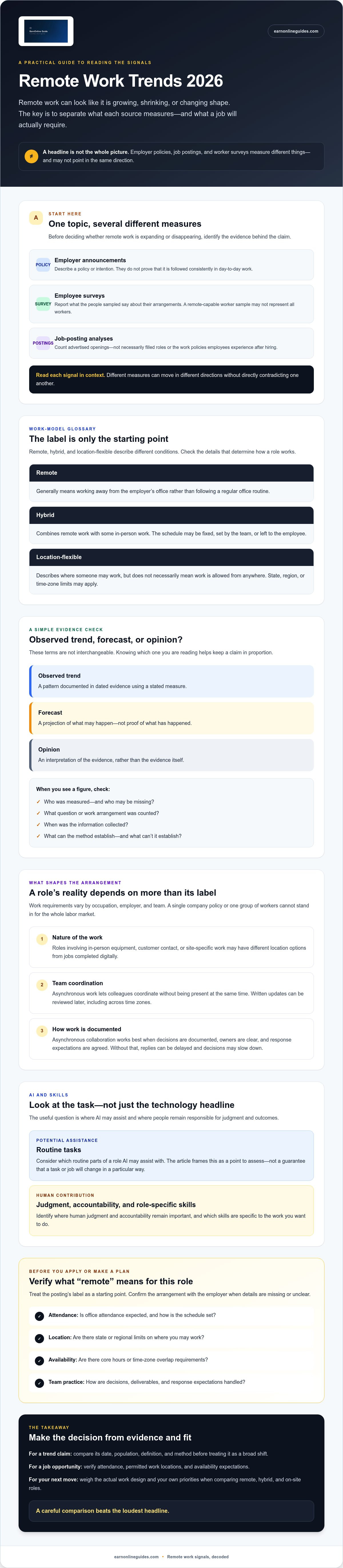
No single headline establishes that remote work is ending. A return-to-office mandate shows what an employer requires or announces. A worker survey describes the arrangements reported by its respondents. A job-posting count shows what employers advertised during a particular period. These signals matter, but they measure different outcomes and can’t be treated as interchangeable evidence of a national trend.
Before drawing a conclusion, check the date, population, and definition behind each claim. Does a survey include all workers or only people whose jobs can be done remotely? Does a posting count distinguish fully remote roles from hybrid ones? Does a policy report describe announced requirements or verified attendance? Without those details, comparisons may be misleading.
The evidence discussed here doesn’t establish whether the total number of remote jobs in the U.S. is rising or falling, or how consistently every employer enforces its policy. That uncertainty isn’t proof in either direction. It means claims about remote work trends 2026 should be limited to what each measure actually captures.
Remote work can offer flexibility for people whose tasks can be done off-site, while hybrid schedules may preserve in-person time for collaboration, training, or work that depends on physical equipment. Fully on-site roles remain necessary for jobs that require a particular location or face-to-face service. These are practical differences, not a ranking of which arrangement is best.
Access also varies. A role may be labeled remote but restricted to specific states, regions, or time zones. Some people may have the tools and quiet workspace remote tasks require; others may prefer workplace equipment, clearer separation between work and home, or more direct interaction with colleagues. The information in this article doesn’t quantify these differences, so avoid assuming that one arrangement suits all workers or occupations.
To evaluate an opportunity, compare the arrangement with the actual work: required office days, eligible work locations, expected availability, and how the team handles collaboration. Then weigh the flexibility against the constraints that matter in your circumstances.
For broader guidance on evaluating remote arrangements and job options, read the complete guide to remote work.
Use remote work trends 2026 as context, not as a prediction of your personal hiring prospects or income. Broad patterns can help you ask better questions, but your decision should rest on the actual role, its stated terms, and how well the work fits your skills and circumstances.
Before applying or changing your plans, review each opportunity against the same practical criteria:
If a posting leaves a material detail unclear, ask the employer before making a decision. Don’t assume that “remote” means location-independent or that a flexible schedule means there are no fixed availability requirements.
Independent work calls for a separate assessment. A freelance project isn’t the same arrangement as an employee role, so clarify the scope, deliverables, payment terms, and who is responsible for each part of the work. For a starting point on setting rates, see this guide to pricing freelance work.
If you’re looking for employment, compare listings with the employer’s own description of attendance and location requirements, and verify details that affect your eligibility. If you’re building skills, use requirements in credible job descriptions to choose what to learn next. Focus on a specific gap tied to roles you’d actually consider, rather than collecting credentials without a clear purpose.
Remote-work patterns can inform your search, but they can’t guarantee an offer, predict an employer’s decision, or determine what an individual worker will earn. Reviewing the job’s terms alongside your own priorities is more useful than reacting to a broad forecast.
For more practical context on evaluating remote arrangements, explore the complete guide to remote work as an optional next step.
The most useful remote work trends 2026 takeaway is that no single policy announcement, survey, or job-posting count tells the whole story. Check what each measure captures before treating it as evidence of a broad shift. Then assess opportunities on their actual terms, including schedule, location limits, communication expectations, and required skills.
AI is another reason to focus on specifics. Tool adoption alone doesn’t prove that a role will disappear or that a new credential will improve your prospects. Compare the tasks employers describe with the skills you already have, and choose learning priorities based on credible role requirements.
EarnOnlineGuides offers a remote job directory, remote-work statistics, and digital-skill learning resources to help readers investigate their options. Explore EarnOnlineGuides’ remote-work resources and directory to compare opportunities and identify a practical next step.
No single headline or employer announcement proves that remote work is disappearing across the United States. A return-to-office policy, a worker survey, and a remote-job posting count each measure something different. Assess remote work trends 2026 by checking the date, population, and definition behind a claim. For an individual job search, the employer’s stated schedule and location requirements are more useful than a broad prediction.
Key areas to watch include hybrid schedules, geographic restrictions on remote roles, distributed-team practices, and workplace use of AI. These don’t all have equally strong evidence as nationwide trends. Asynchronous communication, for example, may shape how a team works, but that alone doesn’t show how common the practice is. Separate measured worker arrangements from employer policies, job advertisements, and forecasts before deciding which changes are established.
Some employers require employees to work on-site for part or all of the week, while others continue to offer remote or hybrid arrangements. A company announcement establishes that a policy was stated, but not necessarily how consistently it’s applied or how widespread it is across employers. If you’re evaluating a role, ask about required office days, how attendance is handled, and whether the policy applies to your team and location.
AI use doesn’t by itself show that remote jobs will be eliminated. A tool may assist with particular tasks, such as drafting or summarizing, while people remain responsible for checking accuracy, applying context, and owning decisions. To assess displacement claims, look for reliable evidence tied to specific occupations and actual job outcomes. Also verify your employer’s rules on approved tools and handling confidential information before using AI for work.
Useful skills depend on the role, but clear digital communication, organized documentation, and independent task management can help teams coordinate when they aren’t working together in person. Technical skills, including AI tool use, should match the tasks an employer actually lists. Review job descriptions for roles you want, then identify a specific skill gap to address. A credential alone doesn’t guarantee hiring or higher pay.
Check who or what was measured, when information was collected, and how “remote” or “hybrid” is defined. A survey describes responses from its sample; a job-posting analysis counts advertisements; an employer announcement reports a policy or plan. These aren’t interchangeable. Look for dated information, clear methods, and stated limitations. If those details are missing, treat the claim as uncertain rather than evidence of a nationwide change.

Article by
EarnOnlineGuides Editorial Team
The EarnOnlineGuides Editorial Team creates practical, research-driven educational content about making money online, remote work, freelancing, side hustles, digital skills, AI tools, online business, and self-employment. Our goal is to help readers understand their options, compare realistic opportunities, avoid misleading claims, and make better-informed decisions. We prioritize accuracy, transparency, practical guidance, and responsible reporting, and we regularly review our content to keep it useful and up to date.
The information provided in this article is for general educational and informational purposes only and should not be considered financial, investment, tax, legal, or professional advice. Earnings, income examples, costs, fees, and other figures may vary and are not guaranteed. Always conduct your own research and consult a qualified professional when appropriate.
Some articles on EarnOnlineGuides may contain affiliate links. If you click a link and make a purchase or sign up for a service, we may receive a commission at no additional cost to you. This does not influence our editorial standards or recommendations.
We strive to keep our information accurate and up to date, but products, services, fees, policies, laws, and market conditions can change. Please verify important information directly with the relevant provider before making financial or business decisions.
Educational information only. This article is not financial, tax, or legal advice. Platform fees and policies change; always confirm current rates in the marketplace's official fee documentation before making decisions.
Explore low cost digital side hustles you can test in 2026. Compare freelance work, digital goods, and reselling while managing hidden platform fees and time.

Learn how to open a freelance business bank account step by step. Explore document checklists, compare bank options, and keep business finances organized.

Learn how to write affiliate product reviews readers can trust. Discover a practical process for honest testing, balanced pros and cons, and clear disclosures.