
Low-Cost Digital Side Hustles: Practical Ways to Start in 2026
Explore low cost digital side hustles you can test in 2026. Compare freelance work, digital goods, and reselling while managing hidden platform fees and time.
October 13, 202618 min read
What if working from home makes a career more sustainable, but only when the role and workplace support it? Remote work from home benefits can include more control over your workday and less time spent commuting. But flexibility alone doesn’t ensure career growth, strong professional relationships, or a clear boundary between work and personal life.
If you’re weighing remote or hybrid work, consider those tradeoffs alongside the role’s daily requirements. A home-based job may suit your needs, but its long-term value also depends on how the employer communicates, evaluates performance, and provides opportunities to learn and contribute.
This article explains which benefits may matter most, where they can fall short, and what conditions help remote work support a lasting career. Use the practical questions below to assess expectations, connection, growth, and boundaries before deciding whether a particular arrangement fits your circumstances.
Remote work from home benefits are the potential advantages of doing job tasks outside a central office, such as having more control over where you work or reducing time spent commuting. For career longevity, a benefit matters when it helps you sustain your work, maintain professional connections, and keep developing skills. Remote work may support those goals, but it doesn’t guarantee them.
A fully remote role is generally performed outside an employer’s office, while a hybrid schedule combines remote work with time at an office or another designated worksite. A remote-first employer designs its processes primarily for a distributed team. These terms can overlap, so ask what an employer means by the label and what the arrangement requires day to day.
Working from home may reduce commuting time, leaving more room for personal responsibilities, rest, or a less compressed start and end to the day. Whether that makes a difference depends on how the time is used and whether the job allows schedule flexibility. Fixed hours, frequent meetings, or quick-response expectations can limit that control. If the workload simply expands to fill the time saved, the practical benefit may be small.
Consider the shape of the workday, not just where it takes place. Someone with predictable project tasks may be able to plan focused work around personal responsibilities. A worker coordinating with customers or teammates throughout the day may have less control over timing. Flexibility is more useful when availability expectations, deadlines, and workload are clear.
The same arrangement can feel different depending on the job and team. Independent work may be easier to complete remotely than tasks requiring specialized equipment, in-person service, or frequent live collaboration. Team habits matter too: a distributed team that documents decisions can keep off-site employees informed, while one that relies on informal office conversations may leave them out of the loop.
Home setups vary as well. A quiet, dedicated office may not be available to everyone, and shared spaces, caregiving responsibilities, limited equipment, or unreliable internet can make concentration more difficult. Assess the actual tasks, schedule, communication practices, and workspace requirements before deciding whether the arrangement fits. For a broader overview of work-from-home options, see work-from-home options.
Some remote work from home benefits come from changes to the workday, not location alone. A quieter setting may help with focused tasks, and no commute may make daily routines feel less compressed. These are possible advantages, not universal outcomes. The work itself, home environment, and employer expectations all affect whether they occur.
Work that requires sustained attention, such as drafting a report or reviewing data, may be easier at home if the workspace is quiet and interruptions are limited. That’s a potential advantage, not proof that remote workers are automatically more productive. Household noise, caregiving, and frequent notifications can replace office interruptions with other distractions.
Tasks that depend on quick discussion may also be harder to coordinate if teammates aren’t available at the same time. Before assuming remote work will improve your focus, consider how much of the role involves independent concentration versus real-time collaboration. Ask how the team handles questions, shares decisions, and resolves blockers when colleagues aren’t online together.
Remote work may give employees more control over the order or setting of some tasks. For example, someone might schedule focused work around standing meetings if the role allows it. That doesn’t mean unlimited flexibility: required hours, customer coverage, deadlines, and team coordination can still define the workday.
Clear goals and reliable communication can make autonomy easier to manage. When a team documents decisions and agrees on response expectations, employees may be able to move work forward without waiting for a live meeting. Other roles depend on frequent real-time contact, so the amount of asynchronous work varies by job and employer.
Commute time can also affect quality of life. Removing a daily trip may leave more room for rest or personal responsibilities, though the effect depends on the commute and how work fills the time instead. A research brief from the Center for Retirement Research at Boston College discusses research on career longevity and reports that remote work appears to make employees less likely to retire. That finding relates to the broader question of careers lasting longer, but it doesn’t guarantee an improvement in any individual’s well-being or career prospects.
To compare how different arrangements work in practice, see this guide to remote work.
Remote work doesn’t automatically improve every career or workday. Flexibility and fewer office interruptions may be valuable, while isolation, blurred boundaries, and fewer informal chances to build relationships can be drawbacks. Which effects matter most depends on the role, your circumstances, and how the employer organizes remote work.
For career longevity, look beyond convenience. Consider whether the arrangement helps you do the work, get useful feedback, stay connected to colleagues, and develop skills. Remote work from home benefits are more likely to last when the workplace makes expectations and opportunities clear, rather than leaving employees to guess how to stay visible or advance.
Fewer spontaneous conversations can make it harder for some remote employees to learn about projects, build rapport, or ask quick questions. That doesn’t mean remote workers are inherently less connected or less likely to advance. It does mean communication habits matter. Ask how managers provide feedback, how employees find mentors, and what criteria guide promotions and project assignments.
Visibility should be based on clear work outcomes, not simply being seen online. Before accepting a role, ask how contributions are recognized and how growth conversations happen. Compare compensation, responsibilities, and advancement expectations together, since a salary figure alone may not describe the full terms of a job.
When home is also the workplace, it can be harder to notice when the workday has ended. Messages outside scheduled hours or an ongoing workload can make “just one more task” feel routine. A defined availability window and a simple shutdown routine, such as writing down unfinished tasks before signing off, may help mark the transition.
Personal routines can’t replace reasonable workload expectations or clear employer practices. Ask whether the team expects responses outside regular hours, how it handles urgent requests, and how workload is managed. If those expectations are vague, flexibility may come with more boundary pressure than the job description suggests.
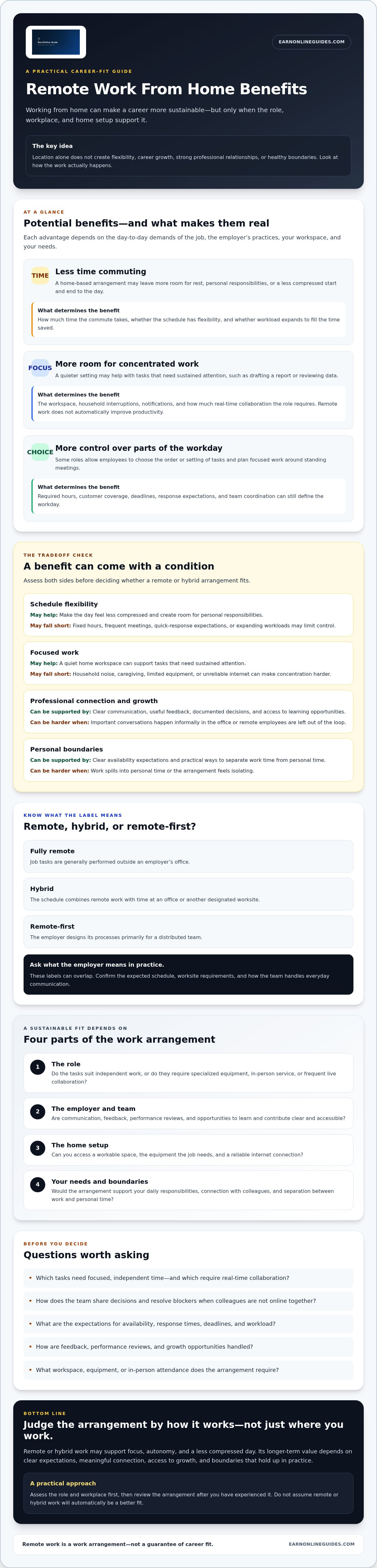
Evaluate a remote role as a work arrangement, not just a location. Separate what you prefer from what the job and employer require. You may be able to adjust your routine, but you can’t change a role’s need for on-site equipment, set coverage hours, or frequent live collaboration. Remote work from home benefits matter most when the arrangement fits both your circumstances and the actual work.
Before accepting a position, get specific about how the work happens. Ask questions that reveal day-to-day expectations instead of relying on the “remote” label:
These questions help distinguish an arrangement that works on paper from one that fits your responsibilities and home setup. If an answer is unclear, ask for a concrete example, such as how the team shares a decision or handles an urgent question.
Once you understand the employer’s practices, clarify expectations that will make the arrangement easier to navigate. Agree on working hours, typical response times, and when a quick call is preferable to a long message exchange. Regular check-ins can provide a reliable place to raise blockers and discuss progress, but their frequency should suit the team’s work rather than follow a fixed formula.
Professional connection may also take deliberate effort. Identify colleagues whose work overlaps with yours, ask focused questions, and take part in relevant team discussions instead of assuming informal contact will happen on its own. For development, choose a specific learning goal related to your role, such as building proficiency with a tool your team uses, and discuss how progress will be reviewed with your manager.
Some factors remain outside your control, including workload design and promotion policies. If the arrangement is new, note what supports your work and what creates friction. Once you have enough experience to assess it, revisit those points with your manager. To compare different work arrangements and find options to explore, review ways to work from home.
Remote work is more likely to support a lasting career when the role fits your responsibilities, the employer provides clear communication and feedback, and you can maintain boundaries while developing relevant skills. Remote work from home benefits aren’t guaranteed by location alone. They depend on how the arrangement works in practice and whether it supports your current needs and future goals.
Give yourself time to assess the arrangement through experience. Keep track of what helps you do your work well, where coordination becomes difficult, and whether you’re receiving useful feedback and learning opportunities. Review those observations with your manager or use them to consider whether a different arrangement may fit better.
Start with one condition you want to evaluate, such as control over your schedule, time for focused work, or connection with your team. Agree on practical expectations for communication and availability, then choose a routine that fits the role, including breaks and a clear end-of-day transition. After you have had time to test it, consider whether the setup supports your responsibilities without undermining longer-term priorities.
Identify the skills your current or prospective role requires, and confirm those expectations with the employer rather than guessing. If a specific skill gap limits the work you can take on, find a learning resource that addresses it and set a clear goal for applying what you learn. Reviewing progress with a manager can help make development part of regular career conversations, not an afterthought.
Remote work practices vary by employer and role, so broad trends shouldn’t be treated as predictions about your individual prospects. For a wider framework to compare arrangements and plan your next steps, read the complete guide to remote work. Use it as a starting point, then check specific job expectations and workplace practices before deciding what fits.
The benefits of working from home depend on whether a role’s tasks, communication practices, and growth opportunities fit your needs. Flexibility may support a more manageable workday, but it doesn’t guarantee focus, connection, or career advancement. Clear expectations, workable boundaries, and continued skill development help determine whether an arrangement can remain sustainable.
Rather than relying on assumptions, assess the role’s requirements and revisit your experience after you’ve had time to work in the arrangement. Pay attention to what supports your work and what needs clarification with your employer.
If you’re exploring your options, EarnOnlineGuides offers beginner-friendly educational guides, a remote job directory, and digital skill learning paths. Explore the directory and learning paths alongside the complete guide to remote work to plan your next step. A thoughtful decision starts with what fits your circumstances, and you can adjust your plan as you learn more.
Common potential benefits include less commuting, more control over parts of the workday, and an environment that may suit focused tasks. Remote work from home benefits depend on the job, employer expectations, and home setup. For example, independent project work may suit a quiet home workspace, while a role requiring frequent in-person collaboration may offer fewer practical advantages. Consider which benefits address your needs and whether the role can support them.
It can, if reduced commuting or greater control over routines leaves room for personal responsibilities and the employer maintains reasonable expectations. But working from home doesn’t automatically create better balance. A heavy workload, messages outside scheduled hours, or difficulty separating work from home life can make boundaries harder to maintain. Before accepting a role, clarify work hours, availability expectations, and how the team handles urgent requests.
No. Productivity depends on the tasks, work environment, communication needs, and individual circumstances. Someone doing focused writing may find fewer office interruptions helpful, while household noise or caregiving responsibilities may disrupt concentration. Work requiring rapid collaboration may also be affected by how readily teammates can connect. Ask how the employer defines successful performance and whether evaluation focuses on clear results rather than assumptions about where or when work happens.
It can create challenges if remote employees have less access to feedback, mentorship, important projects, or informal information. That outcome isn’t inevitable; advancement depends on the role, performance criteria, and employer practices. Ask how promotions are decided, how contributions are recognized, and whether remote employees can take on visible responsibilities. Clear criteria and regular career conversations help you assess whether growth is realistically supported in that workplace.
Agree on communication expectations, schedule regular check-ins, and make deliberate efforts to build working relationships instead of relying only on spontaneous conversations. To clarify the end of the workday, set an availability window and use a shutdown routine, such as noting unfinished tasks before signing off. These steps may help, but they can’t replace employer support, manageable workloads, and clear team norms.
Ask which duties require in-person work, what schedule and response times are expected, and what equipment or workspace the role requires. Also clarify how managers provide feedback, coordinate projects, evaluate performance, and communicate promotion criteria. If the answers are general, request a practical example, such as how a remote employee receives mentoring or handles urgent questions. Specific answers make it easier to compare the role with your needs.

Article by
EarnOnlineGuides Editorial Team
The EarnOnlineGuides Editorial Team creates practical, research-driven educational content about making money online, remote work, freelancing, side hustles, digital skills, AI tools, online business, and self-employment. Our goal is to help readers understand their options, compare realistic opportunities, avoid misleading claims, and make better-informed decisions. We prioritize accuracy, transparency, practical guidance, and responsible reporting, and we regularly review our content to keep it useful and up to date.
The information provided in this article is for general educational and informational purposes only and should not be considered financial, investment, tax, legal, or professional advice. Earnings, income examples, costs, fees, and other figures may vary and are not guaranteed. Always conduct your own research and consult a qualified professional when appropriate.
Some articles on EarnOnlineGuides may contain affiliate links. If you click a link and make a purchase or sign up for a service, we may receive a commission at no additional cost to you. This does not influence our editorial standards or recommendations.
We strive to keep our information accurate and up to date, but products, services, fees, policies, laws, and market conditions can change. Please verify important information directly with the relevant provider before making financial or business decisions.
Educational information only. This article is not financial, tax, or legal advice. Platform fees and policies change; always confirm current rates in the marketplace's official fee documentation before making decisions.
Explore low cost digital side hustles you can test in 2026. Compare freelance work, digital goods, and reselling while managing hidden platform fees and time.

Learn how to open a freelance business bank account step by step. Explore document checklists, compare bank options, and keep business finances organized.

Learn how to write affiliate product reviews readers can trust. Discover a practical process for honest testing, balanced pros and cons, and clear disclosures.