
Low-Cost Digital Side Hustles: Practical Ways to Start in 2026
Explore low cost digital side hustles you can test in 2026. Compare freelance work, digital goods, and reselling while managing hidden platform fees and time.
October 13, 202618 min read

The most practical way to earn online is usually not the one with the biggest income claims. It’s the one that fits your time, skills, and budget. Conflicting advice can make legitimate opportunities hard to distinguish from hype, and every path comes with different demands and risks. Realistic ways to earn online include remote jobs, freelancing, selling products, and building an audience, but none is a shortcut to guaranteed income.
This guide compares common online income models so you can assess the work involved, the resources you may need, and where uncertainty comes in. You’ll see how the options differ in skill requirements, startup costs, time commitment, and predictability. Then you can narrow your choices and identify a small, testable first step before investing more time or money.
A realistic online income path involves legitimate work, requirements you can understand, and outcomes that depend partly on factors outside your control. “Realistic ways to earn online” doesn’t mean easy or certain income. It means you can explain who pays, what value they receive, what work you must do, and what resources the model requires.
It helps to distinguish three broad approaches. Active work exchanges your time or expertise for compensation, as with a remote job or freelance project. Business-building involves finding customers, making sales, and handling operations, as with an online store or service business. Asset-based models aim to earn from something created or owned, such as digital content or a product. Creating, maintaining, and promoting that asset can still take significant work. A broad overview of online business models can help clarify the range of approaches.
Online income comes from an exchange: an employer pays for labor, a client pays for expertise, a customer buys a product, or an audience receives value that supports a business. Employment income is compensation for work under an employer’s arrangement. Self-employment revenue is money received from clients or customers; business profit is what remains after applicable business expenses. Neither revenue nor profit automatically equals take-home income, which may also be affected by taxes and other obligations. The details depend on the work arrangement and personal circumstances.
Before choosing a model, ask whether you can deliver the work consistently, not just whether the idea sounds appealing. This overview of ways to make money online can help you explore options before comparing their requirements.
A claimed result is difficult to evaluate without knowing the work, costs, timeframe, and conditions behind it. A creator’s sales figure, for example, doesn’t reveal how much time went into building an audience, producing content, or promoting a product. One person’s success story describes that person’s experience, not what another beginner is likely to earn.
Use these questions to assess an income claim:
Guaranteed-income language, pressure to pay quickly, and vague explanations of how money is made are reasons to pause. A legitimate opportunity should be explainable without relying on promises. Compare its potential with the likelihood of finding buyers or work, the time you can commit, and your ability to deliver. A path is more practical when those factors fit your circumstances, even if its potential looks less dramatic.
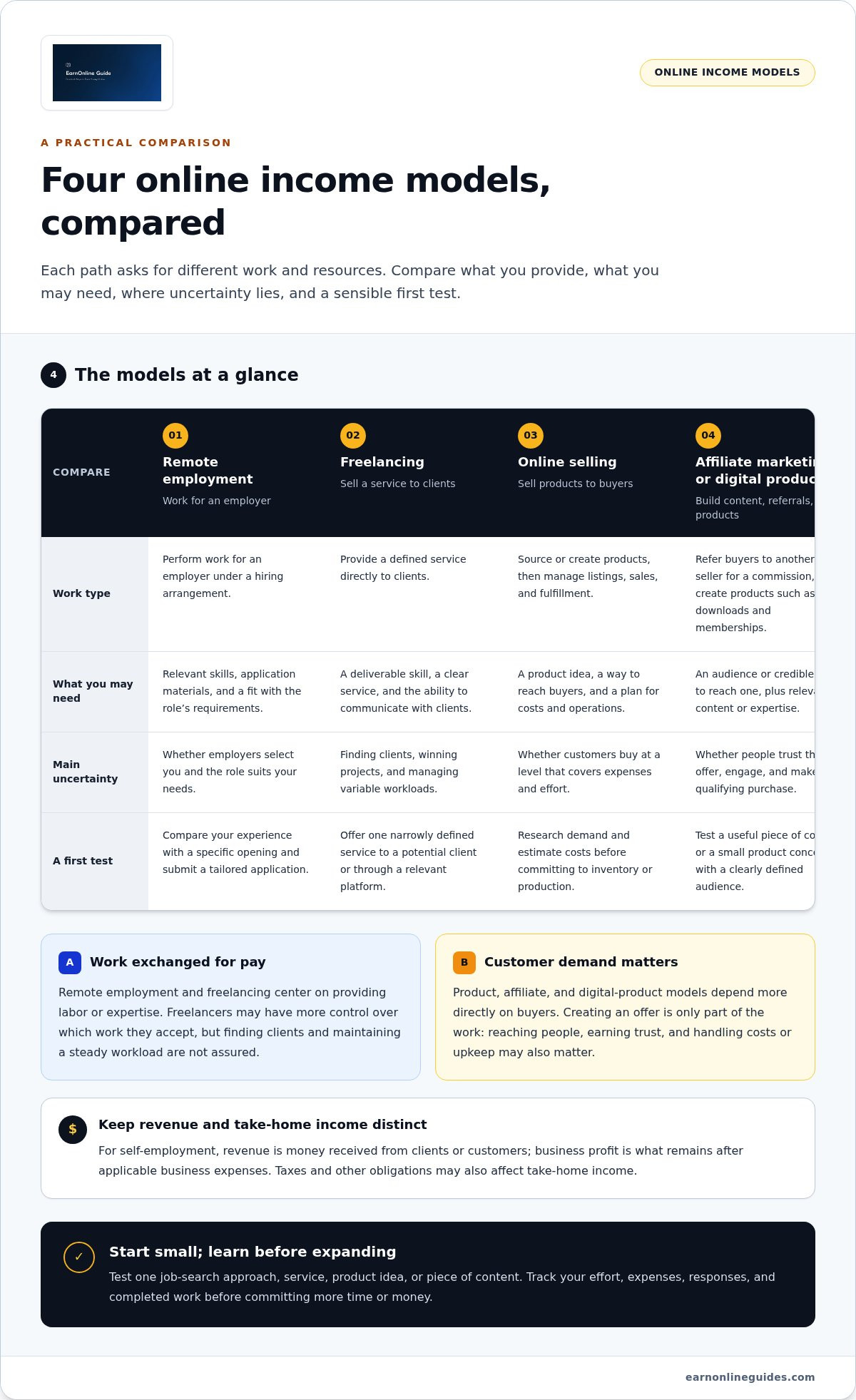
These four models differ in what you provide and where uncertainty enters. A remote job or freelance service exchanges work for pay. Selling products, affiliate marketing, and digital products depend more directly on customer demand. The World Bank’s report on digital progress and trends provides broader context about the digital economy, but growth in a sector doesn’t establish that a particular offer will find customers.
| Model | Work type | Likely prerequisites | Main uncertainty | First test |
|---|---|---|---|---|
| Remote employment | Perform work for an employer under a hiring arrangement. | Relevant skills, application materials, and a fit with the role’s requirements. | Whether employers select you and the role suits your needs. | Compare your experience with a specific opening and submit a tailored application. |
| Freelancing | Sell a defined service directly to clients. | A deliverable skill, a clear service, and the ability to communicate with clients. | Finding clients, winning projects, and managing variable workloads. | Offer one narrowly defined service to a potential client or through a relevant platform. |
| Online selling | Source or create products, then manage listings, sales, and fulfillment. | A product idea, a way to reach buyers, and a plan for costs and operations. | Whether customers buy at a level that covers expenses and effort. | Research demand and estimate costs before committing to inventory or production. |
| Affiliate marketing or digital products | Refer buyers to another seller for a commission, or create products such as downloads and memberships. | An audience or a credible way to reach one, plus relevant content or expertise. | Whether people trust the offer, engage, and make a qualifying purchase. | Test a useful piece of content or a small product concept with a clearly defined audience. |
A remote employee works for an employer under its hiring arrangement. A freelancer sells specific services, such as editing or design, to clients and manages the work relationship independently. Freelancing can give you more control over which work you accept, but finding clients and maintaining a steady workload are not assured. If service work fits your skills, start with this beginner guide to freelancing online.
Online selling involves more than listing a product. You may need to source or create it, fulfill orders, and account for platform and operating costs. Affiliate marketing earns commissions when qualifying referrals lead to purchases, so audience attention alone may not produce revenue. Courses, downloads, and memberships also require creation, trust, promotion, and continued upkeep. A small test can show whether people respond before you expand the offer.
No model is best for everyone. Match the work to your skills, schedule, resources, and willingness to find customers or promote an offer. EarnOnlineGuides affiliate marketing guides can help you explore that model in more detail.
Compare each option by more than its advertised earning potential. “Passive” and “digital” describe how an offer is delivered or how revenue may continue, not how much work it takes to create demand. A digital product may require research, production, promotion, customer support, and updates. Affiliate content still depends on reaching an audience and earning its trust. Neither label makes results predictable.
The time to a first opportunity also varies. A remote employee may need to find suitable openings and complete an employer’s hiring process. A freelancer may need to define a service, approach clients, and secure a project. A seller may need to research demand, prepare listings, and arrange fulfillment. These are different sequences of work, not models with a universal time-to-income estimate.
Start with an honest inventory of the hours you can commit, skills you can deliver now, tools you have, and unpaid preparation you can sustain. If you have limited time, compare scheduled employment with project-based services. Fixed hours may be easier to plan around, while freelance work may offer flexibility but also requires finding clients and managing deadlines. If capital is limited, consider models with modest setup needs, while accounting for possible costs such as software, materials, platform charges, or unpaid preparation.
Look for evidence that identifiable employers or customers need the work before building a full business around it. For a service, review relevant job postings or talk with potential clients about a specific need. For a product, examine comparable offers and test interest before committing heavily to inventory or production. If you plan to start your own business, understand that planning also means assessing your skills and the practical requirements involved.
Make a simple cost map before spending. Separate one-time setup costs, recurring expenses, platform or payment fees, and the time spent on unpaid setup. For marketplace selling, use EarnOnlineGuide’s online selling fee calculators to identify relevant fee categories, then verify applicable rates and terms with the platform itself. Platform policies can change and may depend on account or transaction details.
Tax treatment depends on the nature of the work and your circumstances. Use current information from the IRS or another relevant tax authority, and seek qualified tax help for individual questions. The most practical choice is one whose demands you understand and can test without taking on costs or commitments you can’t reasonably manage.
Test a small version of one idea before making a large commitment. A useful test answers a specific question: will a defined customer or employer respond to this offer, and can you deliver the work with your available time and resources? Testing this way helps you evaluate realistic ways to earn online using evidence rather than assumptions or attention metrics alone.
Keep the first test focused. Choose one model, identify the person or organization it serves, then offer a limited version of the work or product. For example:
A test should involve a real audience or opportunity, not just private planning. Keep the commitment limited, too. Avoid building a full store, extensive product catalog, or large content library before you have reason to believe the offer addresses a real need.
Record the inputs and outcomes that will help you make a decision. A simple spreadsheet or written log can capture:
Views, likes, and sign-ups may show attention, but they don’t establish that a model can support repeatable work or sales. Treat early responses as signals to investigate, not proof of durable demand. A paid request, completed project, or specific feedback from a potential customer can be more informative, though none guarantees future results.
Choose a review point before you start. Set it according to the test’s scope, your available time, and the decision you need to make; there’s no universal timeline. If people understand the offer but don’t respond, revise the audience, problem, or presentation and test again if the cost is manageable. If the work requires resources you can’t sustain or the evidence remains weak, pause or stop rather than increasing your commitment by default.
If you’re ready to turn your test into an implementation plan, use this step-by-step guide to starting online.
A promising test is a reason to learn more, not proof that an idea will become dependable income. Move forward when you see credible demand, can deliver the work at a manageable level, and understand the costs involved. Then repeat the process on a limited scale and see whether the results hold across more than one customer, project, or sales opportunity.
Use what the test revealed to choose your next step. If clients are interested but delivery takes too long, improve the specific skill or process slowing you down. If customers respond to a product but costs make the numbers difficult, revisit sourcing, pricing, or fulfillment before expanding. Avoid changing direction just because a new platform or income trend is receiving attention.
Pause or revise if expenses keep rising, the work is difficult to sustain, or interest doesn’t turn into meaningful inquiries or completed transactions. Replacing employment income may require sustained effort, and the outcome remains uncertain. This guide to the timeline for replacing full-time income online can help you think through that decision without treating a particular timeline as universal.
The next useful resource depends on the model you’re testing. If you’re pursuing employment, use the remote job directory and role-focused guides to explore openings and understand what specific positions require. If you’re offering services, use freelancing guidance to shape a clear offer and consider how your time and expenses affect what you charge. For selling or audience-based models, keep investigating demand and costs before increasing your commitment.
Make your next decision based on evidence you can observe: whether people need the offer, whether you can deliver it consistently, and whether the work remains manageable after accounting for expenses and time. That is a more useful basis for choosing among realistic ways to earn online than copying a success story or switching paths in response to hype.
For practical guidance on comparing options and planning your next move, explore online income guides.
Realistic ways to earn online depend on more than an idea’s earning potential. The work, required skills, time commitment, costs, and uncertainty all matter. Employment and freelancing exchange work for pay, while selling products or building an audience depends more directly on customer demand.
Before committing, choose one model and test a small offer or application. Track the time and expenses involved, along with meaningful responses and completed work. If the evidence supports continuing, improve the skills or process that would make the work more repeatable. If it doesn’t, revise the idea or pause before taking on more cost or effort.
Use educational guides and structured digital skill learning paths to research what your chosen model requires. Specialized online income calculators can support your planning, while a remote job directory can help with an employment search. Explore EarnOnlineGuide’s practical resources to choose a useful next step for your situation.
Start small, assess what you learn, and build only when the work and evidence justify it. A measured first step can help you make a more informed choice.
Realistic options include remote employment, freelancing, online selling, and audience-based models, but each depends on different work and conditions. Employment involves applying for a role and meeting an employer’s requirements. Freelancing means finding clients and delivering a defined service. Selling requires a product and a plan for costs and fulfillment. Affiliate marketing or digital products depend on reaching an audience and earning its trust. Compare the work and risks, not unsupported income estimates.
Beginners can pursue online work, but the right starting point depends on the role or model. Some entry-level positions may emphasize reliability and basic qualifications, while freelance services usually require a skill clients will pay for. Identify roles that match your experience, learn any essential tools, and create a small sample of relevant work when appropriate. Avoid paying for promises of employment or income. Skill-building can help you prepare, but it doesn’t guarantee paid work.
A legitimate opportunity should clearly explain the work, who pays, how compensation is calculated, and what conditions apply. For a job, look for a verifiable employer and a clear hiring and payment arrangement. For freelance or selling platforms, review official terms covering payment, fees, and account requirements. Be cautious if the business model is unclear, earnings are guaranteed, you’re pressured to act immediately, or payment requires unexplained upfront fees. Verify important terms through the official organization or platform.
Not always, but costs depend on the model. Applying for remote roles or offering a service with tools you already own may require little upfront spending, though preparation still takes time. Selling products can involve sourcing, materials, fulfillment, or platform costs; digital products may require tools and promotion. Low-cost doesn’t mean cost-free. List one-time expenses, recurring charges, and unpaid setup work before committing, then verify platform fees directly with the provider.
There’s no reliable universal timeline. A remote job depends on finding a suitable opening and progressing through the employer’s hiring process. Freelancers need to define an offer and secure clients; sellers and creators must also test demand. Your skills, available effort, competition, and customer response all affect timing. Plan around actions you control, such as submitting tailored applications or testing a small offer, rather than relying on a promised date for income.
Usually not if you mean income that requires no work. An online course, downloadable product, or content library takes effort to create and may need updates, marketing, customer support, or platform management. Affiliate income also depends on useful content, audience trust, and qualifying purchases. Some assets may continue generating revenue after the initial work, but demand and earnings can change. Assess both the setup effort and ongoing maintenance before treating an asset-based model as a fit.

Article by
EarnOnlineGuides Editorial Team
The EarnOnlineGuides Editorial Team creates practical, research-driven educational content about making money online, remote work, freelancing, side hustles, digital skills, AI tools, online business, and self-employment. Our goal is to help readers understand their options, compare realistic opportunities, avoid misleading claims, and make better-informed decisions. We prioritize accuracy, transparency, practical guidance, and responsible reporting, and we regularly review our content to keep it useful and up to date.
The information provided in this article is for general educational and informational purposes only and should not be considered financial, investment, tax, legal, or professional advice. Earnings, income examples, costs, fees, and other figures may vary and are not guaranteed. Always conduct your own research and consult a qualified professional when appropriate.
Some articles on EarnOnlineGuides may contain affiliate links. If you click a link and make a purchase or sign up for a service, we may receive a commission at no additional cost to you. This does not influence our editorial standards or recommendations.
We strive to keep our information accurate and up to date, but products, services, fees, policies, laws, and market conditions can change. Please verify important information directly with the relevant provider before making financial or business decisions.
Educational information only. This article is not financial, tax, or legal advice. Platform fees and policies change; always confirm current rates in the marketplace's official fee documentation before making decisions.
Explore low cost digital side hustles you can test in 2026. Compare freelance work, digital goods, and reselling while managing hidden platform fees and time.

Learn how to open a freelance business bank account step by step. Explore document checklists, compare bank options, and keep business finances organized.

Learn how to write affiliate product reviews readers can trust. Discover a practical process for honest testing, balanced pros and cons, and clear disclosures.