
Low-Cost Digital Side Hustles: Practical Ways to Start in 2026
Explore low cost digital side hustles you can test in 2026. Compare freelance work, digital goods, and reselling while managing hidden platform fees and time.
October 13, 202618 min read

What if the best non-phone work from home jobs aren’t the ones with “no calls” in the title? A role may rely mostly on email, chat, or task-management tools and still include team meetings or occasional calls. That distinction matters when a listing leaves call volume and communication expectations unclear.
If you want to work remotely without spending the day on the phone, you also need to know which roles fit your skills and how to assess listings. “Non-phone” rarely means zero conversation, so the job title alone isn’t enough to judge whether a position suits you.
This guide compares 10 remote role types beyond data entry, including typical tasks, communication channels, and common skill requirements. You’ll also learn what to check in a posting and what to ask an employer before applying, so you can evaluate the work and expectations instead of relying on a reassuring label.
A non-phone work-from-home job is a remote position with limited or no routine telephone duties. The work may happen at home, but communication requirements depend on the employer and role. Someone entering records or editing documents may spend much of the day on individual tasks, while another remote employee may respond to customers through live chat.
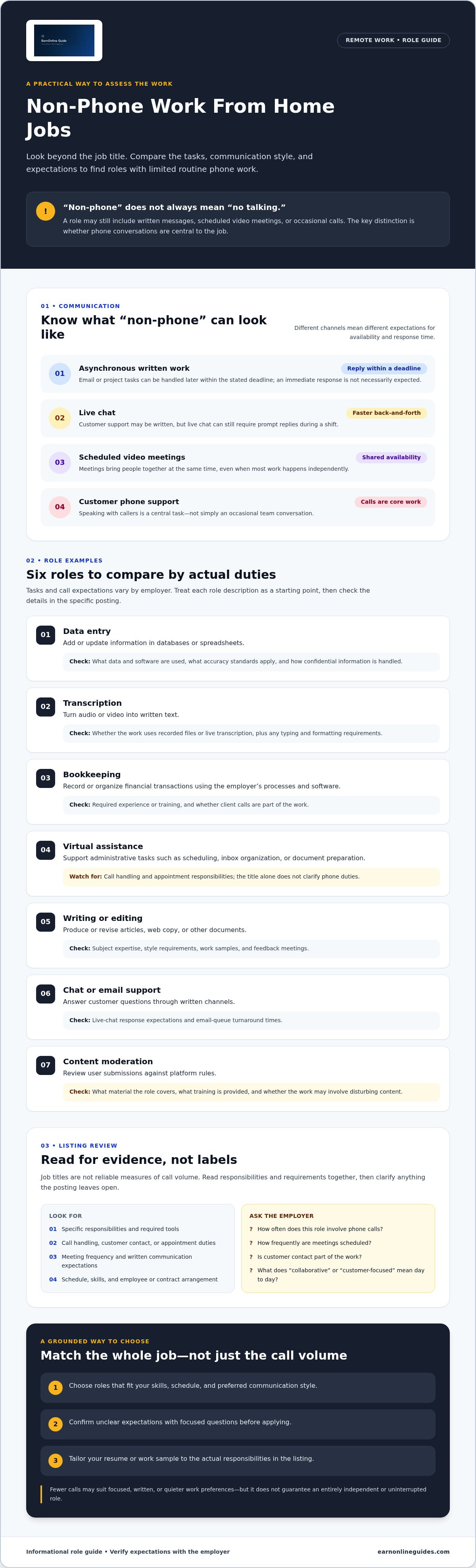
Non-phone doesn’t necessarily mean no talking. A role may include written messages, scheduled video meetings, or occasional calls with a manager or team. The useful distinction is whether phone conversations are central to the job, not whether they happen at all. For broader background on remote work, consider how working away from a traditional office changes where tasks happen. It doesn’t determine how coworkers communicate.
For a closer look at non-phone work-from-home roles, remember that job titles aren’t reliable measures of call volume. Duties can vary by employer, team, seniority, and opening. Read the responsibilities and requirements together, then confirm details the listing leaves unclear.
Asynchronous work doesn’t require people to respond to one another immediately. A coworker might send an email or assign a task in project software, and you can reply or complete it later within the stated deadline. Live chat expects faster back-and-forth, while scheduled video meetings require people to be available at the same time. Customer phone support is different again: speaking with callers is a core task.
Before applying, look for evidence of each communication type. Ask how often the role involves calls, how frequently meetings are scheduled, and whether customer contact is part of the work. If the posting says “collaborative” or “customer-focused” without explaining what that means day to day, request specifics.
Fewer-call roles may suit people who prefer focused work, written instructions, or communication they can review before responding. They may also suit someone seeking a quieter work environment. These are preferences, not guarantees of fit, and they don’t mean a role will be entirely independent or uninterrupted.
Evaluate the whole arrangement. Required skills, schedule, teamwork, and whether the position is employee or contract work can matter as much as phone volume. If the communication pattern fits but the tasks or schedule don’t, the role may still be the wrong match.
These role types can involve limited routine phone work, but no category guarantees a call-free schedule or a current opening. Duties, qualifications, tools, and communication practices depend on the employer. Treat each description as a starting point and compare it with the actual posting. The remote work statistics and trends provide broader context, but remote status alone doesn’t show how a particular team communicates.
These jobs involve defined tasks and digital records, but they aren’t interchangeable. Review the required tools and accuracy expectations. Ask how the team handles questions or sensitive information.
These roles focus on deliverables or customer interactions. Written channels may be common, but deadlines, real-time response expectations, and team meetings can shape the daily routine.
To research openings, use a legitimate remote job search guide alongside the employer’s own posting. These non-phone work from home jobs are possibilities to evaluate, not guarantees of fit or availability.
Use this comparison to narrow your options, not to assume every job with a particular title has the same requirements. Duties and qualifications depend on the employer and opening. Written communication can also vary: email may allow time to respond, while live chat can require prompt replies. A role with mostly independent tasks may still include team meetings.
Entry requirements are specific to each posting, not fixed across an occupation. Accuracy, organization, writing, and basic software use can transfer between roles, but an employer may also require related experience, training, or a portfolio. Creative postings may ask for work samples, while technical roles may specify tools or skills. Compare the listed qualifications with tasks you can demonstrate, and use a guide to remote jobs with no experience to explore possible starting points.
An employee role may have employer-defined responsibilities and a set schedule, while freelance work is often organized around agreed projects and deliverables. Actual terms depend on the arrangement, so a job title alone doesn’t establish employment classification, schedule, or call volume. Freelancers may still need client calls or meetings even when the deliverable is written content, design, or bookkeeping. For project-based work, review how to price freelance work as you assess scope and expectations.
For any non-phone role, ask who sets your hours, how feedback is handled, and whether customer or client calls are expected. Those details often reveal more about day-to-day fit than the title does.
Use a process that checks both the work and the employer. Searching only for “non-phone” can miss suitable roles, and the label itself doesn’t verify call expectations or prove a listing is legitimate.
Be cautious if a recruiter asks you to pay upfront for a job, equipment, or training, requests sensitive personal or financial information before you’ve verified the employer and hiring process, or avoids identifying the organization. These signs merit additional scrutiny, but they don’t replace checking the full context. See this guide to spot fake remote job listings for more verification checks.
A directory can help you discover roles to investigate, but it isn’t a placement service and shouldn’t replace your own checks. Confirm the opening with the employer and apply through the channel the employer identifies. A listing on a job board or directory isn’t, by itself, proof that the job is safe, active, or genuinely non-phone.
Use the legitimate remote jobs guide as a starting point for evaluating opportunities. Before applying, compare the posting’s tasks with your skills and get clear answers about communication expectations. If those details remain unclear, investigate further rather than assuming the role involves few calls.
Don’t apply to every role that advertises limited phone work. Choose two or three types that match your existing skills, preferred schedule, and comfort with written communication, meetings, or customer contact. If you’re organized and accurate, for example, compare data entry with bookkeeping. If you have writing samples, compare content work with editing. Then use specific postings to test whether those options fit in practice.
Hiring timelines and outcomes vary. A careful search can help you target better-fitting roles, but it can’t guarantee an interview, offer, or income. Track your applications and verification steps so you can learn from the process rather than relying on memory.
Tailor your resume to the duties named in each posting. Describe relevant tasks, tools, and results accurately, and don’t imply experience or credentials you don’t have. If a sample would help demonstrate a skill, create a small, role-relevant example and label it clearly as a sample, not paid client work.
Keep a simple application log with the employer, role, date, posting link, questions to ask, and follow-up status. If you receive responses, note what they reveal about communication expectations or qualifications. If a recurring requirement is unfamiliar, identify the skill gap and look for reputable learning resources before deciding whether to apply.
A remote job directory can help you research opportunities, but it doesn’t replace checking the employer’s official careers page, confirming a listing is active, or applying directly to the employer. EarnOnlineGuides offers remote-work information and a job directory; it doesn’t provide recruitment, direct placement, or guaranteed job outcomes. Review the guide to legitimate remote jobs as you assess postings and employer details.
After reviewing your applications, adjust your search based on evidence. If a role repeatedly requires calls you’d rather avoid, focus on postings that describe written workflows. If you’re not hearing back, compare your resume with the listed tasks and required skills before changing your target roles. Small, informed adjustments can make your search more focused, even though the outcome and timing remain uncertain.
For more help evaluating non-phone work from home jobs, explore EarnOnlineGuides’ remote-work resources and use them as research aids while you make your own decisions.
Non-phone work from home jobs span structured tasks, creative and technical deliverables, and written customer support. A job title alone won’t tell you whether the role includes calls, live chat, or frequent meetings, so compare the listed duties and communication expectations before applying.
Start with two or three role types that match your skills, schedule, and preferred way of working. Tailor your resume or a relevant sample to each posting, verify the employer through its official channels, and track your applications. Hiring timelines and outcomes vary, so treat each listing as an opportunity to assess, not a promise of employment or income.
EarnOnlineGuide offers a remote job directory and practical educational guides to help you research and evaluate remote-work opportunities. It doesn’t place candidates or guarantee job outcomes. Explore the remote-work resources as you plan your next step, and keep your search grounded in evidence, fit, and clear expectations.
No. Remote describes where the work is done, not necessarily when you work. Some non-phone work from home jobs may have fixed shifts, required availability windows, or deadlines that determine your schedule. Check the posting for time-zone requirements and ask whether hours are set or flexible. If you need a particular schedule, confirm it with the employer before accepting an offer.
A skills assessment may help an employer evaluate how you approach a task, but its format and purpose can differ by role. Before starting, ask what the assessment involves, how long it should take, and whether it uses sample data. Complete it only through a hiring channel you’ve verified, and don’t use confidential information from a current or former employer in your work.
Clarify which computer, internet, and software requirements apply to the role, and whether the employer supplies any required equipment or accounts. The posting may not cover every detail, so ask before accepting an offer or buying anything. Confirm that the tools named are necessary for the work and that instructions come from a verified employer contact, not an unverified recruiter or unexpected message.
Create a small sample that reflects a task in the posting, such as organizing fictional records in a spreadsheet or editing a short piece of sample text. Label it as a practice sample and describe the tools and steps you used. Don’t present sample work as paid client work or claim experience you don’t have. Follow the employer’s instructions if it requests a specific format.
Separate the qualifications the employer says are required from those it describes as preferred. Compare each requirement with your actual experience, skills, and availability, then decide whether you can perform the core duties. If a requirement is unclear, ask the employer for clarification. Don’t infer that a qualification is optional if the posting presents it as necessary for the role.
Get the project scope, deliverables, deadlines, revision process, and communication method in writing before work begins. Confirm who will review the work and how changes or questions should be handled. These details help both sides understand what completion means and how feedback will be exchanged. If important terms remain vague, request clarification before committing to the project.

Article by
EarnOnlineGuides Editorial Team
The EarnOnlineGuides Editorial Team creates practical, research-driven educational content about making money online, remote work, freelancing, side hustles, digital skills, AI tools, online business, and self-employment. Our goal is to help readers understand their options, compare realistic opportunities, avoid misleading claims, and make better-informed decisions. We prioritize accuracy, transparency, practical guidance, and responsible reporting, and we regularly review our content to keep it useful and up to date.
The information provided in this article is for general educational and informational purposes only and should not be considered financial, investment, tax, legal, or professional advice. Earnings, income examples, costs, fees, and other figures may vary and are not guaranteed. Always conduct your own research and consult a qualified professional when appropriate.
Some articles on EarnOnlineGuides may contain affiliate links. If you click a link and make a purchase or sign up for a service, we may receive a commission at no additional cost to you. This does not influence our editorial standards or recommendations.
We strive to keep our information accurate and up to date, but products, services, fees, policies, laws, and market conditions can change. Please verify important information directly with the relevant provider before making financial or business decisions.
Educational information only. This article is not financial, tax, or legal advice. Platform fees and policies change; always confirm current rates in the marketplace's official fee documentation before making decisions.
Explore low cost digital side hustles you can test in 2026. Compare freelance work, digital goods, and reselling while managing hidden platform fees and time.

Learn how to open a freelance business bank account step by step. Explore document checklists, compare bank options, and keep business finances organized.

Learn how to write affiliate product reviews readers can trust. Discover a practical process for honest testing, balanced pros and cons, and clear disclosures.