
Low-Cost Digital Side Hustles: Practical Ways to Start in 2026
Explore low cost digital side hustles you can test in 2026. Compare freelance work, digital goods, and reselling while managing hidden platform fees and time.
October 13, 202618 min read

A remote job listing is weak evidence that a company is built for remote work. To learn how to find remote companies that support distributed teams in practice, look beyond the label. Check how work is organized, how employees communicate, and where applicants can be based.
It’s frustrating when job boards mix fully remote roles with hybrid openings and location restrictions. Even a clearly labeled remote position may leave basic questions unanswered: Can employees work from your location? Are schedules flexible, or tied to an office’s hours? How does the team share information and make decisions?
This guide shows you how to build a focused list of potential employers, assess their remote-work practices using observable evidence, and prioritize applications that fit your needs and experience. You’ll learn where to search, what to verify across company career pages and employee guidance, and how to distinguish consistent operating practices from broad claims. The goal isn’t to find a perfect employer based on a slogan. It’s to make better-informed choices before investing time in an application.
A remote job listing and a remote company aren’t the same thing. One role may allow remote work while the company still relies on office-centered routines. A remote company, by contrast, has practices intended to support employees working across locations. If you’re learning how to find remote companies, assess both the specific opening and the way the organization operates.
Company-level research matters because a role’s duties, location eligibility, and employment arrangement only tell part of the story. Public information can help you judge whether an employer’s approach fits your needs, but it can’t guarantee what your experience as an employee will be. Treat visible evidence as a starting point for better questions, not a promise.
Look for observable practices, not just a “remote” label. Does the company describe how teams communicate across locations? Are decisions, processes, and project updates documented so employees can find information without being in the room? Does its public guidance explain how remote employees are onboarded and supported? These details can help you understand how distributed work may function day to day, though they don’t prove every team follows the same approach.
Also distinguish the employer’s terms. “Fully remote” may still come with location eligibility requirements. “Hybrid” usually signals some in-person work, while a role may be restricted to certain states or regions. Labels aren’t standardized, so verify the exact wording in each job description and ask the employer to clarify unclear conditions. For background on what remote work is, see this general overview, including how remote and hybrid arrangements differ.
The same job title can have different requirements at different employers. One company may consider candidates across multiple states, while another may require an employee to live near an office or attend occasional onsite meetings. Check the role description for eligible locations, travel expectations, schedule requirements, and whether the position is employee or contractor work. Don’t assume the remote label answers these questions.
Work practices matter, too. Clear documentation can make decisions and instructions easier to find. Structured remote onboarding can help new hires understand processes and locate support. If public materials are vague, note that as an unanswered question rather than treating it as proof of a poor culture. Use interviews to ask how teams share updates, coordinate across time zones, and help new employees get oriented.
For broader search sources and job-search guidance, consult the complete guide to remote work. Use it alongside employer research, then evaluate each opening on its own stated terms.
A useful employer list starts with your constraints, not a broad search for “remote jobs.” Define the role family you’re targeting, your experience level, the schedule you can work, and which employment arrangements you’ll consider, such as employee or contractor roles. Note any non-negotiables, including eligible work locations or required time-zone overlap. These filters help you avoid spending time on openings that can’t fit.
Search company career pages and professional-network profiles using role terms paired with phrases such as “remote” or “distributed.” Industry association resources, conference exhibitor or speaker lists, and professional communities can also surface employers to research. A remote job directory offers another way to discover potential employers and openings, but treat search results and directory entries as leads, not confirmation that a role is open or that its details are current. Verify the opening and requirements on the employer’s own careers page.
Compare each lead with your criteria before investing in a full application. Check whether the role matches your experience, whether the employment type works for you, and whether the description names eligible locations, travel, or schedule requirements. If a requirement conflicts with a non-negotiable, set the lead aside. For entry-level searches, use the guide to remote jobs with no experience to help focus your research.
Then check the employer’s public information. Career pages and role descriptions may explain how remote work is organized, but look for specific practices rather than relying on general culture claims. As you evaluate a company’s remote work culture, consider what its available materials say about collaboration, management, and support. Record what you can verify, and flag unanswered questions for later.
A simple tracking table keeps your research consistent:
| Company | Role | Location rules | Evidence | Follow-up date |
|---|---|---|---|---|
| Example employer | Target role | Listed states or regions | Careers page, role description, remote-work guidance | Date to recheck or ask |
Use the follow-up date to revisit a listing or seek clarification, not to assume it remains available. A directory can help you discover possibilities; your notes and employer-side checks turn those leads into a practical shortlist.
A company’s “remote” label tells you where some work may happen, not how well the organization supports distributed employees. To assess whether its practices seem workable, compare public claims with specific examples in careers pages, role descriptions, and employee guidance. Look for consistent details, then use the hiring process to clarify what remains uncertain.
Check whether the employer explains location eligibility, remote onboarding, communication expectations, and how distributed teams share information or coordinate work. Review several role descriptions, not just the opening you’re considering. Consistent wording can make requirements easier to understand; conflicting descriptions are a reason to ask for clarification. Missing information is a question, not automatic proof of a problem.
Separate what you can observe from what you still need to verify. For example, a public onboarding guide may describe a process, but it doesn’t establish how consistently a particular team follows it. Online reviews and employee comments can suggest topics to explore, yet they reflect individual perspectives and shouldn’t be treated as representative proof of everyone’s experience.
| Evidence found | Unanswered question | What to confirm |
|---|---|---|
| The role description lists eligible locations. | Does the team expect occasional in-person attendance? | Ask the recruiter or hiring manager about travel and onsite requirements. |
| Public guidance describes remote onboarding. | Who supports new hires during the process? | Ask how onboarding works for this team and role. |
| Careers materials mention written communication. | How are decisions documented in practice? | Ask for a general example of how the team shares decisions. |
Use interviews to test the picture you formed from public materials. Ask how the team communicates across locations, where employees find project decisions, and how new hires get help when they’re not office-based. You can also ask how managers conduct check-ins and how employees learn about changes that affect their work.
Compare the answers with the published role terms. If a listing says the role is remote but an interviewer describes regular office attendance, ask what that means for this position and whether the requirement is documented. A clear, specific answer helps you assess fit. Record any unresolved difference before deciding whether to proceed.
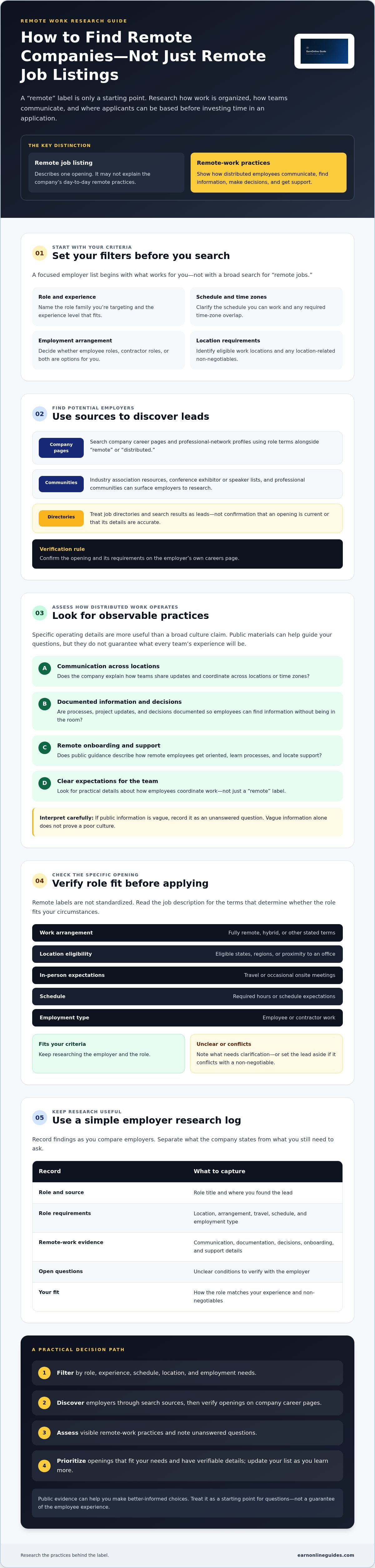
Before tailoring your application, confirm that the opening fits both your circumstances and your qualifications. A remote label doesn’t tell you whether you can work from your location, whether the schedule is workable, or whether the employment arrangement matches what you’re seeking. As you research how to find remote companies, verify the role separately from your assessment of the employer’s remote culture.
Read the full job description, then compare it with the opening on the employer’s careers page. Look for the details that determine eligibility and day-to-day fit:
Compare the terms across the job board and employer site. If one says “remote” while the other lists a location restriction, or if material details are missing, ask the employer to clarify before spending time on a tailored application. Don’t treat an unclear term as permission to assume the role fits.
Match your application to the stated requirements with concrete examples from your work, education, or projects. If the role calls for written communication, describe a relevant report, process document, or customer update you created. If it requires independent execution, explain the task, your responsibility, and the outcome without overstating your contribution. Use the employer’s listed qualifications as your guide; don’t reject yourself based on an unsupported rule about what remote employers expect.
Prepare a few questions that address remaining fit concerns, such as how remote onboarding works for this team or how it coordinates work across locations. Keep company-culture questions distinct from listing-risk checks. To assess warning signs in the posting or hiring process, use this separate remote job listing verification checklist.
Once the role’s terms and your evidence line up, explore legitimate remote job resources to continue your search with clearer criteria.
A repeatable process keeps employer research useful without turning it into an end in itself. Follow the same cycle each time: research potential employers, shortlist relevant roles, verify the details, apply selectively, and update your notes. This is a practical way to approach how to find remote companies while keeping your effort focused on evidence and fit, not application volume.
Rank employers by four factors: how closely the role matches your skills and goals, whether you’re eligible to work from your location, how specific the available evidence is, and how many important questions remain. A role with unclear location requirements may stay on your research list, but it isn’t ready for a focused application until you get clarification.
Set a research limit that fits your available time and application priorities. For example, you might review a small group of promising leads before deciding which deserve a closer look. The right limit depends on your circumstances. The point is to prevent open-ended browsing from displacing application work.
Keep notes factual and dated. Record where you found the information, what the employer stated, and what still needs confirmation. Revisit a company when a new role appears, its requirements change, or its public guidance is updated. A dated note helps distinguish an earlier description from information you’ve checked more recently.
Before applying, use your notes to decide whether to proceed, ask a question, or set the lead aside. If you need to assess the source of an opening, review guidance on legitimate remote jobs and verify the role against the employer’s own information.
A remote job directory can also help you discover potential openings and employers. Treat directory entries as starting points, not a guarantee that a role is still available, that its details have been confirmed, or that an employer’s culture will match your needs. Verify each promising lead directly before applying.
For broader search guidance, explore the complete guide to remote work. Then return to your shortlist and choose the next step based on what you can verify.
Finding a suitable remote employer takes more than spotting a “remote” label. Compare a company’s public evidence with the actual role terms, then clarify gaps before you apply. A focused shortlist, backed by dated notes, can help you spend application time on roles that fit your location, experience, and work needs.
That’s the practical answer to how to find remote companies: verify what the employer says, distinguish confirmed details from open questions, and update your research when roles or requirements change. Public information can guide your decision, but it can’t guarantee what working there will be like.
EarnOnlineGuides offers a remote job directory alongside remote-work guides and listing-verification resources. Use them as research aids, and confirm each opportunity with the employer. Explore the remote work resources to continue your search with a clearer process.
Start by defining the roles, experience level, location eligibility, and schedule you can accept. Search company career pages, professional-network profiles, credible directories, and industry resources for potential employers. To learn how to find remote companies efficiently, treat each result as a lead, not confirmation of an active opening. Check the employer’s own careers page for the specific role and its terms, then record what you verified and what still needs clarification.
Look for specific, consistent descriptions of how distributed employees communicate, onboard, document decisions, and collaborate. Compare those details across company materials and job descriptions, including how clearly roles explain location requirements. General statements about flexibility are less informative than concrete processes. Public information offers an initial signal, not proof of every employee’s experience. Ask focused questions during interviews, then compare the answers with the published role terms and other employer guidance.
No. A listing may allow one employee to work remotely without explaining how the wider company supports distributed teams. First confirm whether the opening is fully remote, hybrid, or restricted to particular locations. Then look for information about onboarding, communication, and team practices. If details are missing, ask the employer rather than assuming the role or workplace is unsuitable. Evaluate the specific position and the organization’s practices as separate parts of your decision.
Search employer career pages, professional networks, industry associations, and established job directories to discover potential employers. No directory or search result replaces checking the current opening on the company’s official careers page. Confirm its location rules, employment type, and qualifications before applying. If a listing raises concerns about whether it’s authentic, use a separate scam-checking process. Researching a company’s remote culture can help assess fit, but it doesn’t establish that a posting is legitimate.
Ask how the team communicates across locations, documents decisions, and supports new hires during onboarding. You can also ask how managers set expectations and what the role’s schedule or location requirements mean in practice. Keep questions specific to the opening. For example, if the description names eligible locations but doesn’t clarify travel, ask whether the role includes in-person attendance. Compare responses with the job description and request clarification about any material differences.
There’s no single number that works for every job seeker. Choose a manageable shortlist based on your available time, role specialization, experience, and application priorities. Focus on employers with relevant openings and enough information to assess basic fit, rather than maximizing the list. Record evidence, open questions, and when you checked each source. Refine the shortlist as you learn which role requirements and remote-work practices align with your needs.

Article by
EarnOnlineGuides Editorial Team
The EarnOnlineGuides Editorial Team creates practical, research-driven educational content about making money online, remote work, freelancing, side hustles, digital skills, AI tools, online business, and self-employment. Our goal is to help readers understand their options, compare realistic opportunities, avoid misleading claims, and make better-informed decisions. We prioritize accuracy, transparency, practical guidance, and responsible reporting, and we regularly review our content to keep it useful and up to date.
The information provided in this article is for general educational and informational purposes only and should not be considered financial, investment, tax, legal, or professional advice. Earnings, income examples, costs, fees, and other figures may vary and are not guaranteed. Always conduct your own research and consult a qualified professional when appropriate.
Some articles on EarnOnlineGuides may contain affiliate links. If you click a link and make a purchase or sign up for a service, we may receive a commission at no additional cost to you. This does not influence our editorial standards or recommendations.
We strive to keep our information accurate and up to date, but products, services, fees, policies, laws, and market conditions can change. Please verify important information directly with the relevant provider before making financial or business decisions.
Educational information only. This article is not financial, tax, or legal advice. Platform fees and policies change; always confirm current rates in the marketplace's official fee documentation before making decisions.
Explore low cost digital side hustles you can test in 2026. Compare freelance work, digital goods, and reselling while managing hidden platform fees and time.

Learn how to open a freelance business bank account step by step. Explore document checklists, compare bank options, and keep business finances organized.

Learn how to write affiliate product reviews readers can trust. Discover a practical process for honest testing, balanced pros and cons, and clear disclosures.