
Low-Cost Digital Side Hustles: Practical Ways to Start in 2026
Explore low cost digital side hustles you can test in 2026. Compare freelance work, digital goods, and reselling while managing hidden platform fees and time.
October 13, 202618 min read

The biggest hurdle to securing legitimate entry level remote work from home isn't your lack of previous distributed experience. It is an unregulated hiring landscape flooded with misleading postings demanding three years of background for entry roles, alongside deceptive scams designed to exploit eager applicants. When every junior listing feels like an administrative trap or an unrealistic hurdle, making steady career progress can feel impossible.
If you're exhausted by search results that treat basic customer support or data roles like senior positions, your frustration is completely justified. You shouldn't have to guess whether an employer's recruitment process is secure, nor should you have to struggle through confusing hardware requirements and tax classifications entirely on your own.
This guide gives you the exact step-by-step process to identify, verify, and secure legitimate entry-level remote positions using your existing transferable skills. Ahead, we will cover viable career categories, clarify the technical prerequisites expected by real employers, and walk through a structured application strategy engineered to pass automated applicant tracking filters.
Securing true entry level remote work from home does not require a resume packed with telecommuting history. The designation simply describes roles requiring zero prior distributed workplace tenure. Legitimate organizations evaluate candidates by how effectively they translate in-person communication, administrative accuracy, or customer-facing backgrounds into an off-site environment. Understanding what qualifies as remote work at the entry tier prevents applicants from wasting time on mislabeled listings that quietly demand years of specialized engineering or mid-level project ownership.
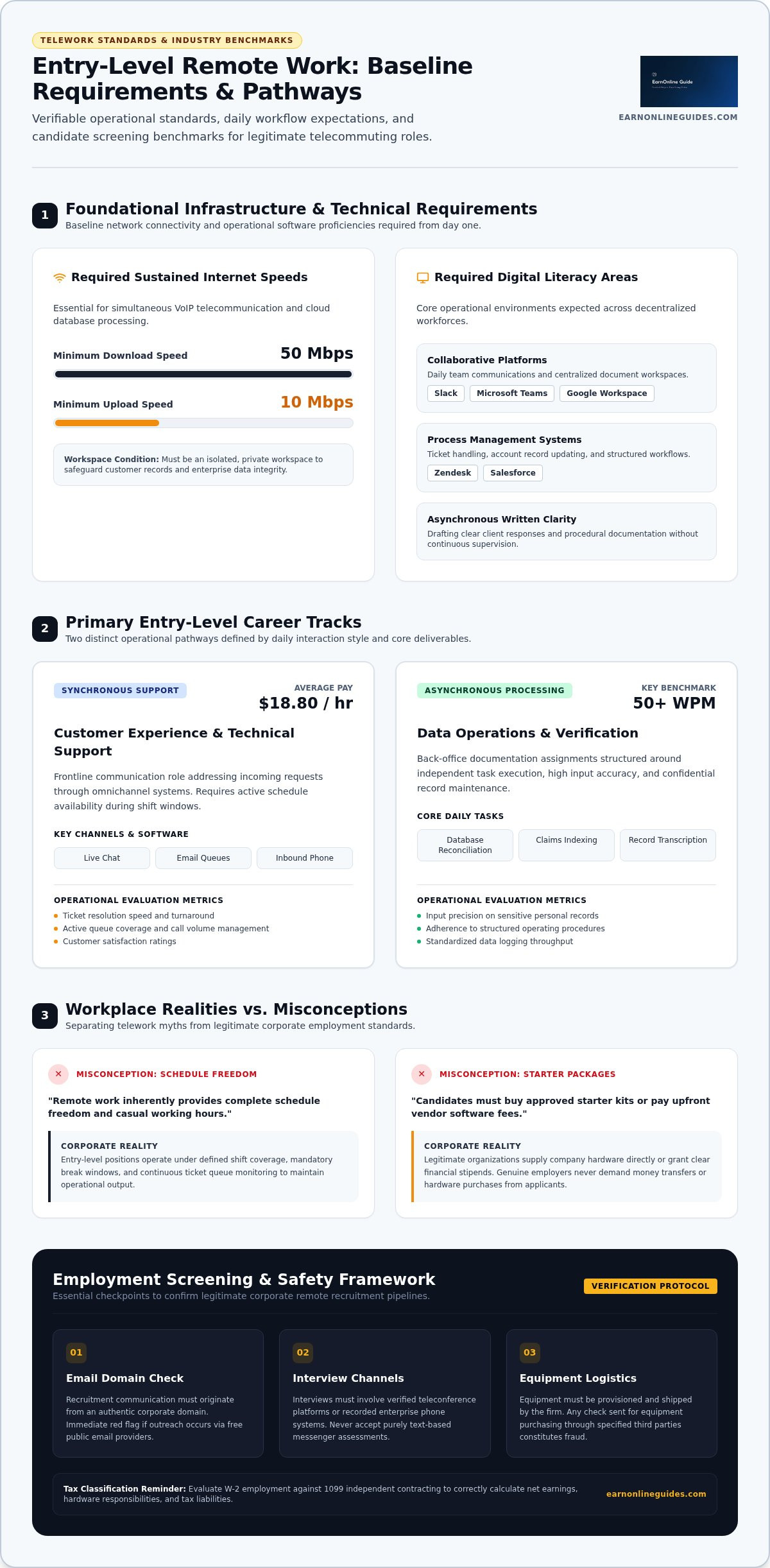
While companies provide training for their proprietary software, operational readiness remains non-negotiable from day one. Employers expect candidates to operate from a private workspace equipped with a stable internet connection, typically requiring minimum sustained speeds of 50 Mbps download and 10 Mbps upload to handle VoIP calls and cloud databases simultaneously.
Daily performance relies heavily on foundational digital literacy across standard operational categories:
Work environments vary significantly across departments. Asynchronous, back-office data roles allow for independent task execution, while frontline customer support roles involve scheduled shift blocks and active queue management.
Prospective candidates frequently encounter misleading narratives regarding beginner telework. The most widespread misconception claims that remote work inherently offers total schedule freedom. In practice, entry-level corporate positions operate on strict coverage shifts that require consistent availability, defined break windows, and continuous ticket monitoring.
Another dangerous misconception involves equipment procurement. Legitimate businesses supply corporate hardware directly or offer explicit stipends; they never ask applicants to purchase starter kits or send money to vendor accounts. Reviewing established, vetted ways to work from home protects job seekers from deceptive job posts while establishing realistic expectations for daily accountability and performance metrics.
Securing sustainable entry level remote work from home comes down to targeting sectors with measurable operational demand. Entry openings broadly split into two distinct tracks: real-time, communication-focused support roles and asynchronous, documentation-heavy back-office workflows. Evaluating these pathways based on concrete daily tasks helps job seekers bypass unrealistic job listings and focus on positions with achievable hiring benchmarks.
Customer support remains the most common entry pathway into remote employment. In the United States, entry-level remote customer service representatives average approximately $18.80 per hour. New hires typically manage omnichannel inquiries across live chat, email queues, and inbound phone systems using software suites such as Zendesk, Freshdesk, or Salesforce. Performance is evaluated through clear operational metrics, including ticket resolution speed, queue management, and customer satisfaction ratings.
For candidates who prefer independent data tasks over continuous voice communication, back-office assignments provide a structured environment. These roles focus on database reconciliation, claims indexing, and digital record transcription. Enterprise teams generally look for typing speeds of at least 50 words per minute combined with high accuracy, especially when logging sensitive personal information under corporate privacy compliance rules. Those interested in quiet, analytical assignments can review specialized non-phone work from home jobs to identify current industry openings. Because entry administrative positions often attract deceptive postings, practicing thorough screening for scams protects your personal data during the research stage.
Content moderation and administrative coordination represent viable options for detail-oriented candidates. Content reviewers audit platform submissions against strict safety standards, applying objective criteria to text, image, and video files. Meanwhile, digital workspace coordinators organize cloud filing systems, schedule cross-timezone appointments, and maintain team documentation. Mastering these daily routines helps workers build practical digital skills for beginners, creating a verifiable foundation for future promotions into operations management or project analysis.
When searching for entry level remote work from home, the legal tax structure governing your role dictates your final take-home pay, legal rights, and daily workplace responsibilities. Most job aggregator boards blur the lines between corporate payroll employment and independent contracting gigs, leaving job seekers unprepared for sudden self-employment tax liabilities. Reviewing the official IRS guidelines on worker classification confirms that an organization's behavioral and financial control over your daily routine defines your legal worker status.
A standard W-2 position offers legal protection alongside structured accountability. W-2 employees receive statutory wage protections, mandatory payroll tax withholdings, and statutory overtime eligibility under the Fair Labor Standards Act. Employers cover half of your FICA taxes (Social Security and Medicare), handle income tax withholdings directly, and generally supply necessary equipment. If a company does not ship dedicated hardware, it typically provides a documented home office stipend to offset connectivity or computing costs.
Independent contractor roles (classified under Form 1099-NEC) offer flexibility in exchange for shifted financial and operational liabilities. As a contractor, you are legally operating as an independent business. You bear full responsibility for the 15.3% self-employment tax covering both employee and employer portions of Medicare and Social Security, on top of normal federal and state income taxes.
Contractors must also absorb ongoing operational overhead:
A $20 hourly 1099 contract often yields less net income than an $18 hourly W-2 position once self-employment taxes, uncompensated breaks, and home office expenses are factored into the equation. For a granular financial breakdown of these trade-offs, evaluate your projected net earnings using the 1099 vs W-2 Breakeven Tool before signing any onboarding paperwork.
Submitting hundreds of generic resumes through mass-application portals rarely yields interviews. Landing genuine entry level remote work from home requires a methodical screening and application protocol. Distributed organizations receive high applicant volumes, so hiring algorithms filter aggressively for clear signals of autonomous execution, software familiarity, and operational reliability.
Begin by reframing your existing background to match distributed workflows. Retail floor supervisors already possess de-escalation tactics and real-time inventory management skills. Administrative clerks already handle records processing and calendar coordination. Translate these in-person tasks into remote-ready capabilities: replace "assisted customers on sales floor" with "resolved multi-channel client inquiries under strict daily resolution targets."
Focus your efforts on realistic opportunities instead of unfiltered job boards filled with misleading titles. For candidates starting with limited direct tenure, reviewing curated lists of remote jobs no experience helps filter out mid-level positions masked as junior roles.
Automated screening systems discard creative resume formats with graphics, icons, and non-standard tables. Use a clean, single-column document layout saved as a plain PDF. Mirror the exact phrasing used in the job description across your core competencies and experience sections:
Reviewing legitimate remote jobs reveals clear patterns in the technical keywords and compliance standards real employers expect.
Your written communication during initial outreach serves as your first work sample. Keep introductory emails brief, error-free, and focused on operational value. When advancing to video evaluations, test your setup beforehand to eliminate background noise, adjust lighting, and ensure audio clarity. Use structured response frameworks like the STAR method (Situation, Task, Action, Result) to explain how you resolve unexpected problems without constant managerial oversight.
To accelerate your search, examine verified openings through our how to find legitimate remote jobs fast framework to target screened employers directly.
The surge in applicants seeking entry level remote work from home has led bad actors to create increasingly complex employment schemes. Fraudulent listings mimic established brands to harvest sensitive personal data or run financial theft operations. Rather than trusting automated platform badges, job seekers need an objective verification method to evaluate every job opportunity before handing over their personal information.
Modern recruitment scams share recurring operational patterns designed to exploit candidates eager to start working immediately. The most damaging scheme involves fake equipment checks. A "hiring manager" sends an electronic check to buy home office gear from a specified vendor portal. Once deposited, the check eventually bounces, leaving the candidate legally liable for the funds transferred to the fake vendor account.
Watch for these immediate warning signs during your initial outreach:
For an expanded breakdown of deceptive recruitment techniques, review our guide on how to spot fake remote job listings before submitting your resume to unverified portals.
Verifying a recruiter's corporate infrastructure takes only minutes and prevents identity theft. Always verify the sender's email domain directly. Legitimate hiring teams email from dedicated corporate servers rather than public domains like Gmail or Outlook. Scammers often register lookalike domains containing subtle typos or extra words, such as adding "-careers" or "-hiring" to an authentic corporate brand name.
Run a domain lookup using ICANN WHOIS data. If the company domain was registered only weeks ago, pause communications immediately. Cross-reference the recruiter's name against company staff directories, or search the official corporate careers page to confirm the position exists. Verifying these technical details ensures you focus your time entirely on authentic, legitimate remote jobs backed by verified employers.
Securing genuine entry level remote work from home requires shifting away from high-volume, unfiltered applications toward a targeted, analytical job search. Long-term success comes down to three operational disciplines: reframing your in-person experience into verifiable distributed capabilities, accurately calculating net take-home earnings across W-2 and 1099 worker classifications, and systematically vetting corporate hiring infrastructure before submitting sensitive personal information.
Legitimate organizations never charge upfront onboarding fees, sell mandatory training kits, or demand payments for job placement. Grounding your search in transparent operational analysis and verified industry benchmarks protects your time, privacy, and personal finances. When you're ready to bypass predatory schemes and evaluate screened opportunities, explore the research-backed resources at EarnOnlineGuides to launch your distributed career with complete confidence.
Yes, you can secure an entry level remote work from home position without direct telework background. Legitimate employers hiring for beginner tiers prioritize transferable skills like accurate written communication, customer service patience, and basic computer proficiency over formal distributed tenure. Highlighting academic projects, retail experience, or volunteer administration on a clean resume demonstrates your ability to follow structured procedures and manage assigned daily tasks independently.
Most authentic W-2 remote employers provide pre-configured company laptops, enterprise security tokens, and USB headsets directly via secure mail prior to your first day. Some organizations offer a documented monthly technology stipend to offset broadband expenses instead of mailing peripheral hardware. If any company asks you to purchase equipment upfront using an emailed check or unverified vendor portal, discontinue communication immediately, as this indicates a fraudulent operation.
Compensation varies by industry, but entry-level remote roles in the United States typically pay between $18.00 and $20.00 per hour. For instance, customer support roles average approximately $18.80 hourly, while basic data entry positions average around $19.47 per hour (roughly $40,500 annually). Independent contractor positions may advertise higher gross hourly figures, but you must account for self-employment taxes and unpaid overhead when estimating net income.
Genuine data entry roles exist, but the category contains a disproportionate number of deceptive listings. Legitimate positions involve clear database management, claims indexing, or medical transcription with defined performance benchmarks. Fraudulent postings usually offer inflated pay rates like $35 per hour for simple typing or request private banking details during initial messaging. Always verify corporate domains and confirm the role on the employer's official careers portal before applying.
Distributed companies track performance through objective operational output rather than continuous visual monitoring. Supervisors evaluate ticket resolution speed, data processing volumes, phone queue availability, and system error rates logged inside platforms like Zendesk or Salesforce. Some organizations utilize time-tracking software that records active application usage and active shift hours. Meeting daily quality quotas and participating in scheduled team standups proves your ongoing productivity and accountability.
The most efficient method for securing entry level remote work from home is bypassing generic job boards and targeting verified company career portals directly. Tailor your resume to mirror the exact operational keywords found in the job description to clear automated applicant filters. Focus your search on high-demand sectors like customer care and back-office verification, and respond promptly to interview requests with professional, well-written correspondence.

Article by
EarnOnlineGuides Editorial Team
The EarnOnlineGuides Editorial Team creates practical, research-driven educational content about making money online, remote work, freelancing, side hustles, digital skills, AI tools, online business, and self-employment. Our goal is to help readers understand their options, compare realistic opportunities, avoid misleading claims, and make better-informed decisions. We prioritize accuracy, transparency, practical guidance, and responsible reporting, and we regularly review our content to keep it useful and up to date.
The information provided in this article is for general educational and informational purposes only and should not be considered financial, investment, tax, legal, or professional advice. Earnings, income examples, costs, fees, and other figures may vary and are not guaranteed. Always conduct your own research and consult a qualified professional when appropriate.
Some articles on EarnOnlineGuides may contain affiliate links. If you click a link and make a purchase or sign up for a service, we may receive a commission at no additional cost to you. This does not influence our editorial standards or recommendations.
We strive to keep our information accurate and up to date, but products, services, fees, policies, laws, and market conditions can change. Please verify important information directly with the relevant provider before making financial or business decisions.
Educational information only. This article is not financial, tax, or legal advice. Platform fees and policies change; always confirm current rates in the marketplace's official fee documentation before making decisions.
Explore low cost digital side hustles you can test in 2026. Compare freelance work, digital goods, and reselling while managing hidden platform fees and time.

Learn how to open a freelance business bank account step by step. Explore document checklists, compare bank options, and keep business finances organized.

Learn how to write affiliate product reviews readers can trust. Discover a practical process for honest testing, balanced pros and cons, and clear disclosures.