
Low-Cost Digital Side Hustles: Practical Ways to Start in 2026
Explore low cost digital side hustles you can test in 2026. Compare freelance work, digital goods, and reselling while managing hidden platform fees and time.
October 13, 202618 min read

A testimonial request should feel like an invitation, not a sales tactic. If you’re wondering how to ask clients for testimonials without making the relationship uncomfortable, focus on timing, clarity, and choice. Ask when the client has enough experience to give specific, honest feedback, and make it easy for them to decline.
A clear process also helps prevent vague praise or misunderstandings about how a comment will be used. Explain why you’re asking, invite the client to describe what they actually experienced, and get approval for the final wording and attribution before publishing. Testimonials can help prospective clients assess whether your work may fit their needs, but one person’s experience doesn’t promise the same results for someone else.
This guide covers when to ask, which method to use, and what to say. It also explains how to follow up and confirm permission to edit, publish, and attribute a testimonial responsibly.
A client testimonial is a voluntary account of someone’s experience with a service. It gives prospective clients a person’s perspective on the work and working relationship, which can help them judge whether the service may suit their needs. It isn’t a guarantee that another client will have the same experience or outcome.
Testimonials, reviews, and case studies overlap, but they aren’t interchangeable. A testimonial is usually selected and presented by the service provider. A review is typically posted by a customer on a third-party platform, where platform rules may apply. A case study goes into more detail, often describing a client’s situation, the work performed, and documented results. Keep these distinctions in mind when deciding what to request and where to publish it.
Specific context is more useful than praise alone. “Great to work with” may be sincere, but it gives a prospective client little information to judge relevance. A brief comment about the client’s original need, a useful part of the process, or a specific observation can offer more decision-support evidence. A single testimonial doesn’t show what clients typically experience, so don’t use one comment to imply a typical outcome.
Invite the client to describe their experience in their own words. Rather than drafting a polished claim for them to approve, offer optional prompts about:
For example, a client might describe how a project clarified a particular deliverable or made communication easier. That’s an illustrative possibility, not a result to suggest or promise. If the client can’t verify a measurable outcome, don’t ask them to state one as fact. A precise description of the process may be more credible than an unsupported claim about results.
General compliments can show goodwill, but relevant details help prospective clients assess fit. A comment about the type of project, collaboration, or deliverable may help someone with a similar need decide whether to learn more. Keep the comment in the client’s voice. Editing for length or clarity should never change its meaning or turn it into marketing copy the client didn’t write.
Testimonials work alongside a clear description of your services, not in place of one. Freelancers can give prospective clients a fuller picture by explaining the scope and basis of an offer as well as sharing feedback. Guidance on pricing freelance work can help clarify that offer. A testimonial adds one client’s perspective while leaving each prospect room to evaluate their own needs.
Ask when the client has experienced enough of the work to describe it accurately. That might be at project completion, after delivery of a major milestone, or when a clearly defined phase ends. The right moment depends on the engagement. A client may be able to assess a finished design soon after using it, while the effects of a longer-term service—such as executive coaching through Simon Lead LLC—may take more time to observe.
Use the project’s progress as your guide instead of relying on a fixed calendar reminder. If a deliverable is complete but the client hasn’t had a reasonable chance to use it, wait. If the project is ongoing, avoid interrupting active work with a testimonial request. You can ask after a meaningful stage wraps, as long as you make clear that you’re asking about that phase rather than the entire engagement.
Consider whether the agreed work, or a defined phase, has concluded and whether the client has had time to review or use what you delivered. If results take longer to appear, ask about the client’s experience with the process instead of inviting a claim about results they can’t yet assess. This keeps the feedback grounded in what they know firsthand.
For example, after a website is completed, a client might comment on the planning and delivery process before enough time has passed to evaluate business impact. For recurring support, a completed reporting cycle or handoff may provide a natural point to ask about that phase. These are timing examples, not rules for every project. If the work is still changing materially, wait until the client can describe a stable experience.
Use consistent, neutral criteria, such as asking after a defined project stage, rather than approaching only clients you expect to praise you. The comments should reflect each client’s direct experience, whether their feedback is enthusiastic, mixed, or brief. Don’t make the request conditional on positive feedback. Let the client know they can decline or offer candid comments instead.
Readiness and permission are separate. A client may be ready to discuss a project without agreeing to have their words published. Silence, continued work, or payment doesn’t give you permission to use a comment as a testimonial. If there’s no response, don’t treat it as approval. Ask separately whether the client agrees to the specific use before publishing.
Use a brief readiness check to keep your timing consistent:
Clear project scope makes milestones easier to identify. If you’re refining your freelance offer, guidance on pricing freelance work can help you define what a project includes and when a phase is complete.
The best way to ask clients for testimonials depends on how you already communicate and what feedback would help. Email gives the client time to consider a clear, low-pressure request. A conversation can fit naturally into an existing project review. A feedback form adds structure when you want input on several parts of the work. Choose the channel that suits the relationship, not simply the one that’s easiest for you.
Each method involves a trade-off. Structure can make feedback easier to organize, but too many prompts add effort for the client. Use the lightest approach that makes it comfortable for them to respond.
| Method | Effort for the client | Structure | When it may fit |
|---|---|---|---|
| Low; the client can respond when convenient | Clear, focused request | You want to explain the ask and intended use in writing | |
| Conversation | Low if it fits an existing check-in | Flexible; follow-up may be needed | A project review or wrap-up already provides a natural opening |
| Feedback form | Moderate; requires time to complete | High; prompts guide the response | The client has several points to address or prefers written prompts |
Email is a good fit for clients who prefer written communication or may want time to think. Use a short subject line that identifies the project, then make one specific, optional request. For instance, ask whether they’d be willing to share a few sentences about a completed deliverable. Explain where you’d like to use the comment and make it easy to decline. A short reply is enough; don’t imply that a response is owed.
Keep the message easy to answer. A long list of questions can make a simple request feel like an assignment. If you need more detail, include a few optional prompts rather than expecting the client to answer each one.
Use a conversation when a check-in already includes discussion of the client’s experience. Listen without steering the answer toward praise. If the client says something you’d like to publish, follow up in writing to confirm the wording and get approval for its use. If you need more structured feedback, send a short form with focused prompts. Avoid asking for information unrelated to the testimonial’s purpose.
A form can help after a project with several distinct stages, but it shouldn’t replace judgment. If one open-ended question is enough, ask just that. And if a client shares feedback verbally, don’t assume the conversation authorizes publication. Confirm the final text and agreed attribution in writing before using it.
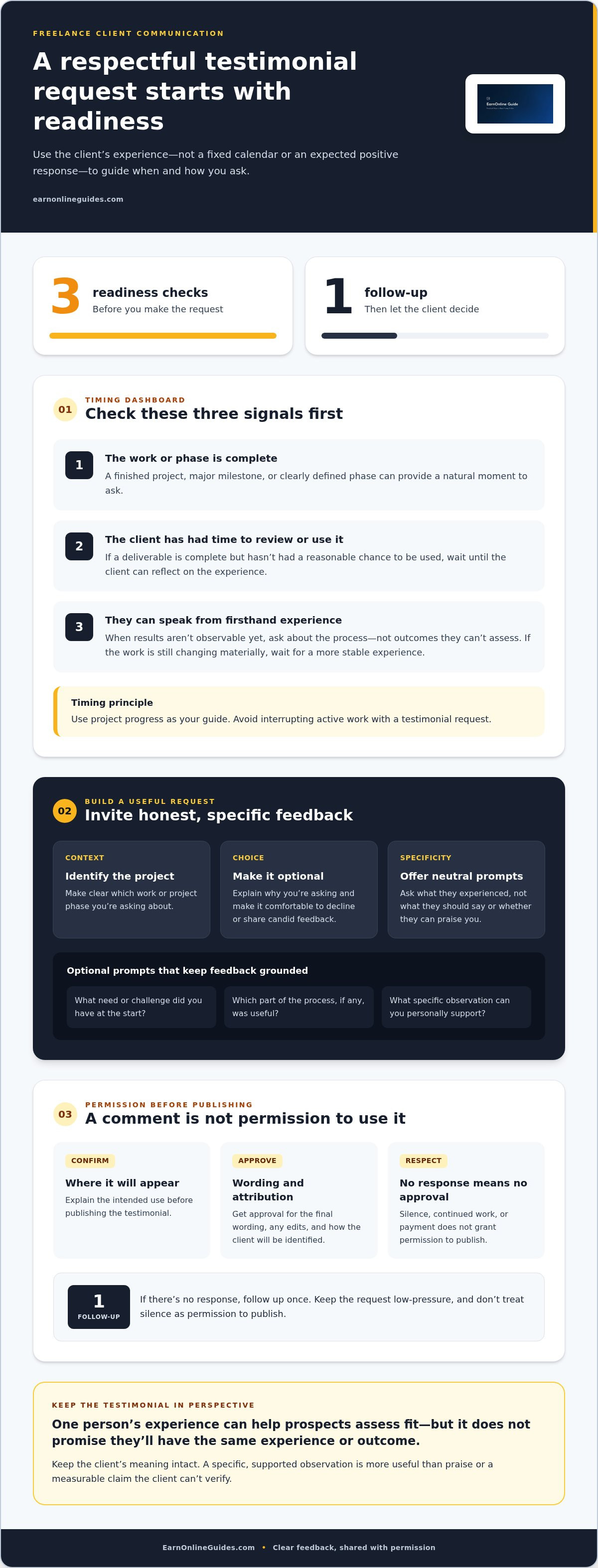
A good request makes the client’s choice clear and leaves them in control. Keep it separate from payment, contract obligations, and requests for positive reviews. The aim is to invite an honest account, not to secure praise.
Use this sequence to shape an email or spoken request:
Refer to completed work, then ask one direct question. For example: “Would you be comfortable sharing a few sentences about your experience with [project or service]?” Name where you’d like to publish the response and invite the client to ask questions. A brief message respects their time and avoids making the request feel like another project task.
Sample wording:
Subject: A brief request about [project name]
Hi [Client name],
Thank you for working with me on [project or completed milestone]. I appreciated the opportunity to [specific, genuine detail about the work or collaboration].
Would you be comfortable sharing a brief, honest account of your experience? If you choose to, I’d like to use it on [specific location, such as my website or portfolio]. You can reply by email, and there’s no obligation to participate. I can send you the final wording for approval before anything is published.
If it helps, you could mention what you needed at the start, which part of the process stood out to you, or a specific detail you found useful. Please share only what reflects your own experience.
Thanks for considering it,
[Your name]
Offer optional prompts, not a script. You might ask what goal led the client to seek help, which part of the process mattered to them and why, or whether they can share a concrete example. Leave room for a short answer or no answer. Any mention of results should be optional. Don’t suggest an outcome or a phrase for the client to repeat.
Don’t tie a testimonial to invoice payment, contract continuation, or receipt of a project deliverable. And don’t ask for a “positive review.” Keep the client’s choice independent of the business arrangement, and don’t edit a response to imply more than they said. To make the service behind a testimonial clear to future clients, refine your offer alongside your freelance pricing approach.
A testimonial request isn’t complete when a client sends a comment. Before publishing, confirm what the client has agreed to share, review any edits with them, and use only the attribution they approve. This connects the published version to the client’s actual experience and avoids treating one response as blanket permission for every use.
Follow a simple sequence: send at most one courteous follow-up if there’s no response, confirm permission and intended placement, share any edited version for approval, then publish with the agreed attribution. If the client doesn’t reply, close the request. Nonresponse isn’t consent, and repeated messages can make an optional request feel like pressure.
Ask before shortening, correcting, or adapting the client’s original wording, even if an edit seems minor. Send the complete final version for approval and confirm whether the client wants their name, role, company, or another form of attribution shown. Don’t add an outcome, endorsement, or claim they didn’t make. If an edit changes emphasis or meaning, revise it or leave it out.
Keep a record of the approved text, where it may appear, and the attribution the client selected. If you later want to reuse the testimonial in another place or format, ask whether that use is acceptable instead of assuming the original permission covers it. A comment approved for a portfolio, for example, shouldn’t automatically be treated as approved for a separate promotional use.
Thank the client whether their feedback is brief, positive, or critical. Constructive criticism can help you improve your work, but keep it private unless the client separately agrees to publish it. If there’s no reply, send one polite follow-up that makes declining easy, then stop. Don’t interpret silence as approval or keep asking through other channels.
Before publishing, check that the testimonial has enough context to be understood without implying the client’s experience is typical. Preserve any qualifications they included. If they describe a result as uncertain, limited, or specific to their circumstances, don’t remove that context to make the quote sound stronger.
A clearly described service also helps a testimonial make sense. Defining what a project includes helps both you and the client identify which experience the comment refers to. The freelance pricing guide offers related guidance on making an offer clear. A testimonial can support a prospect’s decision, but shouldn’t be presented as proof that every client will have the same outcome.
Knowing how to ask clients for testimonials is one part of presenting freelance work clearly. Review your offer from a prospective client’s point of view: can they quickly understand the work you take on, what the project includes, and how to get started? Clear service details give client feedback a meaningful place in your portfolio.
Check whether your project scope, deliverables, and pricing are described consistently in your proposal and public materials. Addressing gaps can help potential clients evaluate the work and decide what questions to ask.
EarnOnlineGuides publishes practical, beginner-friendly resources for freelancers and people building online income. Use its freelance pricing guide to strengthen your client offer as a next step. A clearly defined offer helps prospective clients understand what you do and make an informed decision.
There’s no universal number that makes a portfolio credible. Choose comments that explain the services you offer rather than filling space with similar praise. A small set that reflects different project types or client needs may give visitors a clearer picture than a long list of repetitive statements. Review your selection when your services change, and remove comments that no longer represent the work you want to attract.
They can, if the client’s comment relates to the sample and you have permission to show both together. Pairing them can help readers see the project from two angles: the work itself and the client’s perspective on the collaboration. Make the connection clear. Don’t place a testimonial beside unrelated work in a way that could imply the client evaluated that project.
No. A testimonial shares a client’s perspective, while a sample lets a prospective client assess the work directly. If you can share a relevant sample, present it separately and explain what it demonstrates. Some work may be confidential or unsuitable for public display, so don’t disclose client materials just to add proof. A clear description of your process or deliverables can provide context instead.
Yes, if the excerpt preserves the original meaning and the client approves the version you plan to display. Include enough context that the quote doesn’t suggest a broader claim than the client made. If removing a sentence changes the emphasis, choose another passage or ask the client to review the edit. Keep a copy of the approved full statement for reference.
Group them by the service, skill, or type of project they address so visitors can find feedback relevant to their needs. Use a short label to explain the project context without including details the client hasn’t approved for publication. If a quote applies to several categories, choose the clearest placement rather than duplicating it in ways that could make one comment seem like several endorsements.
Review them when your services, portfolio, or public positioning changes. A quote about work you no longer offer may confuse prospective clients, while a new project type may call for different examples. Check that each testimonial still appears with its approved wording and context. Keep older comments only if they remain relevant and accurately describe the work you want readers to evaluate.

Article by
EarnOnlineGuides Editorial Team
The EarnOnlineGuides Editorial Team creates practical, research-driven educational content about making money online, remote work, freelancing, side hustles, digital skills, AI tools, online business, and self-employment. Our goal is to help readers understand their options, compare realistic opportunities, avoid misleading claims, and make better-informed decisions. We prioritize accuracy, transparency, practical guidance, and responsible reporting, and we regularly review our content to keep it useful and up to date.
The information provided in this article is for general educational and informational purposes only and should not be considered financial, investment, tax, legal, or professional advice. Earnings, income examples, costs, fees, and other figures may vary and are not guaranteed. Always conduct your own research and consult a qualified professional when appropriate.
Some articles on EarnOnlineGuides may contain affiliate links. If you click a link and make a purchase or sign up for a service, we may receive a commission at no additional cost to you. This does not influence our editorial standards or recommendations.
We strive to keep our information accurate and up to date, but products, services, fees, policies, laws, and market conditions can change. Please verify important information directly with the relevant provider before making financial or business decisions.
Educational information only. This article is not financial, tax, or legal advice. Platform fees and policies change; always confirm current rates in the marketplace's official fee documentation before making decisions.
Explore low cost digital side hustles you can test in 2026. Compare freelance work, digital goods, and reselling while managing hidden platform fees and time.

Learn how to open a freelance business bank account step by step. Explore document checklists, compare bank options, and keep business finances organized.

Learn how to write affiliate product reviews readers can trust. Discover a practical process for honest testing, balanced pros and cons, and clear disclosures.