
Low-Cost Digital Side Hustles: Practical Ways to Start in 2026
Explore low cost digital side hustles you can test in 2026. Compare freelance work, digital goods, and reselling while managing hidden platform fees and time.
October 13, 202618 min read

More than half of employees will need reskilling by 2026, according to the World Economic Forum’s Future of Jobs Report 2025. The report identifies AI and big data, networks and cybersecurity, and technological literacy as the fastest-growing skills. Those projections signal change, but they don’t guarantee that learning any one skill will lead to work.
If you’re weighing high demand digital skills 2026, the challenge isn’t finding another list of “next big” opportunities. It’s separating credible demand signals from broad predictions, then checking what each skill involves and how you could demonstrate what you’ve learned.
This guide compares eight digital skill areas by demand evidence, entry requirements, and practical ways to show ability, such as project work or a focused portfolio example. It also considers how your existing strengths might transfer and which learning paths may fit your goals. The aim isn’t to predict who will get hired. It’s to help you choose a direction worth testing and build evidence before investing heavily in training.
A digital skill is worth investigating when it helps organizations or customers complete work they need done repeatedly, not simply because it is widely discussed. Digital literacy covers foundational abilities for using digital technologies. Specialized skills build on that foundation to solve particular problems, such as analyzing data or securing systems.
A labor-market signal is evidence that employers or customers repeatedly need a skill to complete specific work. A popularity trend shows attention, but doesn’t by itself establish hiring or purchasing demand. That distinction matters when evaluating high demand digital skills 2026: a skill may be prominent online without appearing consistently in role requirements or client needs.
Demand also depends on the kind of work you want to pursue:
Demand can vary by industry, experience level, location, and changing business priorities. A skill requested for a senior security role may not be an entry-level requirement. Likewise, a capability useful in a healthcare organization may appear differently in a retail job description.
Compare job postings with occupational information from the Bureau of Labor Statistics (BLS) and O*NET. Check the publication date, occupation covered, and definitions. BLS occupational data describes roles and employment trends, while O*NET provides details about occupations, including tasks and required skills. Postings offer a closer view of employer wording, but one listing is not proof of broad demand. Search interest, social posts, and course promotion can add context, but they don’t confirm hiring.
A skill is only one part of a candidate’s fit. Employers and clients may also consider relevant experience, communication, industry knowledge, and work samples. Knowing how to use an analytics tool, for example, is different from interpreting results and explaining what they mean for a business. A skill is not a complete occupation or service offering. Outcomes depend on how well someone can apply it to the work required.
Before committing to a learning path, compare its likely applications with your strengths and practical goals. If remote work is one route you’re considering, explore these work-from-home career paths to assess roles separately, not as evidence that any single skill guarantees a job.
These eight areas are candidates to investigate, not guaranteed routes to a job or client work. The World Economic Forum’s Future of Jobs Report offers broader context on how work and skills evolve. For your own decision, compare each skill’s typical tasks, starting requirements, and the kind of work you could show.
Compare these options with your existing strengths before choosing a learning path. The digital skills matrix can help you organize that comparison.
Compare high demand digital skills 2026 by the work they support and the evidence you can produce, not by popularity alone. The table is a starting framework, not a ranking. Entry requirements vary by role, client, industry, and project scope.
| Skill area | Typical task or demand signal | Possible starting foundation | Transferable skills | Sample proof |
|---|---|---|---|---|
| AI literacy | Use and check AI-assisted work | Clear instructions and subject knowledge | Writing, research, judgment | Documented workflow with checks |
| Data analysis | Interpret information to answer a business question | Numeracy and spreadsheets; other tools depend on role | Research, attention to detail | Analysis with a chart and explanation |
| Cybersecurity | Identify risks and support protective practices | Systems and network fundamentals | Troubleshooting, careful documentation | Sample risk assessment |
| Cloud computing | Configure or monitor cloud resources | Basic networking; platform knowledge varies | Technical troubleshooting | Test environment diagram and notes |
| Software development | Build, test, or maintain software | Programming fundamentals | Problem-solving, persistence | Small application with tests |
| Marketing analytics | Assess campaign activity against a business question | Comfort with metrics and spreadsheets | Communication, analysis | Campaign report with limitations |
| UX design | Explore user needs and test design solutions | Research and basic design principles | Listening, synthesis | Prototype and usability findings |
| Workflow automation | Automate suitable steps in a repeatable process | Process mapping and tool familiarity | Organization, troubleshooting | Tested demo with review points |
Employee roles may require collaboration, familiarity with a particular industry, and skills that match a defined job description. Freelance work usually centers on a scoped deliverable and clear communication with a client. An online business may use the same skill differently, as one part of serving customers or running operations. Compare these routes with your existing experience and the study time you can sustain. A digital skills matrix can help you organize the comparison.
For each skill, record the evidence source, publication date, geography, and population or role it covers. Compare dated job postings with occupational information and stated requirements, and treat posting counts as a snapshot rather than a complete measure. Job-posting frequency alone cannot establish that an individual will get hired, win clients, or build a viable business.
Then note your starting point. Writing may transfer to AI documentation or marketing reports; numeracy can support analytics; customer support may build useful listening and problem-solving habits for UX. These foundations can make learning more relevant, but they don’t replace practice. Prioritize the option where the work interests you, the prerequisites seem manageable, and you can create a credible sample.
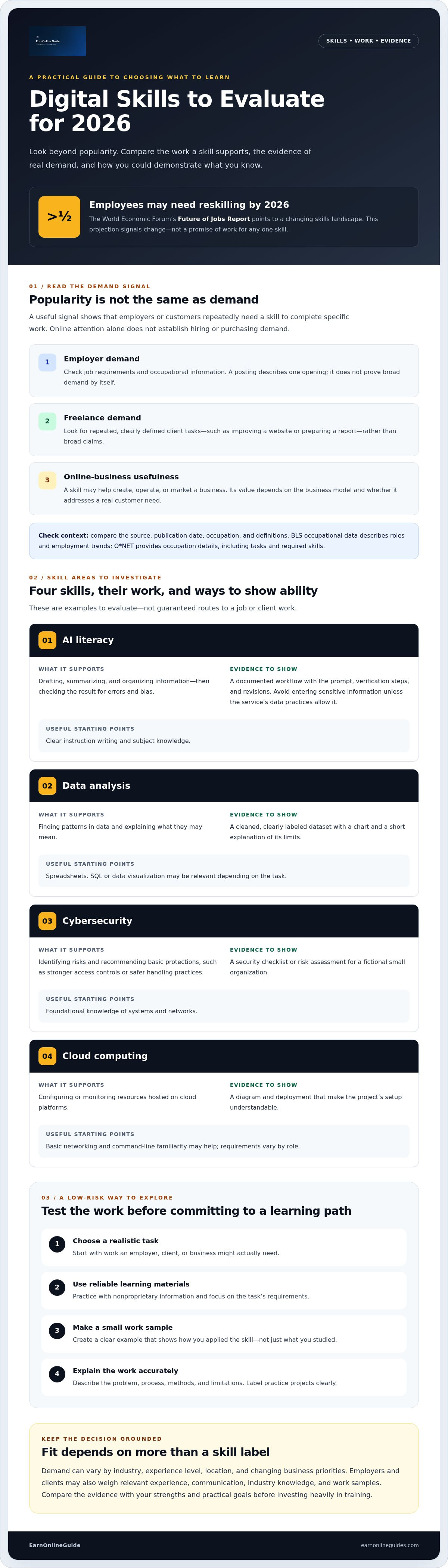
A small project can show whether a skill’s day-to-day tasks suit you before you invest heavily in training. Treat it as a learning experiment, not a test of whether you’re ready for paid work. Choose one task, find reliable learning material, build a sample, review it against clear criteria, and revise it.
Set a modest time boundary so the experiment stays manageable. For example, you might use a few focused sessions over two weeks. That’s a planning example, not a standard timeline. The right scope depends on your schedule, the task, and your access to suitable practice materials.
Pick a task small enough to finish, but specific enough to show how you think. Use public or fictional information. Don’t copy private client data, proprietary materials, or work you don’t have permission to use.
Review your sample as if someone unfamiliar with the project had to understand it. Can they see the problem, your process, the tools you used, and the result? Is it clear what you didn’t test or what the sample can’t establish? Revise any part that relies on unstated assumptions.
Then assess four things: whether you stayed interested in the work, what you learned, where you got stuck, and whether you can access the materials needed for more practice. Ask a credible peer or practitioner for specific feedback, such as whether the analysis supports its conclusion or whether the workflow handles an obvious failure case. General praise is less useful than actionable critique.
If the experiment exposes a gap, use that information to choose what to study next. If AI is the skill area you want to test, explore this guide to AI skills for ideas on developing that track. A completed practice sample can help you decide whether to continue, adjust your focus, or compare another skill before committing to a longer learning path.
A portfolio item should make your contribution easy to assess. Explain the problem you addressed, the steps you took, the tools you used, and the result. Include limitations, such as assumptions you made or tests you didn’t conduct. Clear context helps an employer or potential client understand what the sample demonstrates without overstating what it proves.
Label each project accurately. A self-directed exercise is not paid client work, and a hypothetical brief is not a real business engagement. Say so plainly. Remove confidential information, private data, and proprietary material before sharing any work. Credibility depends on both the quality of a sample and an honest account of how it was created.
Choose a few focused examples that demonstrate relevant skills and decisions, rather than adding every exercise you’ve completed. Show what changed during revision and why. For example, a sample analysis might include the original question, your method, a chart, and a note about what the data can’t establish. A design sample might show the user problem, an early prototype, and how feedback informed a revision.
Before sharing, check that each item identifies your role and the project’s context. If you created it independently, say so directly. If you’re comparing employment options, review work-from-home career paths alongside relevant role requirements.
Your next move depends on whether you’re pursuing a job, freelance work, or an online business. The evidence and expectations differ, so keep your claims specific and grounded in what you’ve actually done.
To compare high demand digital skills 2026 with your goals, keep a record of the work you’ve practiced, what feedback revealed, and what you still need to learn. EarnOnlineGuides' digital skill learning paths and career resources can support further exploration. They’re educational resources, not job placement or individualized coaching. Choose the next area to investigate when your evidence and goals point in a clear direction.
The most useful choice among high demand digital skills 2026 isn’t necessarily the one getting the most attention. Look for evidence of recurring work, consider how the skill fits your strengths and goals, and weigh the effort required to build the foundations. Demand signals can help you decide what to investigate, but they can’t predict an individual job, client, or business outcome.
A small, clearly labeled project can help you test the work and create an honest example of your ability. Explain your process, show what you learned, and be clear about the project’s limits. Then decide whether to deepen that skill, adjust your focus, or explore another area.
If you’re considering applying digital skills to an online business, EarnOnlineGuide’s online selling fee calculators can help you evaluate selling costs. For a structured way to compare skill areas and plan what to learn next, explore the digital skills matrix and learning paths. Explore EarnOnlineGuide’s practical digital skill resources and choose a next step that fits your goals. Your progress starts with a thoughtful choice and work you can stand behind.
There isn’t one digital skill that is most in demand across every industry and role. The World Economic Forum’s Future of Jobs Report 2025 identifies AI and big data, networks and cybersecurity, and technological literacy among the fastest-growing skills. Treat these as broad labor-market signals, not a universal ranking of jobs or a prediction of your individual prospects. Compare role requirements and demand evidence for the industry and work route you’re considering.
Beginners can explore AI literacy, spreadsheet-based data analysis, digital marketing analytics, UX research, and workflow automation. These areas still require practice, but you can start with focused tasks rather than advanced programming. For example, summarize a public dataset in a spreadsheet or map a simple repeatable process before testing an automation. Choose a skill that uses strengths you already have, such as writing, research, organization, or communicating with customers.
Digital skills can support applications for remote roles, but learning a skill alone doesn’t guarantee employment. Employers may also look for relevant experience, communication, industry knowledge, and evidence that you can complete the role’s tasks. Search for specific positions, confirm that they are remote, and review their requirements. Then compare those requirements with your experience and portfolio to identify practical gaps to address.
There’s no fixed timeline. The time needed depends on the skill, your starting knowledge, the depth required, and how often you can practice. Learning enough to complete a small spreadsheet analysis is different from developing the skills expected for a data analyst role. Set a practical goal, such as completing and revising one sample project, then use the result and feedback to decide what to learn next.
Usually, AI skills are one part of a broader role rather than a complete qualification by themselves. Employers may also expect relevant subject knowledge, clear communication, and the ability to check AI output for errors or unsuitable assumptions. Requirements differ by position. Read job descriptions closely, then build a sample that shows how you used AI responsibly, verified the result, and applied your judgment rather than relying on an unchecked response.
Create a self-directed project that resembles a real task and label it clearly as practice, hypothetical, or independently completed. Explain the problem, your process, the tools used, and the project’s limitations. Use public or fictional information, not confidential or proprietary data. For example, share an analysis with its assumptions or a prototype with a short explanation of revisions. Specific feedback from a knowledgeable peer can help you improve the sample before presenting it.

Article by
EarnOnlineGuides Editorial Team
The EarnOnlineGuides Editorial Team creates practical, research-driven educational content about making money online, remote work, freelancing, side hustles, digital skills, AI tools, online business, and self-employment. Our goal is to help readers understand their options, compare realistic opportunities, avoid misleading claims, and make better-informed decisions. We prioritize accuracy, transparency, practical guidance, and responsible reporting, and we regularly review our content to keep it useful and up to date.
The information provided in this article is for general educational and informational purposes only and should not be considered financial, investment, tax, legal, or professional advice. Earnings, income examples, costs, fees, and other figures may vary and are not guaranteed. Always conduct your own research and consult a qualified professional when appropriate.
Some articles on EarnOnlineGuides may contain affiliate links. If you click a link and make a purchase or sign up for a service, we may receive a commission at no additional cost to you. This does not influence our editorial standards or recommendations.
We strive to keep our information accurate and up to date, but products, services, fees, policies, laws, and market conditions can change. Please verify important information directly with the relevant provider before making financial or business decisions.
Educational information only. This article is not financial, tax, or legal advice. Platform fees and policies change; always confirm current rates in the marketplace's official fee documentation before making decisions.
Explore low cost digital side hustles you can test in 2026. Compare freelance work, digital goods, and reselling while managing hidden platform fees and time.

Learn how to open a freelance business bank account step by step. Explore document checklists, compare bank options, and keep business finances organized.

Learn how to write affiliate product reviews readers can trust. Discover a practical process for honest testing, balanced pros and cons, and clear disclosures.