
Low-Cost Digital Side Hustles: Practical Ways to Start in 2026
Explore low cost digital side hustles you can test in 2026. Compare freelance work, digital goods, and reselling while managing hidden platform fees and time.
October 13, 202618 min read

The fastest-looking route to a remote career may be the one most likely to waste your time: collecting certificates in individual tools without building skills employers can verify and use across platforms. If you’re comparing conflicting course recommendations or concerned that a technology may soon be obsolete, that uncertainty is reasonable. The right digital skill learning paths connect practical foundations to a specific role, rather than treating one certificate as a hiring plan.
This guide offers a practical roadmap for choosing what to learn in 2026, assessing training resources, and building proof of your skills through applied work. It starts with the Digital Skills Matrix, then separates broadly useful abilities, such as data and AI literacy, from specializations in analytics, cybersecurity, and software development. You’ll also learn how to check whether a credential includes hands-on projects and relevant support, and how to compare your skills with remote job listings. The aim isn’t to promise a shortcut or a specific income, but to help you make informed learning choices with long-term career adaptability in mind.
Digital skill learning paths are structured sequences that take a learner from foundational digital literacy toward professional competency in a chosen field. They connect concepts, practice, and evidence of ability, so each learning step prepares you for the next. A course can be a useful part of a path, but it isn’t a complete plan by itself.
In 2026, a more adaptable approach is to build a modular skill stack rather than collect one-off courses. Software changes, and a credential tied to one platform may not show whether you can solve a broader work problem. Transferable competencies, such as analyzing information, communicating findings, applying security practices, and using AI responsibly, can carry across tools. For example, learning SEO means understanding search intent and evaluating content, not just knowing where to click in one analytics platform.
A sustainable learning path combines transferable foundations with specialized expertise, rather than relying on mastery of a single tool.
Employers may weigh degrees, certificates, and experience differently across roles. Don’t assume a degree is irrelevant or that a certificate guarantees an interview. When skills are assessed directly, proof of work can help: a portfolio shows how you approached a defined task, what decisions you made, and what the finished work demonstrates. Review remote jobs that may not require a degree to see how requirements vary by role.
Make each portfolio item specific. An SEO sample might include a search-intent analysis and content recommendations. A data project could show how you organized information and explained a finding. Label practice work clearly, and don’t present it as work completed for an organization.
Think of the “floor” as the skills needed to work reliably in a digital environment: basic cybersecurity habits, clear written communication, collaboration tools, and AI literacy. Critical thinking, communication, technology literacy, and flexibility can also help workers adapt as tools and tasks change.
Foundations matter because specialized work depends on them. A data analyst needs to interpret and communicate results, not only operate software. An SEO specialist needs to assess information and explain recommendations, not simply use a platform. Identify gaps in the basics first, then add a specialization that matches the work you want to demonstrate.
A skills matrix turns a career goal into a gap analysis. Use the Digital Skills Matrix to compare your current abilities with the requirements of roles you’re considering. Start with a few relevant job listings and note the skills that appear repeatedly. For each skill, record whether you can demonstrate it, have studied it but not applied it, or still need to learn it.
This creates a practical T-shaped profile: a working range across related competencies, supported by deeper expertise in one specialty. The goal isn’t to learn every tool named in a listing. Look for the underlying task. If several employers mention different analytics platforms, for example, prioritize interpreting metrics and communicating findings, then learn the specific platform used in the roles you’re targeting.
Use the matrix to avoid “tutorial hell” by choosing one useful gap at a time. Before you start learning, define the task you want to complete and the evidence that will show you can do it. Study what supports that outcome, practice, and update your matrix when you can demonstrate the skill. This keeps digital skill learning paths tied to job requirements instead of an endless queue of tutorials.
Assess whether you can contribute reliably to a distributed workflow: share clear updates, organize collaborative files, use project systems, and follow basic security practices. Test your AI fluency with a real task, such as summarizing research or drafting a first pass, then verify the result before using it. Record specific gaps in your matrix rather than treating familiarity with a tool as proof of competence.
Compare your strengths with the work described in job postings. Analytical learners might investigate reporting or data roles; people who enjoy shaping messages could explore SEO or content strategy. Add adjacent skills that help you deliver complete work, such as basic user-experience principles for a developer. To think about automation risk, examine tasks rather than job titles: routine steps may change, so build judgment and verification into your specialty.
“High-demand” shouldn’t be treated as a blanket claim about every job title in a broad field. The evidence is strongest here for data science: the U.S. Bureau of Labor Statistics projects 35% employment growth for data scientists from 2025 to 2035. That statistic does not establish demand for every analytics role, and comparable evidence for digital marketing and remote operations isn’t provided here. Treat these paths as options to investigate, then check current job listings for your target role.
Build skills in sequence: SEO fundamentals, content strategy, analytics, then AI-supported research and production. A portfolio project could assess a page’s search intent, recommend content improvements, and explain how you would measure results. Focus on sound research, clear objectives, and measurement rather than tactics marketed as “growth hacks.” For a structured starting point, see this guide to learning SEO from scratch. Compensation and advancement depend on the role, experience, and employer. Check relevant job postings instead of assuming one field-wide outcome.
Learn to organize data, check its quality, analyze patterns, and communicate findings through clear visualizations. A portfolio project might turn a sample dataset into a concise report that explains a pattern, its limits, and questions for further investigation. This foundation can lead toward analytics, business intelligence, or data science, each with distinct requirements. The BLS reports a May 2025 median annual wage of $120,230 for data scientists. That is an occupation-wide median, not an entry-level salary or a guarantee for an individual analyst.
Develop skills in project planning, documentation, task tracking, and asynchronous coordination. Demonstrate them with a project brief, milestone plan, and status update for a hypothetical distributed team. This work may support applications for operations or project coordination roles, but job titles and requirements vary. The research cited here doesn’t establish a comparable demand projection or entry-level salary for this broad path, so evaluate current postings and compensation information for the specific role you’re considering.
AI can support work across all three paths, but familiarity with a tool alone isn’t a career specialty. Start with a repeatable task, test whether an AI assistant or automation platform improves the workflow, and verify the output. Tools such as Zapier, Make.com, and platform-specific assistants may be relevant, but transferable workflow design and sound judgment matter more than relying on one product. For those seeking structured training to master practical applications, you can explore Artificial Intelligence Course offerings that emphasize hands-on project execution. Compare paths by the work you can demonstrate, requirements in relevant listings, and opportunities to build deeper expertise.
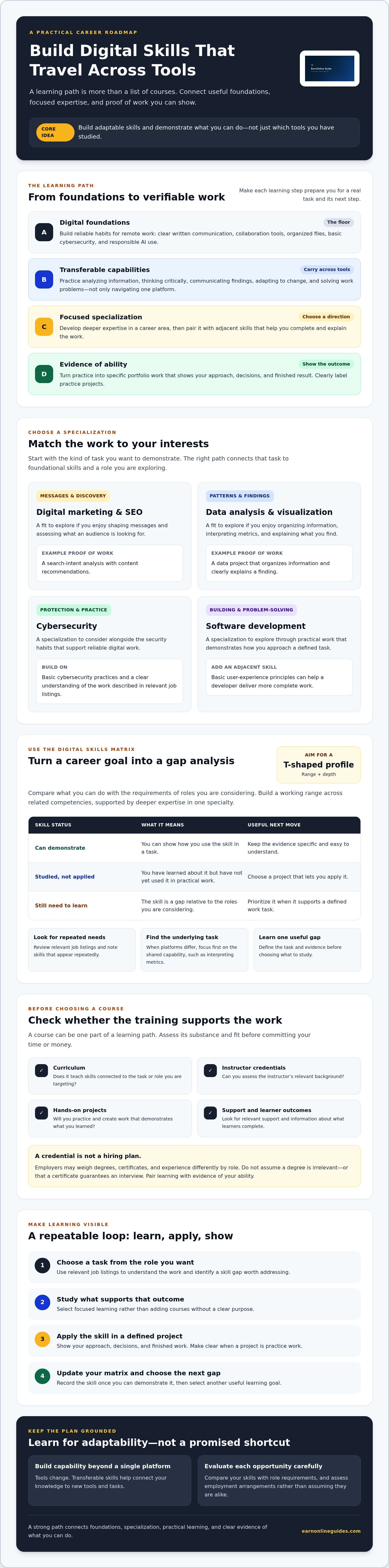
Evaluate a learning resource as you would a job opportunity: check its claims, verify who is behind it, and look for evidence before committing time or money. A “get-skilled-fast” promise isn’t proof of quality. Be cautious if a provider guarantees employment or income, hides its curriculum until checkout, uses pressure tactics, or can’t explain what learners will be able to demonstrate.
Use this checklist to assess whether a course supports your digital skill learning paths:
Free doesn’t automatically mean low quality, and paid doesn’t automatically mean credible. OpenCourseWare and platform-native resources such as Trailhead or HubSpot Academy can offer structured learning. Still, check the material’s scope and whether it includes applied practice. For a parallel checklist on evaluating online claims, see how to spot fake remote job listings.
Compare a training expense with realistic job requirements and compensation, not a provider’s best-case earnings claim. A certification may be accredited, issued by a recognized vendor, or simply a course-completion credential. These are not interchangeable. Accreditation alone doesn’t guarantee hiring value, and a non-accredited credential may still help if employers recognize the issuer and the assessment demonstrates relevant skills. Check job postings to see whether the credential is required, preferred, or absent from the qualifications.
If training is meant to support freelance or contract work, estimate the income you would need after business expenses and taxes before choosing an investment. The 1099 vs. W-2 tool can help compare work arrangements; it can’t predict whether a course will lead to paid work.
Coursera includes courses and credentials from universities and other providers, while LinkedIn Learning offers professional learning content. Neither platform name alone verifies the quality or hiring relevance of every course. For a specific technology, consider its official training source, such as learning AWS through Amazon’s own materials, then practice across tools where possible. Community spaces like GitHub or Discord groups can help you see how practitioners discuss problems, but treat advice there as peer input, not formal validation. Check current course details and credential terms directly with each provider.
Before enrolling, compare the syllabus with actual job requirements and identify the work sample you’ll produce. This helps distinguish a structured learning resource from a persuasive sales page.
Learning becomes career evidence when you can show how you applied a skill to a relevant task. These steps connect your learning plan to portfolio work and a focused job search. They can help you present your abilities, but they can’t guarantee an offer or a particular income.
A certificate can show that you completed training; a relevant work sample can show how you apply it. A developer might share a well-documented code repository, while an aspiring SEO professional could present a transparent site analysis with recommendations and limitations. Keep a brief learning log that records the question, tools used, decisions made, and what you’d improve. This helps reviewers assess your reasoning, not just the final result.
The “no experience” barrier can be difficult, but a carefully scoped volunteer project, personal project, or micro-internship may help you build relevant evidence. Agree on deliverables and boundaries in advance, and don’t imply that unpaid practice work was a paid job. Apply when your samples match the role’s core tasks, even if you don’t meet every preferred qualification. Review how beginners start freelancing online for another way to build practical work examples.
There’s no dependable universal timeline for turning a new skill into steady income. It depends on your prior experience, time available for practice, portfolio quality, hiring conditions, and the roles you pursue. Treat income replacement as an outcome to evaluate, not a deadline to promise yourself. If possible, preserve financial flexibility while you test applications and gather evidence of demand.
As you begin applying, use the remote jobs for candidates with no experience guide to explore relevant search strategies. Check each listing’s duties and qualifications against your demonstrated skills, and revise your learning plan when the evidence points to a specific gap.
Sustainable digital careers start with a clear sequence: assess your current skills, choose a specialty that fits your strengths and relevant job requirements, then demonstrate what you can do through practical work. The strongest digital skill learning paths combine adaptable foundations with focused expertise. A certificate may support your case, but a credible portfolio helps show how you apply what you’ve learned.
Use a research-first approach to compare learning resources and career options against current job requirements. The aim is sustainable income, not a quick win, and no course or credential can guarantee a role or earnings. Before investing more time, identify the next skill gap you can address and the work sample that will make your progress visible.
Ready to connect your skills with possible roles? Explore the remote job directory and practical digital skill guides to compare opportunities and plan your next learning step.
There isn’t one best skill for every beginner. Start with foundations that support your target work, such as clear digital communication, basic cybersecurity, data literacy, and practical AI use. Then choose a specialty by comparing your interests with requirements in relevant job listings. Strong digital skill learning paths connect those foundations to a specific role and help you produce work samples that demonstrate what you can do.
You can learn many digital skills through free materials, including open educational resources and training published by technology platforms. A paid certification isn’t automatically necessary or more valuable. Check whether target job listings request the credential, whether its assessment tests relevant skills, and whether you can demonstrate those skills through projects. If a certification matters for your chosen field, confirm the provider, requirements, and current terms before paying.
There’s no reliable universal timeline. The time required depends on your starting experience, available practice time, the complexity of the target role, and how much project work you need to build. Define a practical milestone instead of relying on a course’s completion estimate: for example, independently complete a role-relevant task and explain your approach. Then compare your skills with job requirements and identify remaining gaps.
Not every remote role requires a four-year degree, but requirements vary by employer and occupation. Some employers prioritize relevant experience, credentials, or demonstrated skills; others require a degree or consider it alongside those qualifications. “High-paying” also depends on the role and individual circumstances, so don’t treat any credential or portfolio as a guarantee. Review actual listings for target roles and note which qualifications are required versus preferred.
No digital skill can be labeled immune to automation. A more useful approach is to assess tasks: routine, repeatable work may be more exposed, while tasks requiring judgment, context, verification, communication, and accountability may be supported by AI rather than fully handled by it. Build subject expertise alongside AI fluency, and practice checking outputs, identifying errors, and explaining decisions. Reassess as tools and role requirements change.
Be cautious if a provider guarantees a job or income, pressures you to enroll immediately, or hides the curriculum, total terms, or refund conditions until after payment. Verify the instructor’s relevant background, inspect sample lessons, and check whether projects teach skills named in job listings. Treat testimonials as individual accounts, not proof of typical outcomes. If you can’t independently confirm key claims, pause before sharing payment or personal information.
Most remote workers benefit from clear written communication, reliable use of collaboration and cloud tools, basic cybersecurity habits, and the ability to organize and interpret information. AI literacy is also increasingly useful: know how to give tools clear instructions, check their outputs, and avoid sharing sensitive information inappropriately. The specific software varies by employer, so focus first on transferable practices, then learn the tools required for the role.

Article by
EarnOnlineGuides Editorial Team
The EarnOnlineGuides Editorial Team creates practical, research-driven educational content about making money online, remote work, freelancing, side hustles, digital skills, AI tools, online business, and self-employment. Our goal is to help readers understand their options, compare realistic opportunities, avoid misleading claims, and make better-informed decisions. We prioritize accuracy, transparency, practical guidance, and responsible reporting, and we regularly review our content to keep it useful and up to date.
The information provided in this article is for general educational and informational purposes only and should not be considered financial, investment, tax, legal, or professional advice. Earnings, income examples, costs, fees, and other figures may vary and are not guaranteed. Always conduct your own research and consult a qualified professional when appropriate.
Some articles on EarnOnlineGuides may contain affiliate links. If you click a link and make a purchase or sign up for a service, we may receive a commission at no additional cost to you. This does not influence our editorial standards or recommendations.
We strive to keep our information accurate and up to date, but products, services, fees, policies, laws, and market conditions can change. Please verify important information directly with the relevant provider before making financial or business decisions.
Educational information only. This article is not financial, tax, or legal advice. Platform fees and policies change; always confirm current rates in the marketplace's official fee documentation before making decisions.
Explore low cost digital side hustles you can test in 2026. Compare freelance work, digital goods, and reselling while managing hidden platform fees and time.

Learn how to open a freelance business bank account step by step. Explore document checklists, compare bank options, and keep business finances organized.

Learn how to write affiliate product reviews readers can trust. Discover a practical process for honest testing, balanced pros and cons, and clear disclosures.